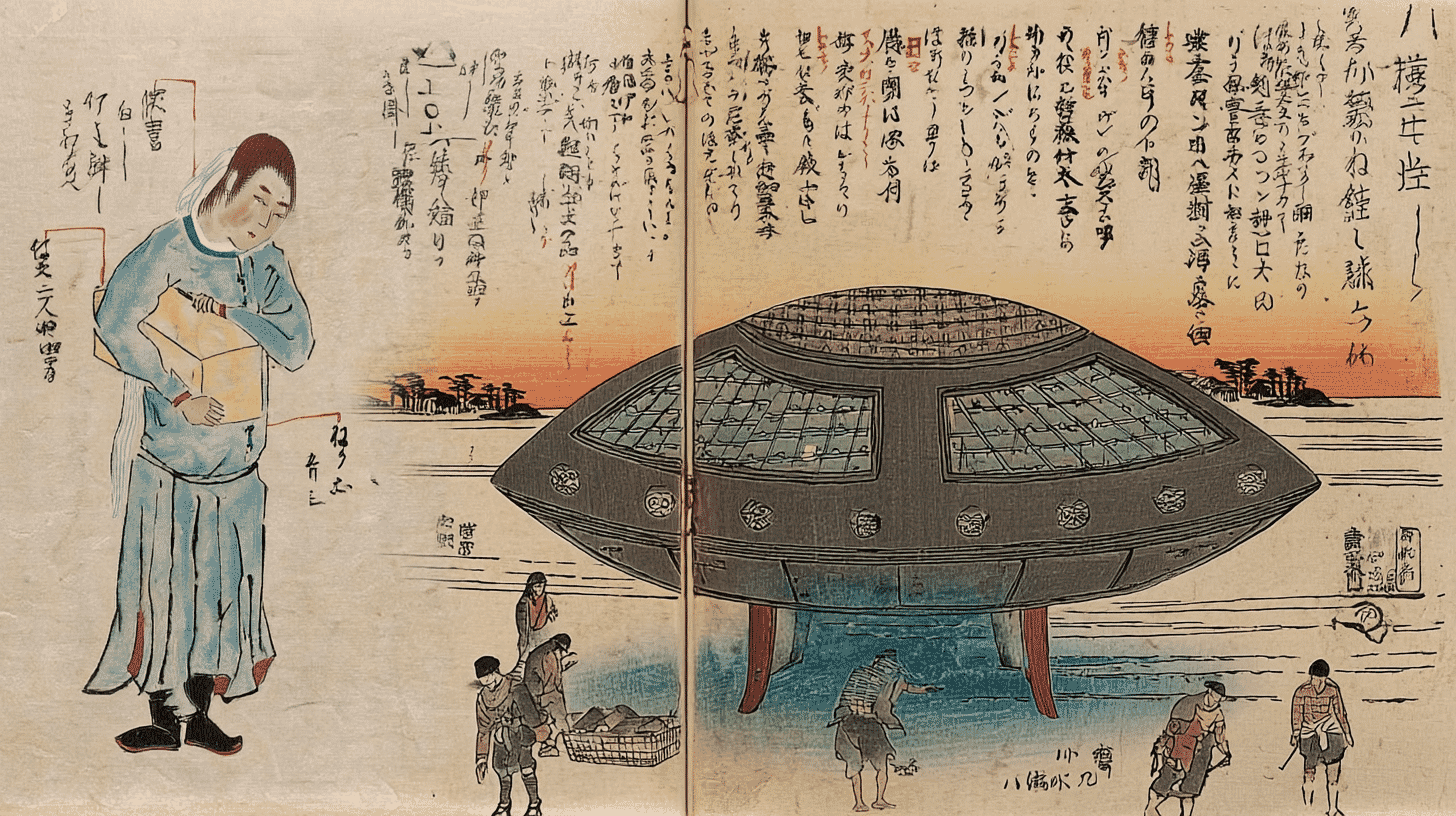
🛸 Did you know that in 1803, a UFO-like disc-shaped vessel allegedly washed ashore on Japan's coast, and a mysterious foreign woman emerged from inside? This incident, recorded in official Edo-period documents, has now been transformed into official merchandise by Japan's National Archives. Discover how the country's most serious historical institution has taken an unexpected turn into mystery territory.

Japan's National Archives Launches Mystery Merchandise

The National Archives of Japan is the guardian of the nation's historical memory, housing approximately 1.7 million records including the original Japanese Constitution and vital government documents dating back to the Meiji era. Yet among their official merchandise offerings lies one product that stands dramatically apart from the rest.

"Double Pocket File: The Barbarian Woman of Utsuro-bune (A5)" – 400 yen.

This clear file features an actual illustration from "Kōken Zuihitsu" (Hirokata's Essays), a document compiled by the scholar Yashiro Hirokata, depicting a bizarre vessel that washed ashore in Hitachi Province (modern-day Ibaraki Prefecture) in 1803, carrying a woman who spoke an unknown language.

What is the Utsuro-bune Legend?

The Utsuro-bune (literally "hollow ship" or "empty vessel") legend describes an incident said to have occurred on February 22, 1803, at a beach called "Harayadori" in Hitachi Province. Fishermen spotted a strange object drifting offshore and pulled it to shore, discovering a disc-shaped craft resembling a kōgō (an incense container with a lid).

According to "Kōken Zuihitsu," the vessel had the following characteristics:

  • Approximately 5.5 meters in diameter (about 18 feet)
  • Glass panels on top allowing visibility inside
  • Iron plates covering the bottom
  • Mysterious characters inscribed within

Inside sat a beautiful woman in unfamiliar clothing. Her hair and eyebrows were red, her face was pink, and she wore white artificial hair that hung long down her back. She clutched a 60-centimeter square box that she refused to release. Unable to communicate, the woman simply smiled at those who approached.

A village elder speculated she was "the daughter of a foreign king, exiled for the crime of adultery, and the box surely contains the severed head of her lover." Fearing the complications of reporting to authorities, the villagers eventually placed the woman back in the vessel and pushed it out to sea—a haunting conclusion to this mysterious encounter.

Why Is It Called "Edo-Period UFO"?

This legend has garnered worldwide attention because its description bears striking similarities to modern UFO reports.

More than 140 years before the 1947 "Arnold Incident" that introduced the concept of flying saucers to public consciousness, Japan had recorded this disc-shaped vessel. UFO researchers and mystery enthusiasts have dubbed this "Japan's Roswell Incident." Professor Emeritus Kazuo Tanaka of Gifu University has dedicated over 20 years to researching this legend, identifying the actual location "Hitachi Harashari-hama" (now Sharihama in Kamisu City) from multiple historical documents—evidence that this may be more than mere fiction.

To date, references to this incident have been confirmed in 11 types and 14 editions of historical documents, including "Toen Shōsetsu" (Rabbit Garden Tales) by the famous author Kyokutei Bakin, "Ume no Chiri" (Dust of Plum Blossoms), and "Hyōryūki-shū" (Collection of Drift Records).

The Unexpected Turn for Official Government Merchandise

The National Archives of Japan has traditionally offered historically orthodox merchandise—clear files featuring the "Heisei Declaration" and "Reiwa Declaration," Meiji-era railway maps, and botanical illustrations. The sudden appearance of a product themed around "Edo-period UFO suspicions" represents a surprising new direction for this prestigious institution.

Importantly, "Kōken Zuihitsu" is housed in the National Archives' Cabinet Library collection, and this institution is reportedly the only place in Japan where the original document can be viewed. This means the organization that holds the sole original manuscript has commercialized its own material—making this the genuine "official" Utsuro-bune merchandise.

The Fusion of Japanese Historical Mystery and Pop Culture

Utsuro-bune has been incorporated into various forms of pop culture over the years. In 2016, reproductions of the historical documents were displayed at the Mori Art Museum's "Universe and Art" exhibition, where novelty items like the "Utsuro-bune Rice Bowl" became popular. In 2023, the Jōyō Historical Museum in Mito City, Ibaraki Prefecture, hosted the "Mysterious World: Utsuro-bune" exhibition, featuring works by local artists alongside historical documents.

A monument and playground equipment shaped like the Utsuro-bune was once installed at Ōtake Beach in Hokota City, Ibaraki Prefecture. In Ibaraki—the "homeland" of this legend—the Utsuro-bune is increasingly recognized as a regional historical and cultural resource.

The decision by a public institution like the National Archives to commercialize this legend represents an attempt to balance the scholarly value of historical documents with entertainment appeal—creating new pathways for public engagement with history.

Closing Thoughts: What About Your Country's Mysteries?

In Japan, the decision by the traditionally serious National Archives to merchandise an Edo-period UFO legend has sparked discussions about government institutions "going bold" and "embracing mystery." This initiative to present the mysterious aspects of historical documents in an accessible format may open new doors to historical appreciation.

Does your country have strange historical legends or unexplained incidents that have been turned into merchandise by government institutions, public museums, or official archives? We'd love to hear about them!

References

Reactions in Japan

Just found out the National Archives sells Utsuro-bune goods. The only institution with the original Kōken Zuihitsu making official merchandise—that's literally the most legit official goods possible.

I agree 0
I disagree 0

As a local, I'm happy to see Utsuro-bune getting national attention. Sharihama in Kamisu actually exists. Hope the prefecture promotes it as a tourist attraction.

I agree 0
I disagree 0

The Archives selling Utsuro-bune goods... feels like the times have caught up. Used to be dismissed as occult stuff.

I agree 0
I disagree 0

I get the UFO hype around Utsuro-bune, but researcher Sato Hideki's work connects it to Russian encroachments and the Princess Konjiki legend. Academically fascinating beyond just the UFO angle.

I agree 0
I disagree 0

Surprised the serious-looking Archives is selling stuff like this. But they're publicly funded, so earning revenue matters. If it brings more visitors, why not.

I agree 0
I disagree 0

400 yen for a clear file is cheap. Museum goods are often expensive. Plus you can view the original on Digital Archive—double the fun with the goods.

I agree 0
I disagree 0

Calling Utsuro-bune a UFO feels off. Could've been fiction or rumors from that era. I get the romance, but viewing it calmly as historical material matters too.

I agree 0
I disagree 0

I collect Archives clear files but didn't know about Utsuro-bune! Different vibe from the Heisei/Reiwa set. Definitely buying next visit.

I agree 0
I disagree 0

Utsuro-bune is pretty well-known overseas too. Introduced as Japan's Roswell Incident. If there's official merch now, I'm making a video about it.

I agree 0
I disagree 0

The detail about the woman clutching the box and never letting go is memorable. The locals interpreting it as 'her lover's severed head'—such imagination, or maybe creepy...

I agree 0
I disagree 0

Want to use Utsuro-bune for a novel. A mysterious vessel and woman seen by Japanese in 1803—would be interesting from a modern perspective. Grateful the Archives makes sources accessible.

I agree 0
I disagree 0

I've covered Utsuro-bune in class before. Students love it. Beyond the UFO debate, it's great material for exploring worldviews and reactions to foreign cultures in that era.

I agree 0
I disagree 0

Ibaraki should promote Utsuro-bune more. There was a monument in Hokota—wonder what happened to it. Could organize mystery tours for inbound tourists.

I agree 0
I disagree 0

Utsuro-bune is interesting viewed in the lineage of exile tales of nobility. Relates to Princess Konjiki legend too. Drift motifs exist worldwide—maybe Japan's version of a universal tradition rather than a unique UFO.

I agree 0
I disagree 0

Didn't know the Archives sold merchandise. Can buy it at the main building in Takebashi? Near the Imperial Palace, might stop by.

I agree 0
I disagree 0

The Barbarian Woman of Utsuro-bune as character design—red hair, pink skin, white artificial hair. Pretty innovative. Edo people had amazing imagination.

I agree 0
I disagree 0

Voices from Around the World

James Mitchell

As a US UFO researcher, I've been following Utsuro-bune for years. Japan's National Archives making official merchandise is groundbreaking. The US government has started releasing UAP reports, but no merch yet, haha.

Sophie Laurent

From France. A National Archives selling mystery goods—that's such Japanese flexibility. The French Archives nationales would never do this. Fascinating cultural difference.

Thomas Weber

Studying German folklore here. The Utsuro-bune narrative structure shares elements with European 'visitor from the sea' legends. Worth comparative research from a global perspective.

Chen Wei

From China's perspective, 1803 was the Jiaqing period of the Qing Dynasty. Foreign ships washing ashore in East Asian waters wasn't rare then. Could've been Russian or European vessels.

Maria Santos

Brazil has the famous 'Varginha Incident' UFO sighting. Amazing that Japan's Utsuro-bune is a 200+ year old record. Takes courage for a government institution to acknowledge this through merchandise.

Kim Min-jun

From Korea. Interesting that Japan's Archives sells merchandise to the public. Korea's National Archives doesn't do this, so it's a good reference for approachability.

David Brown

From the UK. The Utsuro-bune woman's description—'red hair, white powder'—matches European aristocratic fashion of the time. High chance she was actually Western?

Anna Kowalski

Museum merchandise enthusiast from Poland. I compare what national institutions worldwide produce. Japan's ideas are always interesting—now I want the Utsuro-bune goods.

Michael O'Connor

As Irish, mysterious visitors from the sea is a familiar theme. Celtic mythology has similar motifs. Might be a universal theme transcending cultures.

Yuki Tanaka

Japanese-American here. Grew up hearing mysterious Japanese stories from grandparents, but didn't know Utsuro-bune. If there's official merch, I'll buy it on my next Japan trip to show family.

Alessandro Rossi

From Italy. If the Vatican Secret Archives released UFO-related goods, there'd be chaos. Japan does this stuff so casually. Perfect balance of seriousness and playfulness.

Raj Sharma

Indian history researcher here. 1803 was when the East India Company still had influence. If the Utsuro-bune woman existed, she could've been a European who came via India.

Emma Wilson

From Australia. Few tourists might visit Japan's National Archives, but with unique goods like this, it could work as a tourist spot.

Erik Johansson

Utsuro-bune has been discussed in Swedish UFO communities too. It's introduced as one of Asia's oldest UFO legends. Official merchandise is welcome news.

Lin Mei-ling

From Taiwan. Japanese Archives merchandise is popular here too. The Reiwa declaration clear file is especially famous. Utsuro-bune will probably become a topic among history buffs.

Peter van Berg

As Dutch, what's interesting is the record that characters on Utsuro-bune resembled Dutch or British ship markings. Might be traces of 'foreign lands' as seen by Edo Japanese.