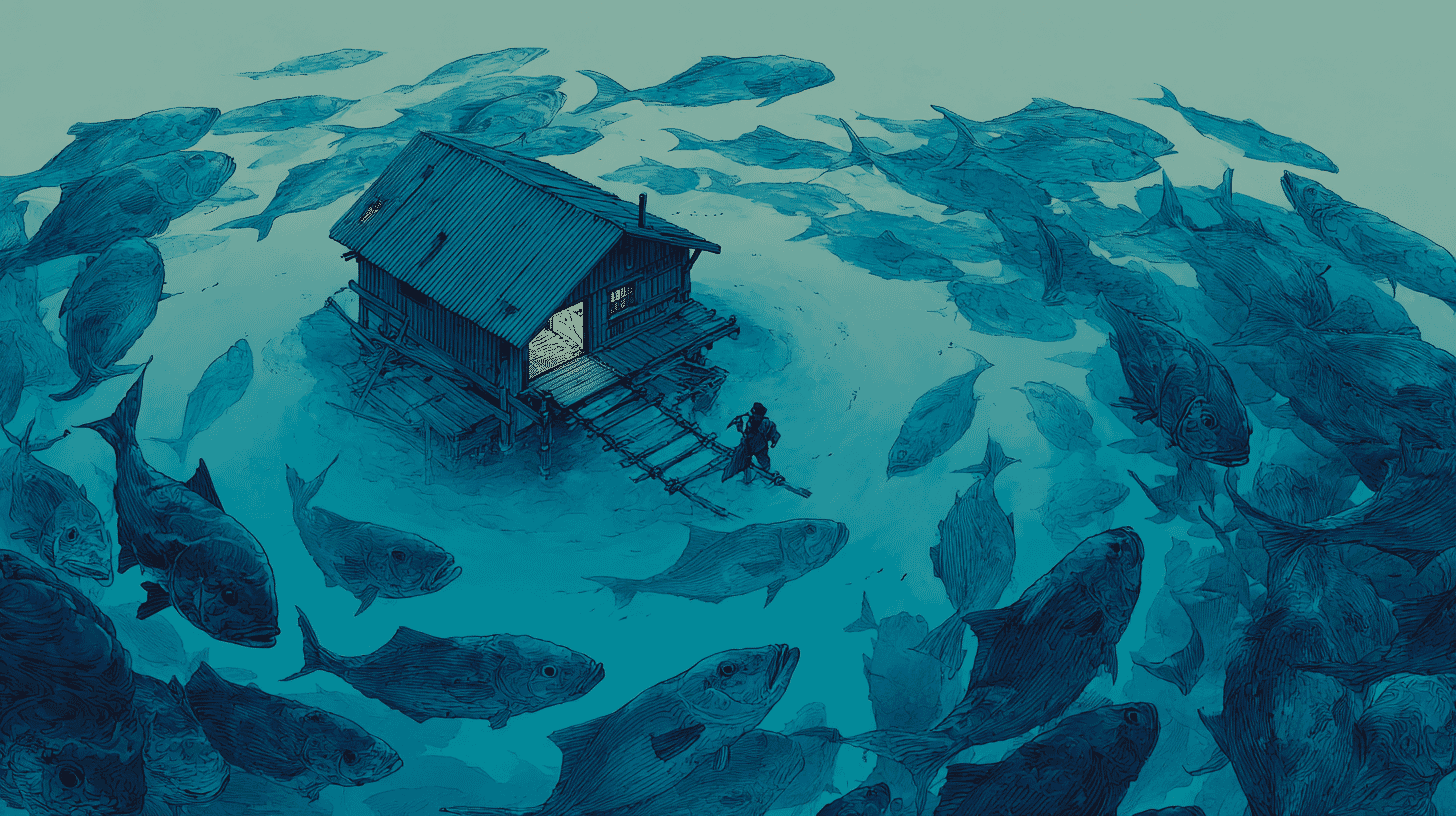
🐟 Japan spent 32 years learning how to breed bluefin tuna in captivity, a feat once thought impossible. Now, barely two decades after the breakthrough, the big seafood firms are shutting the program down. The strangest part? The thing that broke the business wasn't a technical failure. It was success. The wild tuna they were trying to save came back.
A breakthrough that took three decades
To understand what's being lost, you have to go back to 2002, when researchers at Kindai University in western Japan announced something no one else on Earth had managed: a fully closed life cycle for Pacific bluefin tuna. They had raised hatchery fish to adulthood, collected their eggs, and hatched the next generation, all without touching the wild population.
That's what "full-cycle aquaculture" means, and it matters because most farmed tuna isn't farmed that way at all. The standard method, sometimes called ranching, scoops up small wild juveniles and fattens them in pens. It still depends on the ocean. Full-cycle farming was supposed to cut that cord entirely: a way to keep tuna on the world's sushi counters without draining the sea.
It took Kindai 32 years of trial and error to get there. The achievement made global headlines, spawned a branded "Kindai tuna" served at the university's own restaurants, and set off a small investment rush. Major seafood companies climbed aboard, betting that closed-cycle bluefin would be the future. For a while, it looked like a sure thing.
The math that never closed
Here's the problem the headlines glossed over: full-cycle bluefin was always brutally expensive to produce, and the gap never closed.
Bluefin tuna are voracious. It takes roughly 15 kilograms of feed, mostly sardines and mackerel, to add a single kilogram of tuna. When sardine and mackerel catches slumped, feed prices climbed, and the cost of raising each fish climbed with them.
Then there's time. A ranched tuna, started from a wild juvenile of two or three kilograms, reaches market in three to four years. A full-cycle tuna, raised from an egg, needs about five. That extra time isn't just patience. It's money locked up. A closed-cycle operation has to keep four generations of fish growing in the water simultaneously, which means more pens, more capital tied up for years, and more time exposed to typhoons, red tides, and disease. Every season a fish stays in the pen is another season something can go wrong.
For a single company trying to run the whole chain in-house, the numbers simply didn't add up.
When sustainability became the headwind
And then came the twist that no business plan accounted for.
Years of international catch limits on Pacific bluefin actually worked. Stocks recovered. In 2025, Japan's near-shore bluefin quota was expanded by around 50%. With more wild tuna legally available, the price came down. The average wholesale price for domestic tuna at Tokyo's Toyosu market in 2024 was about ¥3,879 per kilogram (roughly $24), down 6% from the year before.
Sit with that for a second. Full-cycle farming was invented to protect a dwindling wild population. The conservation effort succeeded so well that cheap, plentiful wild tuna flooded back into the market, undercutting the very technology built to replace it. The floor fell out of demand for hatchery-raised juveniles. Sustainability didn't just fail to rescue the business model. It buried it.
"Right now, there aren't many orders for full-cycle tuna fry," Takahiko Okada, who heads Kindai's aquaculture seed-stock center, told Nikkei. By 2024, the university was selling around 7,000 juveniles a year, about a tenth of its peak.
The numbers behind the retreat
The withdrawal has been swift. Maruha Nichiro, one of Japan's largest seafood companies (it rebranded as Umios in March 2026), announced it would cut output for fiscal 2025 by about 80%. Its planned production of 50 tons is a mere 5% of its 2020 peak, and from April most of it is earmarked for export rather than Japanese shelves. Nissui's tuna subsidiary in Sasebo paused its full-cycle operation back in 2022. Kyokuyo pulled out too.
The official statistics tell the same story. According to Japan's Fisheries Agency, the country shipped 18,687 tons of farmed bluefin in 2024, up 11% overall. But the full-cycle share of that was just 405 tons, down 46% year on year, or 2% of the total. That's down from 4% the year before, and a steep fall from the 16% peak in 2020. A dream technology, shrinking to a rounding error.
The pragmatic answer: fatten them fast
So what are the companies doing instead? Increasingly, the answer is "short-term farming."
The idea is almost the opposite of the closed-cycle dream. Instead of raising a fish from an egg over five years, crews net large wild tuna, fish already weighing 80 to 120 kilograms, during the summer and fatten them in pens for just six to nine months. The fish ship out at 100 to 200 kilograms, far bigger than the 50-to-80-kilogram range of conventional farmed tuna, with a flavor closer to wild.
Because the fish spend so little time in the water, growers dodge the three big risks of aquaculture (red tides, typhoons, disease) and slash feed and labor costs. In January 2025, a Maruha Nichiro fishing subsidiary shipped its first short-term-farmed bluefin from Nagato in Yamaguchi Prefecture: a single fish topping 150 kilograms, sold at a roughly 20% premium over conventional farmed tuna. Nissui, meanwhile, wants to push short-term farming from around 23% of its output today to roughly 55% by 2030.
It's a clever workaround. But notice what it gives up: short-term farming still leans on wild tuna. It's a smarter way to use the ocean, not a way to leave it alone.
Sustainable isn't the same as profitable
The near-death of full-cycle bluefin is a hard lesson, and it isn't really about tuna. It's about the uncomfortable gap between what's good for the planet and what pays the bills.
Full-cycle farming works. The science is sound; Kindai never lost the ability to do it. What collapsed was the economic case, and it collapsed precisely because the conservation goal succeeded. The technology was solving a problem that, for now, partly solved itself.
That doesn't mean it's gone for good. Demand exists where you might expect it. Okada notes that big Western supermarket chains and major conveyor-belt sushi operators increasingly insist on hatchery-raised, traceable fish, and Japan, oddly, isn't positioned to ride that wave. Some in the industry argue the real fix is structural: split the work the way the salmon industry already does, with specialized hatcheries, growers, and finishers sharing the risk, instead of one company carrying a five-year bet alone. Okada, for his part, says he won't give up, even with sales down 90%.
In a sense it's an enviable problem: the sea recovered. But a technology the country spent decades perfecting is now being quietly shelved because, for the moment, nature is doing the job instead. "We figured out how to do it" and "the market wants it" turn out to be very different sentences.
Where you live, is there a technology like this, clean, clever, the obvious "right" answer, that barely survived once the cheaper option came back? And would you want someone to keep it alive anyway?
References
- https://www.nikkei.com/article/DGXZQOUB168TG0W5A110C2000000/
- https://www.nikkei.com/article/DGXZQOUB251G10V20C25A3000000/
- https://www.nikkei.com/article/DGXZQOUB2153C0R20C25A1000000/
- https://www.nikkei.com/article/DGXZQOUB308OV0Q5A130C2000000/
- https://biz-journal.jp/company/post_386741.html
- https://tsurinews.jp/336929/
- https://note.com/minatoshimbun/n/n83259bce0b28
- https://www.maff.go.jp/j/heya/sodan/1808/02.html
- https://www.umios.com/jp/corporate/news_center/news_topics/2025/03/24.html
- https://project.nikkeibp.co.jp/mirakoto/atcl/food/h_vol91/




Global Discussion
4 comments