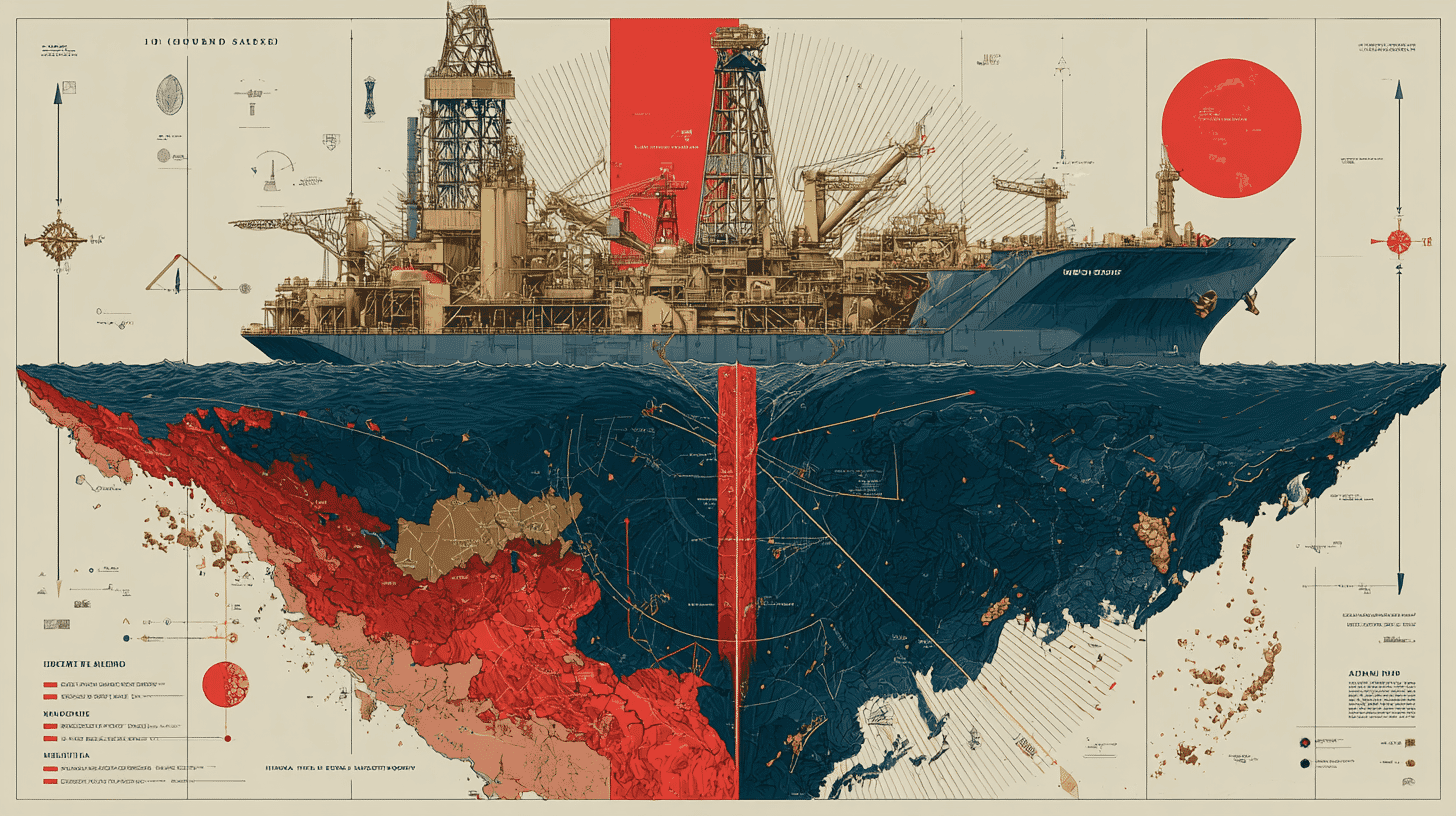
⚓ Japan just pulled rare earth-bearing mud from 6,000 meters beneath the Pacific Ocean. The world celebrated.
Now the ruling party says: the ship that did it isn't good enough.
On May 13, 2026, Japan's Liberal Democratic Party (LDP) decided to recommend that the government build a dedicated rare earth mining vessel near Minamitorishima: a deep-sea mining ship estimated to cost around 100 billion yen (roughly $640 million USD). The proposal also calls for upgrading the port and airport of the remote island itself, and it was handed to Prime Minister Sanae Takaichi on June 12. This is the moment Japan's rare earth ambition stops being an experiment and becomes a national infrastructure project.
What just happened: from research to nation-building
The LDP's Special Committee on Ocean Development decided on May 13, 2026 to put a vessel specialized for rare earth mining into its recommendation to the government. The committee had begun deliberating on March 11, and delivered the finished proposal to Takaichi at the prime minister's office on June 12. She said she would consider it favourably.
Committee chair Hirofumi Takinami, an Upper House member, told reporters bluntly: it isn't about whether the project pays for itself. "Amid China's economic coercion, we want to back rare earth development as a potential trump card. This has to be approached not just from economic viability but from economic security."
The proposal package, according to reporting by Mainichi Shimbun, includes three elements:
- A dedicated deep-sea mining vessel with construction costs around 100 billion yen ($640M)
- Expansion of Minamitorishima's port to handle large vessels and dewatered mud cargo
- Upgrades to Minamitorishima's airport for personnel and logistics
The aim is to reflect this in the government's annual "Basic Policy on Economic and Fiscal Management" (the so-called Honebuto no Hoshin) and Japan's Growth Strategy. Rare earths were not the only item. The same document asks for public procurement to seed demand for marine drones and maritime domain awareness systems, for commercial development of manganese nodules to be brought forward, for an ultra-deep-sea research mother ship, and eventually for a dedicated Ocean Agency.
Background: why rare earths matter, and why Japan is worried
For readers outside Japan: rare earths are 17 metallic elements essential to permanent magnets, electric vehicle motors, smartphones, wind turbines, fighter jets, and missile guidance systems. Despite the name, several are not actually rare in the Earth's crust; extracting and refining them is what is technically difficult and environmentally messy.
According to the US Geological Survey, China accounts for roughly 70% of global rare earth mining and over 90% of refining capacity. For heavy rare earths like dysprosium and terbium, used in EV motor magnets, Japan still depends on China for nearly 100%.
Japan learned how dangerous that dependence is in 2010, when China effectively halted rare earth exports after a maritime incident near the Senkaku Islands. Japan's manufacturers were paralyzed for months. Diversification has since brought dependence down from about 90% in 2010 to somewhere around 60–70%. The wound never fully healed.
Then came 2025 and 2026:
- April 2025: China imposed new export restrictions on seven types of rare earths in retaliation against US tariffs, cutting global magnet exports by 70% year-on-year.
- January 6, 2026: China's Ministry of Commerce announced effective-immediate export bans on dual-use items to Japan, in retaliation for Prime Minister Sanae Takaichi's National Diet statement that a Taiwan contingency could constitute a "situation threatening Japan's survival." Tokyo protested the same day and demanded withdrawal.
- June 29, 2026: Beijing widened the ban, adding 20 more Japanese companies and bodies, among them a Mitsubishi Electric software subsidiary and the Defense Ministry's National Institute for Defense Studies. Together with the Mitsubishi Heavy Industries affiliates designated in February, 40 entities are now covered.
Nomura Research Institute estimates a three-month rare earth supply halt would cost Japan around 660 billion yen ($4.2 billion); a one-year halt, 2.6 trillion yen ($16.5 billion).
The Minamitorishima project, in this context, is not just about resources. It's about leverage.
Why "Chikyu" isn't enough
Japan already has the world's most advanced deep-sea drilling vessel: JAMSTEC's Chikyu. It left Shimizu port on January 12, joined roughly 600 lengths of ten-metre pipe to reach the seabed about 6,000 metres down, and lifted its first rare earth mud in the early hours of February 1. The Cabinet Office and JAMSTEC announced the success the next day. Nobody had done it before.
So why build a new ship?
Chikyu was designed for scientific deep-sea drilling: seismic research, geological cores, the search for life beneath the ocean floor. Its schedule is shared with academic projects worldwide. Operating it costs over 10 billion yen a year, tens of millions of yen a day. SIP program director Shoichi Ishii has described horizontal travel distance (from Tokyo) and vertical depth as the two largest cost drivers.
For an industrial operation that would eventually need to recover hundreds of tons of mud per day for years, competing with seismology projects for ship time is impractical. What the LDP committee wants is a purpose-built vessel: optimized for the 6,000-metre pipe-string, the slurry pump system, the dewatering hardware, and continuous operations.
Think of it as the difference between a Formula 1 lab car and a commercial freighter. They do different jobs.
The roadmap: 2027, 2028, and the cliff
The Cabinet Office's Strategic Innovation Promotion Programme (SIP) has laid out a clear timeline:
- February 2027: A full-scale demonstration test aiming to recover 350 tons of rare earth mud per day. Before this, a dewatering facility must be built on Minamitorishima to reduce mud volume by about 80% before shipping to the mainland for refining.
- By March 2028: A formal evaluation of whether commercial mining at Minamitorishima is economically viable.
- From FY2028 onward: Targeted industrialization, moving from experiment to commercial extraction.
The new dedicated vessel would, in theory, support the 2027 demonstration and the post-2028 commercial phase. Construction of a 100 billion yen vessel typically takes several years, which means the political decision needs to happen now if it's going to be ready in time.
This is where the LDP committee's urgency comes from.
Minamitorishima: the remote island at the center
Minamitorishima, also known by its English name Marcus Island, is Japan's easternmost territory, roughly 1,950 km southeast of Tokyo. It's a coral atoll about 1.5 km on each side, with no permanent civilian residents, only a small detachment of Self-Defense Force personnel, coast guard, and meteorological agency staff.
But the island anchors an exclusive economic zone (EEZ) of over 400,000 square kilometers, and beneath that ocean lies what some estimate to be 16 million tons of rare earth resources, including dysprosium reserves potentially equivalent to hundreds of years of Japanese demand.
The catch: the island's existing port and airstrip were built for a small remote outpost, not for an industrial-scale resource extraction operation. Large rare earth mining vessels can't dock easily. Cargo throughput is limited. Personnel rotation depends on small aircraft.
That's why the LDP proposal bundles port and airport upgrades together with the new vessel. Without that infrastructure, even a brand-new $640 million ship would be operationally constrained.
How Japan compares: the US and Europe are moving too
Japan is not the only country trying to break China's rare earth grip. The strategies, however, look different.
United States: In 2025, the US Department of Defense made a $400 million equity investment in MP Materials, the operator of the Mountain Pass mine in California, giving the Pentagon a stake of over 15% and effective influence over operations. The same package set a ten-year floor price of $110 per kilogram for MP's NdPr, insulating the domestic industry from Chinese price competition.
European Union: The EU's Critical Raw Materials Act, which entered into force in 2024, sets targets to reduce China dependence and source 10% of strategic raw materials from domestic mining by 2030. Japanese funding has flowed into French refiner Caremag for heavy rare earth supply.
Australia: In March 2026, Lynas Rare Earths, the largest producer outside China, extended its supply agreement with JARE, a vehicle owned by JOGMEC and Sojitz, out to 2038. JARE takes 5,000 tonnes of NdPr (neodymium-praseodymium) a year at a floor price of $110 per kilogram, the same level Washington guaranteed MP Materials, plus half of everything Lynas produces in separated heavy rare earth oxides.
Japan-US cooperation: At the March 19, 2026 summit, the two governments signed a memorandum on rare earth development in waters around Minamitorishima and agreed to set up a working group on deep-sea mineral resources, covering information sharing and industry collaboration. Takaichi has positioned the project as a pillar of US-Japan cooperation.
Japan's approach is distinctive: domestic deep-sea mining combined with alliance-based supply chain diversification. The $640M vessel is the centerpiece of the first track.
The hard truths: cost, refining, and China
The honest assessment is that this project still faces three big walls:
1. Economics. Even with a dedicated vessel, deep-sea mining at 6,000 meters and 1,950 km from Tokyo is unlikely to be cost-competitive with Chinese rare earths anytime soon. Daiichi Life Research Institute estimates that with optimal scale, Minamitorishima rare earth oxide could approach Chinese prices, but only at daily extraction volumes in the thousands of tons, far beyond what's currently feasible.
2. Refining technology. Mining mud is one thing; separating and purifying individual rare earth elements is another. China currently controls over 90% of global refining capacity. Even if Japan extracts the mud at scale, the refining bottleneck remains. The mud's low radioactive content (compared to terrestrial rare earth ore) is a major advantage, but the actual rare earth content of the February 2026 mud samples is still under analysis.
3. China's response. In June 2025, the Chinese aircraft carrier Liaoning briefly entered the Minamitorishima EEZ. Sasakawa Peace Foundation analysts have suggested this may have been intended as a deterrent gesture toward the rare earth development. Beijing has also been suspected of pressuring companies that cooperate with the Minamitorishima project through export-control threats.
The LDP committee's response to all three: build it anyway. As Takinami put it, the question is not pure economics. It is economic security.
What this means
With the proposal delivered on June 12, the question has shifted to how much of it survives into the Honebuto no Hoshin and the Growth Strategy, and whether budget follows. If it does, the construction order would likely be placed within a year or two.
The bigger story is the shift in framing. For over a decade, the Minamitorishima rare earth project lived in the world of university research, special innovation programs, and bilateral memoranda. With this proposal, it crosses into the world of major national infrastructure, alongside fighter aircraft programs, semiconductor subsidies, and energy security investments.
In Japan, there's growing public support for the idea that the country should not be hostage to any single supplier of critical minerals. There is also healthy skepticism. Is 100 billion yen ($640M) the right place to put scarce fiscal resources? Does the refining bottleneck make upstream extraction moot? Can the project deliver before the political moment passes?
Over to you
In Japan, the debate over the $640M mining vessel is unfolding in newsrooms, Diet committees, and online forums right now.
How is your country thinking about seabed resources and critical mineral security? Is there a national strategy to reduce dependence on a single supplier? Are governments willing to fund projects that might never be economically viable, purely for strategic insurance?
We'd love to hear how this debate is playing out where you live.
References
- https://news.yahoo.co.jp/articles/7d735e2ffe481ab385116a14fb8a40aa5d40c3a0
- https://www.nikkei.com/article/DGXZQOUA111B40R10C26A3000000/
- https://www.nikkei.com/article/DGXZQOSG226XD0S6A120C2000000/
- https://www.nippon.com/ja/in-depth/d01229/
- https://www.spf.org/opri/global-data/opri/perspectives/prsp_036_2025_kobayashi.pdf
- https://www.dlri.co.jp/report/macro/556251.html









Global Discussion
14 comments