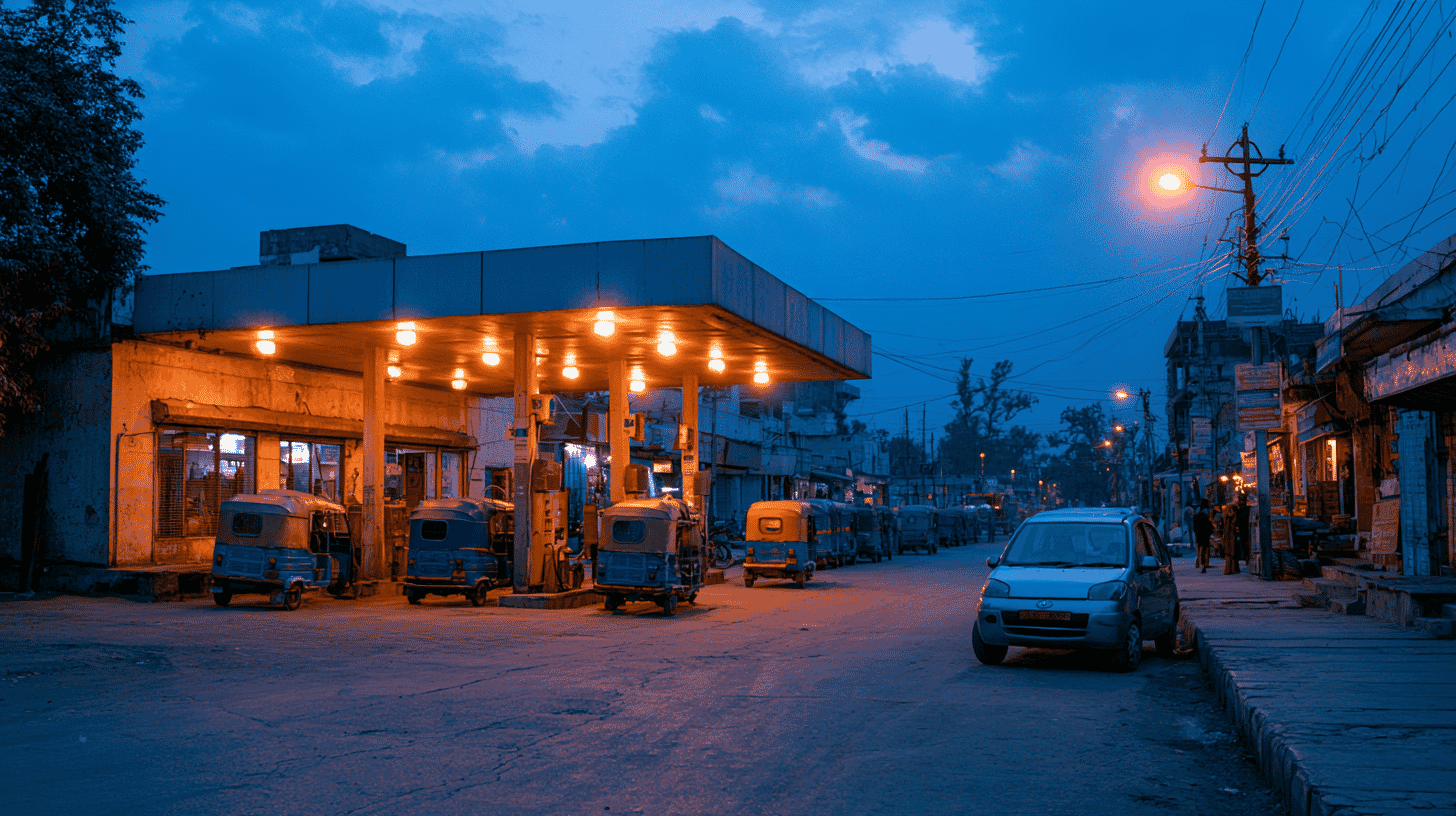
🐄 In rural India, cow dung has always been fuel, dried into patties and burned for cooking. Now Japan and India want it to power something else: cars.
At the annual summit in New Delhi on July 2, Prime Ministers Sanae Takaichi and Narendra Modi launched a plan to turn cattle waste into compressed gas for vehicles, and to grow a market of 2.5 million gas-burning cars across India. It reads like an environmental project, but it is also a farm-income scheme, an energy-security bet, and a counter to China's dominance of the electric car.
What the two leaders are signing in New Delhi
This is Takaichi's first trip to India since she took office in October 2025, and the centerpiece is the 16th India-Japan Annual Summit, the latest round of the "shuttle diplomacy" that saw Modi in Tokyo last August. The two governments exchanged a memorandum on energy and named the framework the Japan-India CBG Initiative. CBG stands for Cooperative Biogas for Growth, and the "cooperative" part is the whole idea: the dairy and sugarcane cooperatives that already gather milk and cane from millions of small farmers become the collection network for biomass.
The stated goal is to build 1,000 biogas plants across India, with Tokyo helping to finance them through yen-denominated development loans. Suzuki and other companies would work with local cooperatives to collect cow dung and other farm waste, and convert it into automotive fuel plus organic fertilizer. Japan brings the technical side too: fermentation research in partnership with Toyohashi University of Technology, know-how for producing organic fertilizer, and training for the people who will build and run the plants. The first project under the new push is slated for Assam, in India's northeast, where Suzuki, the government-backed National Dairy Development Board (NDDB), and the state government plan to build a plant together.
Much of the fine print, meaning the loan amounts, the timeline for 1,000 plants, and which states come next, only became clear in the formal documents released around the summit. The number everyone is quoting is 2.5 million: the size of the CNG-vehicle market the two leaders want to create, which Japanese reports peg at roughly a tenth of what Japanese automakers build worldwide in a year.
Update: At the July 2 summit the two leaders formally agreed to launch the Japan-India CBG (Cooperative Biogas for Growth) Initiative. It was signed as a memorandum of cooperation between Japan's Ministry of Economy, Trade and Industry and India's Ministry of Cooperation, with 2030 as the target year for the 1,000 plants. Japan plans to put roughly ¥400 billion in yen loans behind the first 500. The same summit produced a ¥2 trillion Japanese private-investment package for India. (Added July 29, 2026)
From the barn to the fuel tank
The chemistry is not new; the supply chain is. Cattle dung is fed into a digester, where bacteria break it down and release methane. That raw biogas is purified until it is at least 95 percent methane, then compressed into what the industry calls CBG, or compressed biogas. The overlap with the initiative's acronym is not a coincidence. At that purity it behaves almost identically to CNG, the compressed natural gas that already runs a large share of India's taxis, auto-rickshaws and delivery vans. The leftover slurry doesn't go to waste either: it becomes organic fertilizer, which cuts a farm's need for imported chemical inputs.
Japan is not starting from a slide deck. Suzuki has been running this experiment in Gujarat since 2023, when it signed a three-way agreement with NDDB and Banas Dairy, one of India's biggest dairy cooperatives. In December 2025, that partnership opened the Banas Suzuki Biogas Plant in Banaskantha district, Suzuki's first facility built to produce and sell biogas as vehicle fuel. It is designed to turn up to 100 tonnes of dung a day into about 1.5 tonnes of CBG, enough to run roughly 850 CNG cars for a day's driving. The New Delhi announcement takes that pilot and, on paper, multiplies it by a thousand.
Why India is buying in
For New Delhi, the appeal is not sentimental. Compressed gas already accounts for more than a fifth of new passenger-car sales in India, and the country still imports the overwhelming majority of the crude oil it burns, an expensive and exposed position every time the Persian Gulf gets tense. Homegrown fuel made from cattle that Indian farmers already own is, in that light, a form of insurance. Swapping imported LNG for domestic biogas nudges the country toward energy self-reliance.
Then there is the money that flows to the countryside. Dung that a farmer used to shovel away for nothing becomes a product with a buyer, a small but real new income stream in villages where margins are thin. The fertilizer byproduct does double duty, trimming a chemical-fertilizer import bill that has strained India's budget for years. It is the kind of circular arrangement, waste in one door and fuel and fertilizer out the other, that is easy to promise and hard to run at scale, but the underlying logic is sound.
The electric-car shadow
Look closer and the deal has a geopolitical spine. A CNG car is still an internal-combustion vehicle, the technology Japanese automakers have spent generations perfecting. An electric car is not, and the EV supply chain, from battery cells to the rare earths in its motors to the processing that turns ore into usable metal, runs heavily through China. By betting on gas-burning engines rather than batteries, Tokyo and New Delhi are backing a lane where Japan is strong and China's leverage is weaker, while giving Japanese carmakers a supply chain they can actually control.
That fits the mood of the whole summit. The two sides are also discussing resilient supply chains in semiconductors and critical minerals, a large green-ammonia project in the eastern state of Odisha, and a private-investment target of around ¥10 trillion (roughly $60 billion) over the coming decade. Running through all of it is Takaichi's "Free and Open Indo-Pacific" framing, and the shared, rarely-stated goal of not being at Beijing's mercy for the things a modern economy runs on.
A template Takaichi wants to sell to the world
Takaichi's ambition doesn't stop at India. Japanese officials describe the CBG initiative as a model case, something to be refined in India and then offered to other countries across Asia, Africa and Latin America, wherever there are lots of livestock, lots of farms, and a hunger for fuel that doesn't have to be imported.
The skeptics have their points ready. A thousand plants is an enormous jump from a handful, and biogas projects have a long history of stalling on maintenance, logistics and financing once the ribbon-cutting is over. There are climate questions too: methane is a potent greenhouse gas, and a system built on it lives or dies on how little of it leaks. Whether cattle-based fuel is genuinely cleaner than the electric route it partly sidesteps is a lifecycle question worth asking, not assuming. None of that makes the idea a bad one. It makes it a bet whose payoff depends on the parts that never make the summit photo.
In Japan and India, the pitch is that a cow can help run a car and pay a farmer at the same time. What's the waste-to-energy story in your country, and would you fill up a car with fuel made from a farm?
References
- https://news.yahoo.co.jp/articles/27d536961d7071e49b7978849e03c4bd28df8c27
- https://www.globalsuzuki.com/globalnews/2025/1209.html
- https://www.nddb.coop/node/2415
- https://aninews.in/news/world/asia/japanese-pm-takaichi-arrives-in-india-for-three-day-official-visit-to-participate-in-16th-india-japan-annual-summit20260701195358/








Global Discussion
5 comments