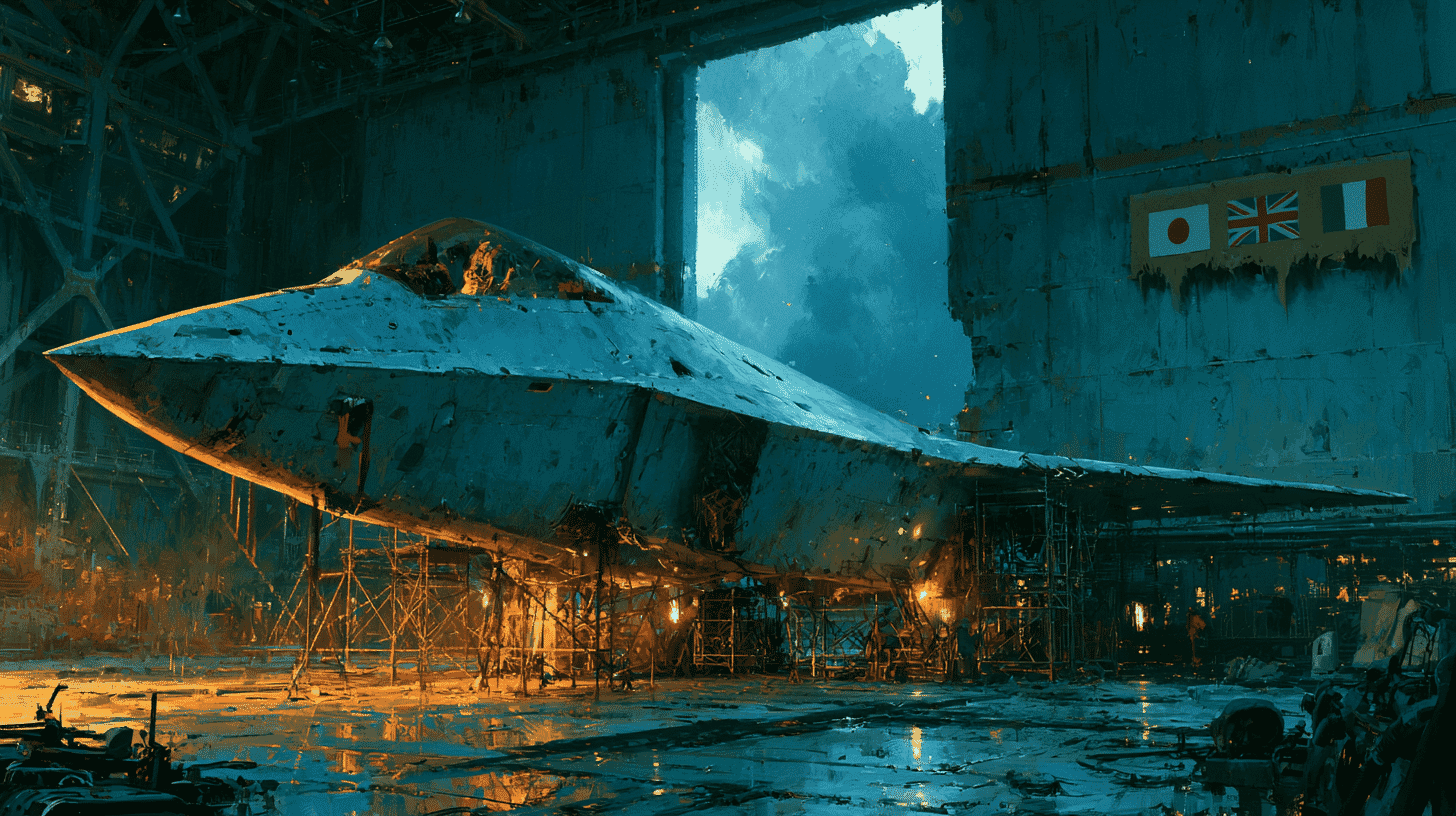
🛩️ Japan placed its biggest defense bet in a generation on a stealth fighter it is building with Britain and Italy. Now the British government is coming apart, the lead partner still can't confirm the money, and the contract keeping the whole thing alive runs out in days. Of the three partners, Tokyo is the one losing sleep.
The jet Japan tied its name to
The Global Combat Air Programme, or GCAP, is a plan by Japan, the UK, and Italy to build a sixth-generation stealth fighter and field it by 2035. It is meant to replace Japan's Mitsubishi F-2 and the Eurofighter Typhoons flown by Britain and Italy. The work runs through a joint company called Edgewing, owned by Britain's BAE Systems, Italy's Leonardo, and Japan Aircraft Industrial Enhancement Co. (JAIEC), the Japanese vehicle backed by Mitsubishi Heavy Industries and others, with a coordinating government body, GIGO, headquartered in Reading, England, and led by a Japanese official, Masami Oka.
For Britain and Italy, GCAP is one defense program among many. For Japan it is something larger. Analysts have described it as the country's first major international defense project that does not run through the United States, a notable shift for a nation that has bought American fighters for decades. That makes it as much a political statement as a procurement decision. Prime Minister Sanae Takaichi has staked real prestige on it: by one account reported in the British press, Japan has already committed around 500 billion yen, roughly 2.3 billion pounds or about 3.1 billion dollars, to the effort.
Britain's collapse, in slow motion
The problem is that the lead partner is in the middle of a political meltdown.
Prime Minister Keir Starmer announced his resignation on June 22, 2026, after a brutal run: a rout in May's local elections, a defeated party, and a by-election win that handed his most dangerous internal rival, Greater Manchester mayor Andy Burnham, a seat in Parliament and a path to the leadership. Burnham is now the frontrunner to replace him, which would make him Britain's seventh prime minister in a decade.
Underneath the politics is a money fight. Britain's own defense review calls for roughly 28 billion pounds (about 37 billion dollars) more over four years than the Treasury says it can find. The argument over how to close that gap got personal. On June 11 it took down the defense secretary, John Healey, along with the armed forces minister, both resigning over the stalled defense investment plan. There have also been reports that the Treasury wants to pull GCAP's funding in-house, taking control away from the Ministry of Defence to keep costs from running over. Of the settlement now being negotiated, only a slice, reported at up to 6 billion pounds (about 8 billion dollars), is earmarked for GCAP.
Why Japan is the one sweating
Plenty of countries run over budget on big weapons. What makes this acute is the calendar.
Japan wants the jet flying by 2035, and that target leaves no slack. The current arrangement is a stopgap: in April, Edgewing won a contract worth 686 million pounds (917 million dollars) to keep design work going only through June 30. After that, without a full multi-year contract, the work has no funding to stand on. Britain says the international contract will be signed by the end of the month, a promise made around June 14 when Takaichi met Starmer in London during a European tour and the two pledged to speed the program up. Whether a government in the middle of choosing a new leader can actually deliver that signature on time is the open question.
The doubts are not only Japanese paranoia. Ben Wallace, a former British defense secretary, claimed in early June that the government quietly wants out, and is hoping to stall the program with vague, incremental work until Japan, which cannot accept a long delay, walks away on its own so London avoids the blame. Britain's MoD has publicly reaffirmed its commitment, but the tone gap is hard to miss. As one British commentator put it, GCAP carries far more urgency for Takaichi, who needs to look like she is leading a strong, well-allied Japan, than for a Starmer government fighting to survive the summer. Reports out of Tokyo suggest senior figures have privately questioned how serious Britain really is.
Meanwhile, a queue is forming at the door
Here is the strange part: as the core wobbles, the waiting list is growing.
Canada is the most concrete. It has formally asked to join as an observer, sending a request to London with letters to Tokyo and Rome to follow, framing the move as a way to diversify away from US defense purchases. On June 24, Canadian defense minister David McGuinty met his Japanese counterpart, Shinjiro Koizumi, and said afterward that Canada wanted to know more and would leave the decision to the three partners. Germany, having walked away from its rival Franco-German FCAS fighter, is now weighing GCAP, and Leonardo's chief has openly welcomed Berlin, though London has said little. Saudi Arabia has wanted in for years through the UK, with Japan historically cautious. Poland, Sweden, and India have all been mentioned.
To handle the interest without slowing the core three, Japan has been pushing a new observer framework: countries that want to buy the jet, not co-develop it, would get access to performance and progress data under confidentiality, with parts-manufacturing cooperation possible later. The trilateral defense ministers are expected to meet in July, where Canada's observer status could be announced. The irony is sharp. The program is recruiting new members at the very moment its founding partner can't guarantee it will pay its own share.
The real question
Strip away the jargon and GCAP is a bet on a partner. Japan looked at a dangerous neighborhood, decided it could not rely on the United States forever, and put its money and its prestige behind Britain and Italy. As of late June, that bet was hostage to a British leadership contest and a Treasury spreadsheet, things no one in Tokyo can vote on.
[Update] The deadline held. On June 30 Britain published its Defence Investment Plan, committing 8.6 billion pounds to GCAP over four years. Effective July 1, the GCAP Agency, the contracting arm of GIGO, awarded Edgewing a contract worth 4.6 billion pounds (about 6.1 billion dollars); it was made public on July 3. The 18-month deal runs to the end of 2027 and covers locking in the aircraft's requirements plus detailed design and testing. The politics resolved too. Labour chose Andy Burnham unopposed as leader, and he took office as prime minister on July 20, Britain's seventh in a decade. Then on July 21, at a meeting in London timed to the Farnborough air show, the defense ministers of Japan, the UK, Italy, and Canada announced that Canada will become GCAP's first official observer nation. The first country in the queue is now inside the door.
Japan bet big on an ally it can't control. Has your country ever staked its security on a partner whose politics you couldn't count on?
References
- https://news.yahoo.co.jp/articles/b31e61615a3448bdbb39ac9b5a6eb9c668279780
- https://www.nikkei.com/article/DGXZQOCB2487X0U6A620C2000000/
- https://breakingdefense.com/2026/06/uk-eyes-sixth-generation-gcap-fighter-contract-signing-in-weeks/
- https://aviationweek.com/defense/uk-signals-gcap-international-contract-due-soon
- https://spectator.com/article/how-serious-is-starmer-about-building-a-fighter-jet-with-japan/
- https://en.wikipedia.org/wiki/2026_Labour_Party_leadership_crisis
- https://defence-industry.eu/britain-and-japan-agree-to-speed-up-gcap-fighter-programme-as-part-of-wider-technology-and-security-partnership/




Global Discussion
4 comments