🛰️ For the first time since it was founded in 1954, a branch of Japan's military is changing its name. The Air Self-Defense Force is about to become the Aerospace Self-Defense Force, and that extra word carries more weight than it looks. Behind it sits a unit that has grown from 20 people to nearly 900 in six years, and an argument about whether space is now somewhere Japan has to be ready to fight.
What the Diet actually passed
On June 26, 2026, Japan's upper house approved a package of amended laws, the centerpiece being a revision to the Act for Establishment of the Ministry of Defense. The change renames the Air Self-Defense Force (ASDF) as the Aerospace Self-Defense Force, with the switch taking effect at some point in the current fiscal year, which runs through March 2027.
It sounds like a cosmetic update. It isn't only that. The same package creates a dedicated space unit, raises the number of deputy defense ministers from one to two, increases certain benefits for personnel who leave the force, and, on the ground, upgrades an army brigade in Okinawa to a full division. Still, the headline is the word "aerospace," because no branch of Japan's Self-Defense Forces has ever been renamed before. The ASDF has carried the same name since July 1954.
From 20 people to 880
The air force's first space unit, the Space Operations Squadron, stood up in 2020 with about 20 people, tasked with watching for suspicious satellites and orbital debris. It became a group in 2022 and, on March 28, 2026, a wing based at Fuchu Air Base, with roughly 670 personnel. The new law elevates it again, to a larger formation of about 880.
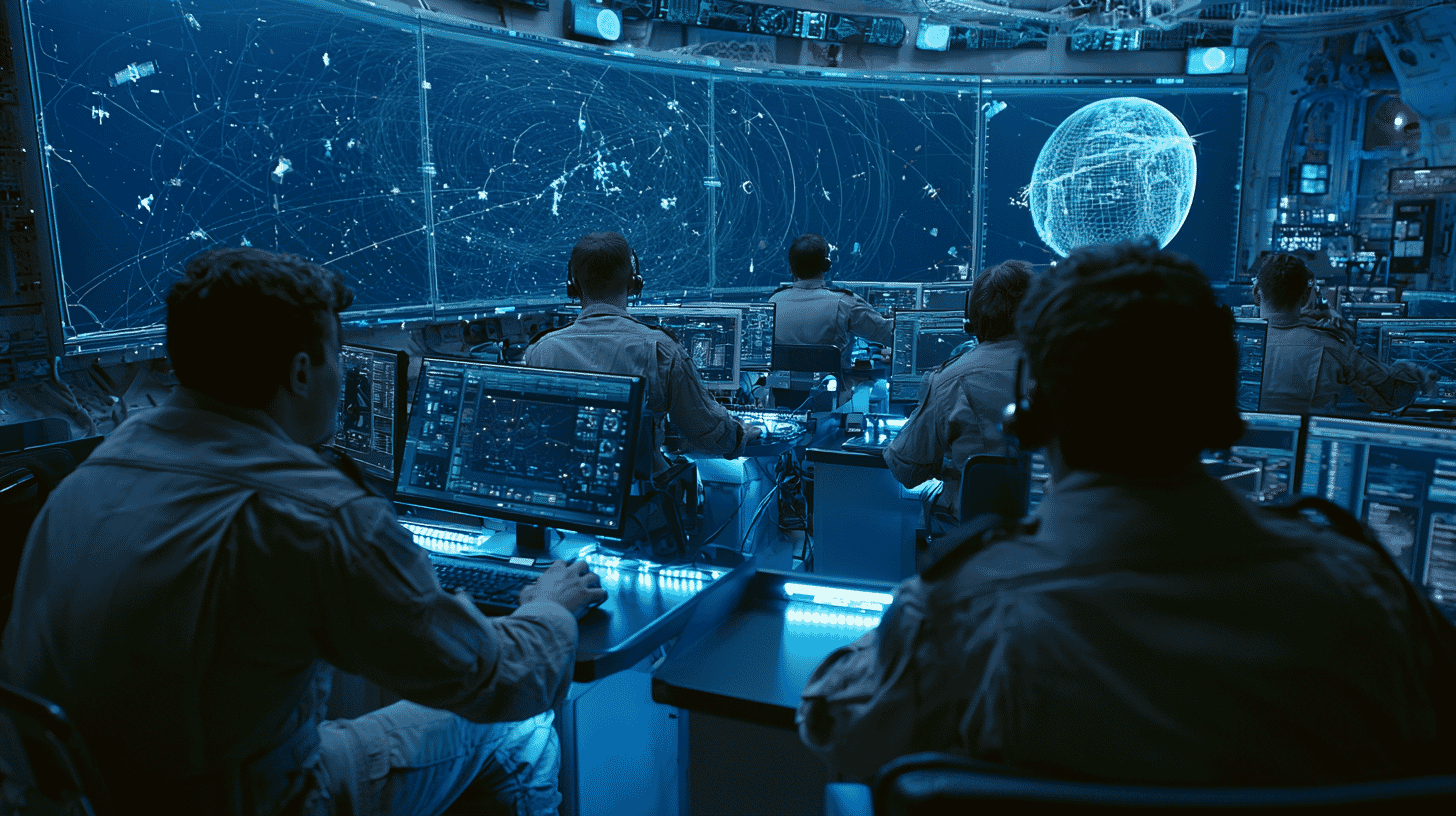
In Japanese military naming, units climb a ladder by size, and each rung up brings more people and a higher-ranking commander. The new command will be led by a senior general, outranking the major-general-equivalent who heads the current wing. It is expected to be built around several space squadrons plus support and intelligence units, handling space situational awareness (SDA, essentially knowing what is flying where in orbit), detection of satellite jamming, and analysis of data from space-based sensors. Alongside the existing wing, it will house a space operations control group and a space operations intelligence unit. The law also retitles the branch's top uniformed officer, the Chief of Staff of the Air Self-Defense Force, to match the new name.
Why space, why now
For most of the space age, orbit was a place you used (for communications, navigation, weather, reconnaissance), not a place you defended. That assumption is breaking down. Satellites can be jammed, dazzled with lasers, shadowed by other satellites, or destroyed outright, and debris from past anti-satellite (ASAT) tests already threatens working spacecraft.
Japan leans heavily on satellites for everything from missile early warning to disaster response, and it sits in a neighborhood where two of the world's most active counter-space programs, China's and Russia's, operate. A Defense Ministry briefing released in May 2026 laid out the gap bluntly: by one count, China fielded 167 reconnaissance satellites as of 2024, far ahead of anyone else. Japan's near-term answer is a commercial satellite constellation coming online this fiscal year, plus sensors meant to track hypersonic glide vehicles, weapons that fly too low and maneuver too sharply for older warning systems to follow.
Money follows the priority. Japan's space-defense budget reached roughly ¥174 billion (about $1.1 billion) for fiscal 2026, more than triple what it was in 2022.
Not quite a "Space Force"
Here is where overseas readers may need to recalibrate. When the United States stood up its Space Force in 2019, it created an entirely new, independent military service, a sixth branch alongside the Army, Navy, Air Force, Marines, and Coast Guard. Japan is doing something more modest. It is not creating a separate space service. It is renaming the existing air arm and building a space command inside it.
Part of that is structural caution, part of it is constitutional flavor. Japan's postwar constitution renounces war, and the country's forces are officially called "Self-Defense Forces" rather than an army, navy, and air force, a careful wording that still shapes how new capabilities are introduced. In that context, adding "aerospace" to a branch name is a bigger symbolic move than it looks from the outside: for the first time, space is written into the identity of a service.
Where the disagreement lies
The bill passed comfortably. The governing Liberal Democratic Party and its coalition partner, the Japan Innovation Party, voted for it, joined by several other parties including Komeito and the Democratic Party for the People. But it was not unanimous. The Japanese Communist Party and the Social Democratic Party voted against, arguing that expanding the military use of space and reinforcing troops in Okinawa raise regional tensions rather than ease them.
That Okinawa piece is not incidental. The same law upgrades the army's 15th Brigade, headquartered in Naha, to a division. Its infantry regiments go from one to two, and Okinawa receives its first maneuver combat vehicles, adding firepower in the part of Japan closest to Taiwan and to contested waters. The space rename and the southwest-islands buildup are, in effect, two faces of the same strategy.
The day the sign changes
So what changes on the day a new sign goes up over the headquarters? In the short term, little a civilian would notice: same bases, same aircraft, a longer name. The substance is in the trend line, and in the fact that Japan has now written on paper that space is a place it has to be ready to defend.
Does your country treat space as a military domain? And if so, did it build something new, or just rename what it already had?
References
- https://news.yahoo.co.jp/articles/242799f661d992c9b74d5ce0f1deebd365d216b3
- https://www.nikkei.com/article/DGXZQOUA262NB0W6A620C2000000/
- https://www.jiji.com/jc/article?k=2026062600122&g=pol
- https://www.sbbit.jp/article/cont1/185912
- https://defence-blog.com/japan-reveals-sweeping-military-space-buildup/








Global Discussion
4 comments