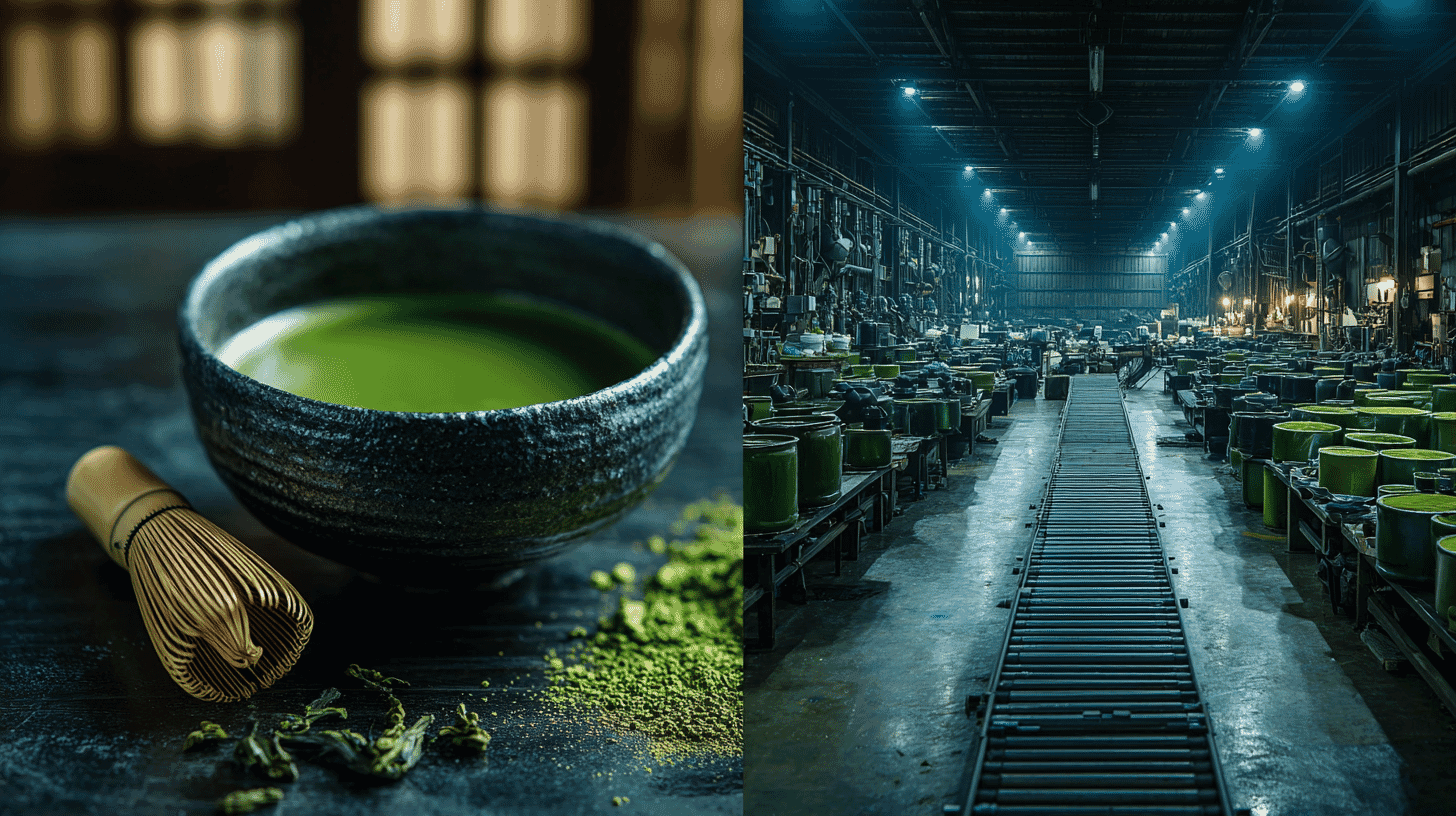
A tectonic shift is underway in the global matcha market. World matcha production has roughly doubled in just five years, but the new center of gravity isn't Japan anymore. A world-class matcha factory in China's Guizhou Province is now running at full automation. Starbucks USA and Häagen-Dazs are already using Chinese matcha. Despite the weak yen at around ¥160 per dollar, Japanese matcha sells at roughly twice the price of Chinese matcha, while Japan's output is less than half China's. Should Japan defend matcha as cultural heritage, or embrace it as a global beverage? The country is at a critical crossroads, and its grip is slipping.
A Cup of Matcha in Australia That Changed Everything
The wake-up call came in the form of a single cup.
In an April 2026 note article, Sho Watanabe, founder of Japanese matcha brand "NAGOMI", recounted his shock after trying Chinese-produced matcha in Australia. The price was less than half of Japanese matcha, yet the color, flavor, and particle fineness felt comparable to Japanese-grown product.
The numbers explain why. China has roughly 30 times Japan's farmland and produces about 50 times more green tea overall. A single Chinese factory can produce thousands of tons annually, with robotic full automation slashing labor costs. Crucially, Chinese producers comply with EU pesticide residue standards from the cultivation stage onward.
Given those conditions, it was only a matter of time before global chains adopted Chinese matcha. And they have. Starbucks USA and Häagen-Dazs are now sourcing from China.
Demand Doubled in Five Years: Japan Can't Keep Up
The data paints a stark picture of a boom Japan simply can't supply.
According to Straits Research, the global matcha market was valued at roughly $4.2 billion in 2024, projected to grow to $7.86 billion by 2033. On Google Trends, search interest for "Matcha" hit an all-time high in 2025, 33% above the previous peak set in 2019.
Meanwhile, Japan's production base is approaching its physical limit.
Domestic output of "tencha", the shade-grown tea leaf that becomes matcha after grinding, roughly doubled from about 2,700 tons in 2020 to about 5,300 tons in 2024. Kagoshima Prefecture, where five new tencha factories came online, surpassed Shizuoka in 2024 to become Japan's top crude tea producer (27,200 tons). Traditional regions like Uji (Kyoto), Nishio (Aichi), and Yame (Fukuoka) are also expanding.
Still not enough.
Heritage tea houses including Ippodo, Marukyu Koyamaen, and Yamamasa Koyamaen raised prices, restricted sales, and even temporarily suspended product lines through 2024–2025. Long-established Japanese tea wholesalers are now turning away orders from overseas buyers on a daily basis.
Guizhou's "Fanjing Matcha": A Rising Brand From China
The clearest symbol of the shift is Tongren City in China's Guizhou Province.
According to reporting from 36Kr Japan, Tongren attracted Gui Tea Group in 2017 and built one of the world's largest dedicated matcha factories, 300 meters long, 40 meters wide, with robotic arms automating every stage of production.
The region's "Fanjing Matcha" brand reportedly became China's #1 in production volume and domestic sales in 2023, and ranked second worldwide in export volume. Tongren alone now produces roughly a quarter of all Chinese matcha, earning the title "China's matcha capital."
A January 2026 report from Aichi Prefecture projected Chinese domestic matcha production rising from about 1,330 tons in 2016 to over 5,000 tons in 2025. In fact, 2026 industry data later put China's actual 2025 output at roughly 12,000 tons, around 60-70% of global production, outpacing even that forecast. New entrants are emerging in Zhejiang, Hubei, Sichuan, and Fujian provinces.
The Chinese strategy isn't simply "cheap and inferior."
Gui Tea Group manages pesticide residues to EU standards from the cultivation stage and operates ISO-grade hygiene systems. The factory was designed from day one to meet the specifications demanded by international brands like Starbucks and Häagen-Dazs. Separately, Shaoxing in Zhejiang Province pioneered ultra-fine grinding technology, opening matcha-infused product categories like toothpaste, face masks, and matcha noodles.
The Battle Over the Definition of "Matcha"
Here a structural problem emerges: there is no internationally agreed definition of matcha.
In Japan, the Japan Tea Central Council defines matcha as "fine powder produced by stone-grinding tencha, leaves grown under shade, steamed, and dried without rolling." But that's a domestic standard.
China, on the other hand, enacted national standard "GB/T 34778-2017: Matcha" in May 2018, defining matcha as "tea product made by fine-powdering steam-fixed or hot-air-fixed and dried leaves from shade-grown tea sprouts." It strictly prohibits non-tea additives or colorants.
In other words, China has positioned its national standard for the global stage first. While building on Japanese-derived definitions, China is establishing the international legitimacy of "Chinese matcha", through standardization rather than cultural authority.
In an April 2026 Business Insider Japan interview, Ryo Iwamoto, CEO of TeaRoom and an associate professor at the Urasenke tea ceremony school, described the situation as "the textbook losing pattern for Japanese-origin products and technology." Outproduced in volume, late on international rule-making, a structure that has played out repeatedly with Japanese consumer electronics, semiconductors, and software is now repeating with matcha, he warns.
Iwamoto has long advocated "economic impact over economic scale," and a focus on demand creation rather than chasing short-term sales. Maximizing ripple effects across the entire tea industry, and protecting demand itself, is what ultimately preserves the brand. As Chinese producers gain share, this framing carries new weight.
Three Layers of Strategic Choice
The decision facing Japan isn't binary. It plays out across at least three layers.
Layer 1: Defending the premium market
In ceremonial-grade matcha, Japan still dominates. European buyers willingly pay over ¥10,000 (about $63) per kilogram for named Japanese single-origin matcha. The tea ceremony tradition, regional brands like Uji, Nishio, and Yame, and 800 years of refined production technique form a moat. China is unlikely to overtake Japan here anytime soon.
Layer 2: Industrial-volume processing
The real battlefield is processing-grade matcha for lattes, ice cream, and confectionery. Cafés alone account for roughly 60% of global matcha demand, and at this price tier, Japan has already lost competitiveness. Should Japan keep investing in capacity expansion, or cede this segment to China, Vietnam, and Korea while specializing in premium?
Watanabe of NAGOMI warns that aggressive volume investment may itself become Japan's death trap. Faced with China's economies of scale, even brand-new Japanese matcha factories risk becoming "ghost facilities" within a few years.
Layer 3: International standardization
In ISO discussions, Japan's National Agriculture and Food Research Organization (NARO) is leading efforts to formalize a global matcha definition. An ISO technical report including Japan's matcha production methodology was published in April 2022. The world's first dedicated industry body, the International Matcha Association (IMA), was founded in Tokyo in April 2026.
But it's a race against time. China's GB/T 34778-2017 has been operational for eight years and is steadily becoming a de facto global standard.
The Deeper Question: Do Japanese People Themselves Care About Matcha?
The sharpest question Watanabe raises is cultural, not commercial.
While matcha boomed worldwide, did matcha consumption rise inside Japan? Did more Japanese people rediscover their own cultural treasure precisely because the world was celebrating it?
Matcha had become so ordinary in Japan that domestic interest faded, and during that quiet stretch, the global market transformed beyond recognition. There's an uncomfortable observation that Japan-loving foreign tourists may now be more passionate about matcha than the average Japanese person.
What ultimately defends a cultural brand is the people who genuinely carry that culture. The last line of defense against a Chinese-dominated future isn't export subsidies or tariffs, it's whether Japanese people themselves continue to love matcha. That's a deeply cultural question.
At the same time, a strategy of treating matcha as Japan's exclusive property has clear limits. The world wants matcha. If Japan can't supply it, someone else will. The real question is how Japan partners, segments, and redefines value alongside that "someone else", not whether Japan can stop them.
Where was the matcha sold in your country actually produced? Have you ever checked the back of the packaging? And do you think of matcha as "traditional Japanese culture," or as "a global wellness drink"? We'd love to hear how it shows up where you live.
References
- https://note.com/sho_0120/n/nf36388adf72a
- https://www.businessinsider.jp/article/2604-15-the-crisis-of-japanese-matcha/
- https://www.pref.aichi.jp/uploaded/attachment/595704.pdf
- https://36kr.jp/366941/
- https://matcha-times.jp/2026/04/matcha-global-market-reasons/17/
- https://tamakino.hatenablog.com/entry/2026/04/22/080000
- https://www.maff.go.jp/j/tokei/kekka_gaiyou/sakumotu/sakkyou_kome/kougei/r7/tya/index.html







Global Discussion
14 comments