⚓ Why do some aircraft carriers have a curved ramp at the bow while others are completely flat? In October 2024, Japan's JS Kaga successfully launched and recovered F-35B stealth fighters for the first time. But Kaga's flight deck looks nothing like a US supercarrier — and nothing like a British carrier either. The reason comes down to a fascinating intersection of engineering, economics, and national strategy that shapes every carrier deck in the world.

The Core Problem: How Do You Launch a Jet from a Short Runway?

An aircraft carrier's flight deck is far shorter than a land-based runway. A standard military runway might stretch 2,500 meters or more, but even the largest carrier decks max out around 330 meters — and jets typically use only a fraction of that for takeoff. So navies have developed different solutions to get heavy, fast-moving aircraft airborne from these confined spaces.

There are essentially two approaches, and they define the shape of every carrier in the world.

Catapults: The Slingshot Approach (CATOBAR)

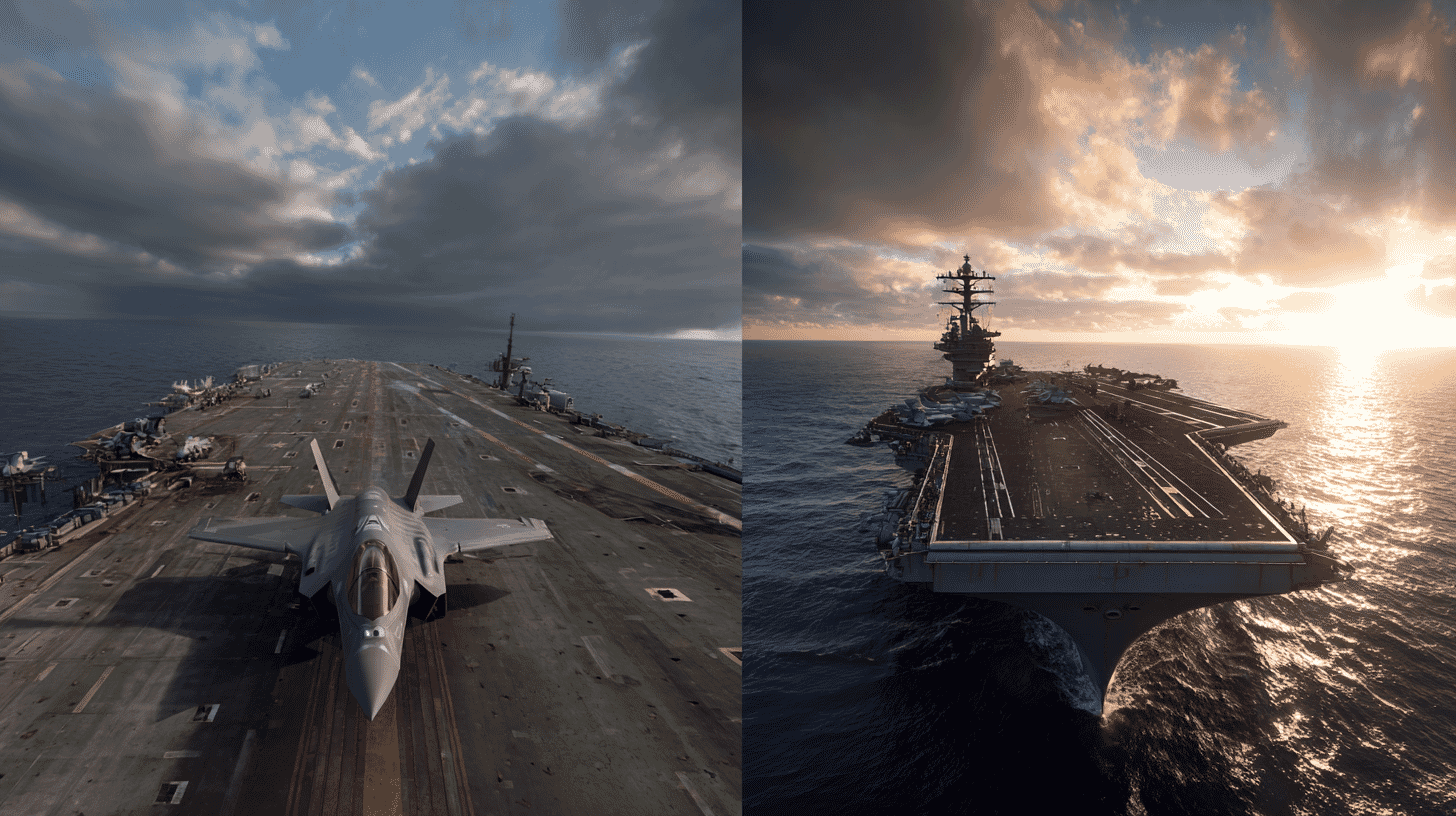
CATOBAR — Catapult-Assisted Take-Off But Arrested Recovery — is the gold standard used by the US Navy's supercarriers. A steam- or electromagnetically-powered catapult hooks onto the aircraft's nose gear and accelerates it from zero to flight speed in about two to four seconds. Think of it as launching a 30-ton object with a giant rubber band.

Only three nations currently operate CATOBAR carriers. The US Navy fields 11 nuclear-powered carriers (Nimitz-class and the new Gerald R. Ford-class) equipped with catapults. France has one, the nuclear-powered Charles de Gaulle. And China's third carrier, the Fujian, launched in 2022, is fitted with an electromagnetic catapult system (EMALS) similar to the Ford-class.

The advantages are significant. Catapults can launch aircraft at maximum takeoff weight, meaning fighters can carry full fuel and weapons loads. They also enable operations with heavier aircraft that lack the thrust-to-weight ratio for self-powered takeoff — critically, this includes E-2 Hawkeye early warning aircraft, which provide the fleet with long-range radar coverage.

The downsides? Enormous cost and technical complexity. The USS Gerald R. Ford cost roughly $13 billion to build, partly due to its cutting-edge EMALS. Steam catapults require either nuclear propulsion or a very large conventional power plant to generate the necessary steam. The entire system demands specialized crew training and constant maintenance.

Ski-Jump Ramps: The Budget-Friendly Alternative (STOBAR/STOVL)

The ski-jump is an elegantly simple solution. The forward end of the flight deck curves upward like a ski jump, angling the aircraft's nose skyward as it leaves the deck. This generates additional lift — similar to how a kite catches wind when tilted upward — giving the aircraft's engines more time to accelerate to flying speed.

No moving parts, no catapult machinery, no massive power generation requirements. It's cheaper to build and maintain, which is why most of the world's non-US carriers use this design.

The UK's Queen Elizabeth-class carriers (65,000 tons, about $4 billion each) use a ski-jump with F-35B fighters. Russia's Admiral Kuznetsov, China's Liaoning and Shandong, and India's Vikramaditya and Vikrant all feature ski-jump decks.

The trade-off? Aircraft must rely on their own engine power alone, which limits takeoff weight. Fighters may have to carry less fuel or fewer weapons, reducing their combat range and payload. And heavy, low-thrust aircraft like early warning planes simply cannot use a ski-jump at all — a significant tactical limitation.

Japan's Kaga: The Third Option — Flat Deck STOVL

Here's where things get interesting. Japan's JS Kaga has neither catapults nor a ski-jump. Its flight deck is essentially flat, with only a modification to reshape the bow from a tapered form to a squared-off rectangle.

This works because Kaga operates the F-35B Lightning II — a STOVL (Short Take-Off and Vertical Landing) fighter. The F-35B has a unique propulsion system with a downward-deflecting engine nozzle and a lift fan behind the cockpit that together generate enough vertical thrust for the aircraft to land straight down like a helicopter. For takeoff, a relatively short rolling start is sufficient.

The US Navy and Marine Corps have been operating F-35Bs from flat-decked amphibious assault ships (Wasp-class and America-class, around 257 meters long) for years without ski-jumps. Since Kaga measures 248 meters, the precedent was well established.

Why Kaga Skipped the Ski-Jump

If a ski-jump would give F-35B pilots more performance margin, why not install one? Japan had specific reasons.

Sonar placement — Kaga carries an anti-submarine warfare sonar system in its bow, below the waterline. Adding a ski-jump on top would have significantly increased bow weight, potentially compromising the ship's stability or requiring removal of the sonar — a core capability for a vessel originally designed as a helicopter destroyer.

Cost and schedule constraints — Kaga isn't a new-build carrier. It's a converted Izumo-class helicopter destroyer being modified during regular five-year maintenance cycles. A ski-jump would require fundamental structural redesign of the bow section — far more expensive and time-consuming than simply squaring off the deck shape.

Operational sufficiency — US amphibious assault ships have demonstrated that F-35Bs perform effectively from flat decks. The performance penalty compared to a ski-jump launch was deemed acceptable for Japan's defensive mission requirements.

Interestingly, the UK's Queen Elizabeth-class carriers demonstrate what a ski-jump adds to F-35B operations. They can perform "SRVL" (Shipborne Rolling Vertical Landing), where the aircraft approaches at a shallow angle rather than hovering straight down, allowing pilots to bring back more fuel and weapons — but this requires the ski-jump geometry for the corresponding takeoff benefits.

The F-35 Family and Carrier Compatibility

The F-35 comes in three variants, and each one matches a different type of deck:

F-35A — Conventional takeoff/landing. Air force version for land bases only. Japan's Air Self-Defense Force (JASDF) is acquiring 105 of these for Misawa and Komatsu air bases.

F-35B — Short takeoff, vertical landing. Designed for light carriers and amphibious ships with flat or ski-jump decks. JASDF began deploying F-35Bs to Nyutabaru Air Base in August 2025, with plans for 42 total aircraft.

F-35C — Carrier variant. Requires catapult launch and arrested recovery. Larger wings (45% bigger than F-35A) give longer range and heavier payload. Only operated by the US Navy from Nimitz and Ford-class supercarriers.

This means the shape of a carrier's deck isn't just an engineering preference — it dictates which aircraft a navy can operate, which in turn defines that navy's capabilities and limitations.

Reading National Strategy Through Deck Design

Every carrier's flight deck tells a story about its nation's ambitions and constraints.

United States — Eleven CATOBAR supercarriers, all nuclear-powered. This fleet allows the US to maintain continuous global presence, launching the full spectrum of naval aircraft from any ocean. The cost is staggering (a carrier strike group's annual operating cost exceeds $6 billion), but so is the capability.

United Kingdom — Two 65,000-ton ski-jump carriers operating F-35Bs. London originally considered catapults for the Queen Elizabeth class but abandoned the plan when electromagnetic catapult costs spiraled. The result is a capable but more limited air wing compared to US carriers.

China — Rapidly evolving, from ski-jump (Liaoning, Shandong) to electromagnetic catapult (Fujian). China's trajectory clearly aims toward CATOBAR supercarrier capability, mirroring the US model.

India — Currently operating ski-jump carriers, with a future CATOBAR carrier (INS Vishal) under discussion for years.

Japan — Two flat-deck light carriers (Izumo and Kaga) operating F-35Bs, carrying approximately 10 aircraft each. Rather than projecting power globally, Japan's carriers are optimized for island defense and flexible air support across its vast maritime territory — stretching from the seas around Hokkaido to the remote Nansei Islands near Taiwan.

Kaga's Carrier Conversion: Where Things Stand

Japan's conversion of Kaga has proceeded in stages:

Phase 1 (2021–2023) — Heat-resistant deck coating (F-35B exhaust reaches nearly 1,000°C/1,800°F), bow reshaping to rectangular form, and air traffic control room upgrades. Total cost: approximately $1.5 billion.

F-35B landing trials (October 2024) — US Marine Corps F-35Bs successfully landed on and launched from Kaga off San Diego. A British pilot also supported the tests — echoing the historical moment in 1923 when a British pilot made the first-ever landing on Japan's first carrier, the Hōshō.

UK F-35B first landing (August 2025) — F-35Bs from HMS Prince of Wales landed on Kaga during joint exercises, alongside US Marine F-35Bs — a historic "cross-deck" operation demonstrating trilateral interoperability between Japan, the US, and UK.

Phase 2 (from late FY2026) — Interior modifications including crew quarters, maintenance facilities, and operational workflow optimization for F-35B operations. Full completion targeted by FY2028.

Prime Minister Shigeru Ishiba personally inspected Kaga at Yokosuka Naval Base in August 2025, signaling the government's commitment to the light carrier program.

The Bottom Line: Form Follows Strategy

A carrier's deck shape isn't a random design choice. It's the physical manifestation of a nation's technological capability, budget reality, and strategic vision. The US can afford catapult supercarriers because it needs to project overwhelming force worldwide. The UK chose ski-jumps because they deliver 80% of the capability at a fraction of the cost. And Japan chose flat-deck STOVL operations because converting existing ships for island defense was the most pragmatic path to a new capability.

In Japan, Kaga's transformation has sparked debate — supporters see it as a necessary response to an increasingly complex security environment in East Asia, while others question whether it aligns with Japan's postwar pacifist constitution. What about in your country? How do people view aircraft carriers and naval power projection? We'd love to hear your perspective in the comments.

References

Reactions in Japan

I think it was the right call not to install a ski-jump on Kaga. Removing the sonar and losing anti-submarine capability would defeat the purpose. Converting it to a carrier while keeping its multi-role design as a destroyer was the rational choice.

I agree 0
I disagree 0

Honestly, calling Kaga a 'carrier' when it can only carry about 10 aircraft is a stretch. US carriers hold over 70. I question whether this really functions as a deterrent. Hope it doesn't end up being carrier conversion in name only.

I agree 0
I disagree 0

The idea that you can read a nation's strategy from its deck shape is an interesting perspective. America goes all-in with catapults, UK gets 80% with ski-jumps, Japan gets just enough with a flat deck. Each country choosing what fits their size.

I agree 0
I disagree 0

Rather than debating deck shapes, shouldn't we question whether Japan owning carriers contradicts the spirit of the constitution? We need more discussion about whether this is consistent with our exclusively defensive posture.

I agree 0
I disagree 0

As someone who was involved in Izumo-class operations during active duty, converting to a carrier while maintaining anti-submarine helicopter capability involves significant constraints. The key is how much the Phase 2 refit can improve things, including space for F-35B maintenance crews and munitions storage.

I agree 0
I disagree 0

The photo of an F-35B landing on Kaga off San Diego gave me chills. The hiragana 'kaga' written on the tail is incredibly moving. It's been about 100 years since the old Imperial Navy carrier Kaga... deeply emotional.

I agree 0
I disagree 0

With China transitioning to full-scale EMALS carriers with the Fujian, Japan's two light carriers are insufficient in both quality and quantity. I think the next defense plan needs to consider a domestically-built medium carrier.

I agree 0
I disagree 0

People often say catapults are the ultimate solution, but when you factor in lifecycle costs including maintenance, the rationality of ski-jumps and flat decks becomes clear. It all depends on the mission.

I agree 0
I disagree 0

Considering contingencies around the Senkaku or Sakishima Islands, scrambling F-35As from Naha alone can't guarantee air superiority. If Kaga can launch F-35Bs, we can push the air control zone forward. This has major practical significance.

I agree 0
I disagree 0

Kaga's refit costs $1.5 billion, and 42 F-35Bs will run over $7 billion more. With social security costs ballooning due to our declining birthrate, is it really right to prioritize this much spending on defense?

I agree 0
I disagree 0

The moment the British F-35B landed on Kaga was truly moving. And 100 years ago, the first-ever landing on Japan's first carrier Hōshō was also by a British pilot. The way history comes full circle is amazing.

I agree 0
I disagree 0

Honestly, what two light carriers can do is limited. But the political message of securing interoperability with allies is probably more important. Being able to do cross-deck operations is a big deal.

I agree 0
I disagree 0

I bought Hasegawa's 'Kaga multi-purpose carrier' kit with the hypothetical ski-jump deck, but reality went with a flat deck. Still, this kind of what-if speculation is the joy of model building. Want the post-refit version too.

I agree 0
I disagree 0

Mainlanders get excited about carrier conversion, but in a crisis, Kaga would likely deploy around the Nansei Islands. As locals, we have mixed feelings about increasing militarization. Please prioritize residents' safety first.

I agree 0
I disagree 0

The deck coating technology that can withstand F-35B exhaust temperatures of 1,000°C is quietly impressive. SafTrax TH604-type heat-resistant coatings have potential for civilian applications too. Defense tech broadens the industrial base.

I agree 0
I disagree 0

Kaga is named after the old Imperial Navy carrier 'Kaga,' which was originally laid down as a battleship but converted to a carrier due to the Washington Naval Treaty. Today's Kaga is also being converted from a destroyer to a carrier. History repeats itself.

I agree 0
I disagree 0

Voices from Around the World

James Mitchell

As a former US naval aviator, a carrier without catapults isn't the 'real deal' in my book. But the F-35B and flat deck combo is proven on our amphibious assault ships. Japan made a smart choice going this route.

Eleanor Ashworth

From an RN perspective, choosing the ski-jump for the QE-class was partly budget-driven, but the SRVL combination made it a good decision in the end. Shame Kaga doesn't have one, but understandable for a converted ship.

Wang Haifeng

No matter how much Japan calls it a 'destroyer,' mounting F-35Bs makes it effectively an offensive carrier. China is building the Fujian with EMALS precisely to respond to this kind of military buildup by neighboring countries.

Rajiv Sharma

India also operates ski-jump carriers, but we want to transition to CATOBAR with INS Vishal in the future. Japan's flat-deck approach is technically interesting, but doesn't it have more limitations than a ski-jump?

Pierre Moreau

France operates CATOBAR on the Charles de Gaulle, but with only one nuclear carrier we can't maintain permanent deployment. Having two light carriers through conversion, like Japan, might actually be more operationally flexible.

Kim Seongjin

Korea is also advancing our CVX light carrier program, so Japan's Kaga conversion is a reference. But honestly, a neighbor possessing carriers does increase security tensions. I hope this doesn't become an East Asian arms race.

Tom Brinkley

Australia doesn't have carriers anymore, but we have Canberra-class LHDs. The debate about putting F-35Bs on them has gone on for years. What Japan did with Kaga could set a precedent for our navy too.

Marco Bellini

Italy's Cavour is also a light carrier operating F-35Bs — with a ski-jump though. The comparison with Kaga is interesting. Same aircraft, different approaches. The Mediterranean and Pacific demand different things.

Alexei Volkov

Russia's Kuznetsov has a ski-jump but has been essentially under repair for years and isn't operational. Japan is steadily improving capability through ship conversions. Ironic, but Japan is more efficient at this.

Sarah Chen

Considering Taiwan Strait security, having Kaga operational around the Nansei Islands is welcome. The Japan-US-UK cross-deck capability contributes to overall regional stability. It's a realistic counterbalance to China's carrier buildup.

Fatih Yilmaz

Turkey built the amphibious ship Anadolu but couldn't get F-35Bs, so it became a drone carrier. Japan's approach only works because they have the alliance relationship to acquire F-35Bs. Not every country can do this.

Hans Becker

As a German, I have complicated feelings about carriers. We don't have them and don't plan to. But looking at the Pacific security environment, I understand Japan's decision. It will also affect NATO's Indo-Pacific engagement.

Carlos Mendes

Brazil hasn't had a carrier since we decommissioned our only CATOBAR carrier São Paulo in 2017. We know firsthand how difficult maintaining a catapult carrier is. Japan's approach is realistic.

Nguyen Thanh Duc

For Vietnam, South China Sea security is a matter of survival. Japan acquiring carrier capability strengthens multilateral deterrence against China's maritime expansion. This is a reassuring development for Southeast Asian nations.

Liam O'Sullivan

From militarily neutral Ireland, carrier deck shapes feel pretty distant. But as a technical comparison it's fascinating. Understanding why each country chose its design reveals a microcosm of international relations.