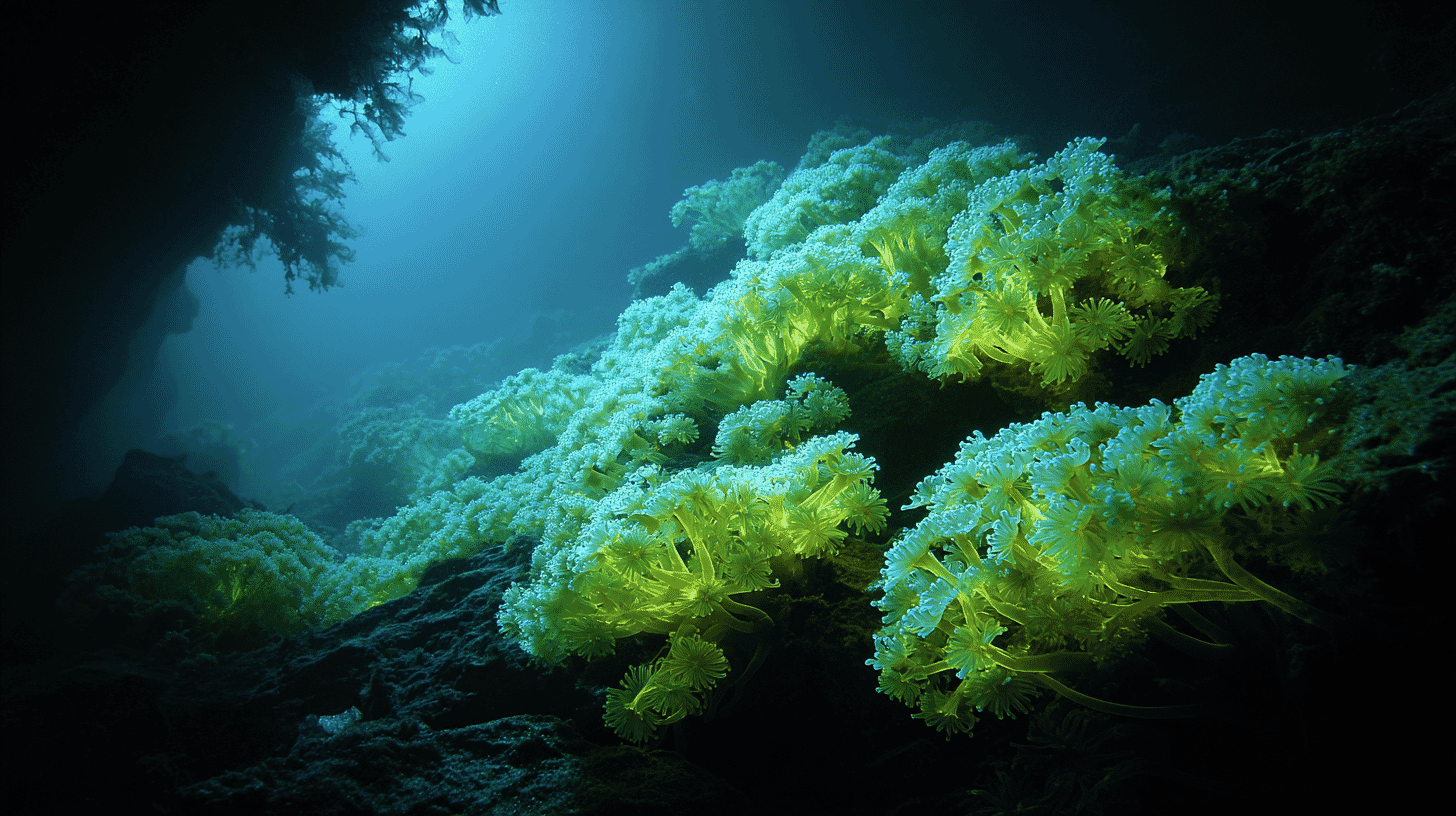
🌑 Nearly 400 meters down, inside a pitch-black limestone cave off a tiny Japanese island, a robot's arm brushed against a clump of yellow coral, and the darkness flashed green. No one had ever filmed a living thing glow inside a deep-sea cave before. The creature turned out to be new to science, and it is only one of the surprises pulled from a place so unexplored that the scientists weren't even sure it existed.
The find comes from D-ARK, a JAMSTEC project whose name reads almost like a riddle: Deep-sea Archaic Refugia in Karst. Strip away the jargon and it means "the ancient hideouts inside underwater limestone caves." The team is betting that some of the ocean's oldest and strangest life is sheltering in caves no human has ever entered.
A frontier that might not have existed
Caves are good places to hide. So is the deep sea. Both are dark, stable, and short on predators: exactly the conditions a species needs to outlast the changes that wipe out everything around it. Biologists have long known that "living fossils" can linger in shallow sea caves; the coelacanth, famously, tucks into caves by day and hunts at night. D-ARK's wager is simple: combine the two refuges. Put a cave inside the deep sea, and you may find creatures that have survived nowhere else.
The problem is that almost nobody has looked. Deep-sea caves are one of the least studied environments on the planet, and there was no established way to explore them. The project lead, JAMSTEC senior researcher Yoshihiro Fujiwara, has said the team had to build their methods from scratch.
They chose the Daito Islands: South and North Daito, two small inhabited islands roughly 360 kilometers east of Okinawa's main island. The choice was deliberate. The Daito Islands are essentially solid limestone, from the surface down to about 2,000 meters, and limestone dissolves. Over time, rainwater carves it into the tunnels and chambers known as karst. As sea levels rose and fell across the ages, caves that formed on dry land ended up submerged in the deep. At least, that was the theory. When the project began in late 2023, no one actually knew whether deep-sea caves existed there at all.
How do you send a robot into a cave 400 meters down?
You start by finding the door. In 2024, the team mapped the seafloor around the islands using a multibeam sonar mounted on the research vessel Kaimei, hunting for spots where slopes had collapsed and might have torn open the mouth of a cave. When they sent cameras down, the cliffs were riddled with holes, some the size of a dinner plate, others five meters across.
Getting inside was the hard part. A diver can swim into a shallow cave, but no human goes 400 meters down. A standard deep-sea robot won't work either: the big remotely operated vehicles are tethered to the ship by thick cables that snag at any narrow opening. So the team rigged a workaround. The large robot, KM-ROV, carries a smaller drone, a Mini-ROV about the size of a microwave oven and 65 centimeters long, to the cave mouth on a thin cable, then releases it to slip inside. On the first dive they gave it only 15 meters of slack, just to test whether the little drone could even fly in and out. It could.
The green flash
The animal that lit up is a zoanthid, a soft anemone-like relative of corals. The team found a colony of golden-yellow polyps, about half a meter across, growing on the branches of a precious coral at the mouth of a karst cave 385 meters down. When the robot disturbed it, the colony pulsed green. Sit and watch it quietly and nothing happens; it only lights up when something touches it.
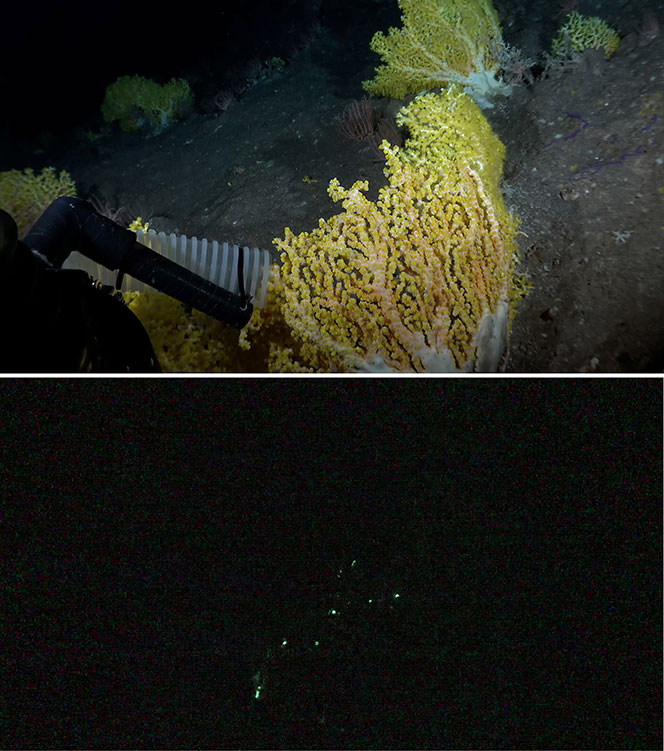
Source: D-ARK/JAMSTEC
Researchers from JAMSTEC and Japan's National Institute of Advanced Industrial Science and Technology described it as a new species, Corallizoanthus aureus (aureus is Latin for golden) in the journal Royal Society Open Science in November 2025. Their paper carries a title scientists rarely allow themselves: "Glow in the D-ARK." Bioluminescence, they note, had never before been documented inside a deep-sea cave. The light peaks at around 515 nanometers, squarely in the green, and it comes from the animal's own chemistry: an enzyme reaction, not glowing bacteria living inside it.
Why glow at all, in a place already pitch black? The leading guess is an idea from the 1940s with a memorable name: the burglar alarm hypothesis. A small animal under attack lights up not to scare the attacker, but to summon something bigger. The flash advertises the attacker's position to its predators: a way of shouting "enemy of my enemy, come and get it." Whether C. aureus really works this way is still unknown. Finding a glow in a deep-sea cave is new enough that the reasons behind it are only now up for study.
The discovery drew notice beyond Japan: the World Register of Marine Species named the golden zoanthid one of its "Ten remarkable new marine species from 2025." There was also a quieter moment the team likes to mention. The dive that caught the glow was being live-streamed to schoolchildren on South Daito Island at the time. The scientists were thrilled to film it; the kids, by all accounts, were thrilled too.
The residents of the dark
The glowing coral gets the headlines, but the caves keep handing over oddities.
There is a fish the color of jade: Epigonus glossodontus, about 15 centimeters long, its green sheen visible only while it's alive. Until now it was known from just a handful of specimens collected off Hawaii. D-ARK recorded it in Japanese waters for the first time in 2024, counting more than 122 individuals across 44 hours of seafloor observation at depths of 340 to 588 meters, often in small shoals around the cave mouths in the island walls. The species had no standard Japanese name, so the team took suggestions from those aboard and settled on horaana-hisui-yasemutsu, roughly "cave jade fish." Nobody yet knows whether the Hawaiian and Daito populations are the same lineage, or how a fish that seems to need caves manages to spread between them.
Then there are the worms, which are stranger than they sound. One new species, a polychaete just five millimeters long, was teased out of a thin pocket of sand at 700 meters, remarkable in a place with almost no sediment, because the Daito Islands are too small and too far from anywhere to collect much mud. Another, Lanice spongicola, seems to have given up on mud entirely. Most worms of its kind burrow; this one grips a branching sponge with a sucker-like structure and builds its home there instead. The caves have also yielded a new ribbon worm. And a paraonid polychaete found in the deep water off South Daito glows green when disturbed, the first bioluminescence recorded anywhere in that family, so C. aureus isn't even the only light in the dark down there.
What ties them together is the word in the project's name: refugia. These animals appear to be cave specialists, found in the karst and nowhere else, surviving precisely because so little else can reach them.
Coelacanths, refugia, and an honest answer
So has D-ARK found a true living fossil, a relict species marooned from an age when its kind ruled the seas? Pressed on this, Fujiwara has been refreshingly blunt: not yet. A relict species, strictly speaking, needs a fossil record proving it was once widespread, and so far nothing from the caves clears that bar. Cave-endemic species and a never-before-seen ecosystem are, he has said, already achievement enough.
What about a coelacanth, the relict everyone wants? Probably not the usual kind: the Daito Islands sit in busy fishing grounds, and a normal-sized coelacanth would likely have turned up on a line by now. But Fujiwara won't rule out a miniature one, shrunk to fit a small island's resources. It's the kind of maybe that keeps a project going.
There is a sober note worth keeping, too. The golden zoanthid makes its home on precious coral, the slow-growing, commercially prized kind, and any robot poking around a fragile, barely-known ecosystem changes it a little. The instinct to explore and the duty to leave the place intact pull against each other in environments this delicate.
D-ARK runs until March 2027, and the team is rebuilding its tools for the next phase. They've learned the caves come in two kinds: open tunnels that water flows through, which look much like the world outside, and dead-end chambers that trap a quieter, more peculiar set of life. The dead ends are where they want to go. A longer tether will let the Mini-ROV, now nicknamed "DroSea," push perhaps 100 meters in; an endoscope-like probe called χscope and a "CaveCam" left running in the dark are being built to reach where even the drone can't. Meanwhile, you can go see some of the catch yourself: specimens are on display at the Enoshima Aquarium near Tokyo.
Japan's deep-sea caves were a blank space on the map until three years ago, and the first proper look already turned up a creature that glows. Most of the world's underwater karst has never been examined this way. What unexplored corners (caves, trenches, sinkholes) are still waiting off your own coast?
References
- https://www.jamstec.go.jp/j/pr/topics/explore-20260318/
- https://www.jamstec.go.jp/dark/e/
- https://royalsocietypublishing.org/doi/10.1098/rsos.250890
- https://www.discoverwildlife.com/animal-facts/marine-animals/corallizoanthus-aureus-japan
- https://www.earth.com/news/coral-species-discovered-corallizoanthus-aureus-glows-in-the-dark/
- https://www.u-ryukyu.ac.jp/news/64937/
- https://www.jamstec.go.jp/dark/j/result/








Global Discussion
4 comments