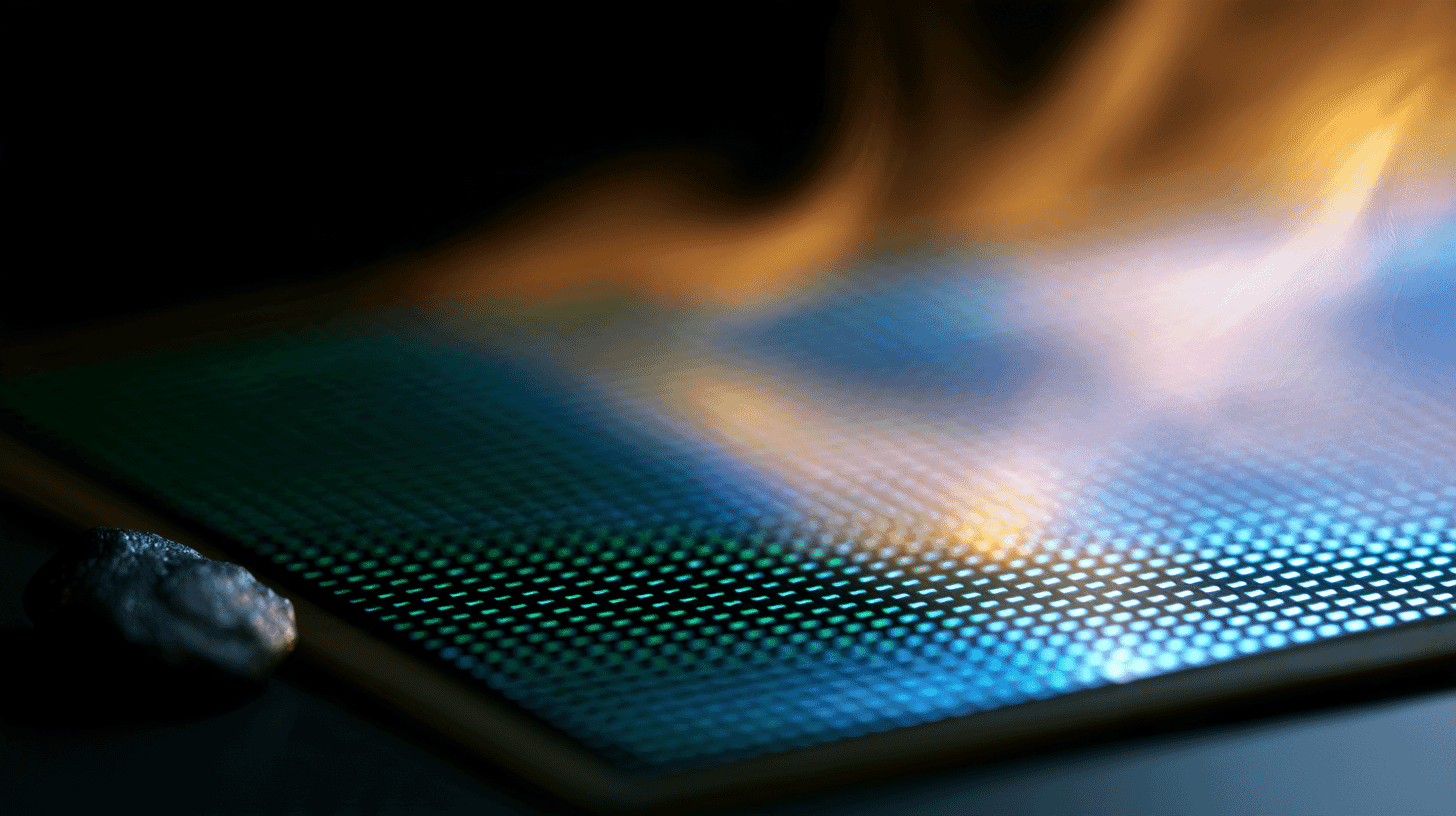
📱 To make phone screens glow at full efficiency, the display industry put a rare metal called iridium inside them. Chihaya Adachi, Distinguished Professor at Kyushu University, named a Clarivate Citation Laureate on September 17, 2026, helped put it there. Then he found a way to take it out.
Three generations of turning electricity into light
Inside an OLED (organic light-emitting diode, a display that glows when current passes through thin films of organic material), electricity becomes small packets of energy called excitons, and those become light. The catch is that excitons come in two kinds. According to Kyushu University, 25% form as "singlets," which emit light easily, and 75% form as "triplets," which mostly don't.
First-generation fluorescent materials could only turn that 25% into light. The rest was lost without ever becoming light.
Second-generation phosphorescent materials built iridium or platinum into the molecule and used the heavy atom to pull light out of the triplets too. Their internal quantum efficiency, the share of excitons that end up as light, can in principle reach 100%.
The third generation is TADF, thermally activated delayed fluorescence, the work honored this month. It aims for the same 100% with no metal at all, using ordinary organic molecules.
The man who put iridium in, then found a way to take it out
Clarivate's physics pick is a trio: Adachi, Stephen R. Forrest of the University of Michigan and Mark E. Thompson of the University of Southern California. The citation credits their pioneering research on phosphorescent OLEDs (PHOLEDs) and on TADF. In other words, both the second and the third generation.
Adachi spent 1999 to 2001 as a researcher at Princeton University. Working with Forrest and Thompson, he was first author on a 2001 Journal of Applied Physics paper titled "Nearly 100% internal phosphorescence efficiency." The device used an iridium-containing molecule, and its calculated internal quantum efficiency came to about 87%.
After moving to Kyushu University, Adachi went the other way. A paper published in Nature in December 2012 showed high-efficiency emission from molecules with no metal in them. His faculty profile at Kyushu University lists the weaknesses of the second generation as limited design freedom, high cost and scarce resources.
Recovering the 75% that was thrown away
Picture a staircase (it is only an analogy): the triplet sits on a step just below the singlet. If the step is tall, the energy stays stuck. If it is very short, the ordinary jiggling of room-temperature heat is enough to nudge the energy back up to the singlet step, where it leaves as normal fluorescence. Because it takes a detour through the triplet first, the light comes out slightly late: hence "delayed" fluorescence.
According to Kyushu University, Adachi's team used quantum-chemical calculations to design molecules whose singlet-triplet energy gap is 100 millielectronvolts or less, small enough for that upward nudge to happen. The materials are relatively simple aromatic compounds, and labs around the world followed.
A metal the world mines only about 7 tonnes of a year
According to the May 2026 report from British precious-metals group Johnson Matthey, mines worldwide supplied 7.1 tonnes of iridium in 2025. Nobody digs for it on its own; it comes out as a by-product of platinum mining. In a 2022 explainer, the company said up to about 95% of output comes from South Africa and Zimbabwe.
Displays are not the only customer. Johnson Matthey notes that PEM electrolysers, which split water to make hydrogen, rely on iridium-based catalysts too (see our story on Toyota's electrolyzer mass production).
Where efforts such as Japan's push to make its own hafnium try to secure metals produced in only a few countries, TADF takes the opposite road: molecules that don't need the metal at all.
OLED screens still have iridium in them
That said, TADF has not replaced phosphorescence yet. Kyulux, the Kyushu University spin-out that Adachi co-founded in Fukuoka in 2015, lists as its first aim replacing the second-generation phosphorescent emitters used in displays today. According to the company, the first product to use its materials came from Taiwan's WiseChip, and it was not a phone screen but a small PMOLED, a simple, compact type of OLED display.
One obstacle has been color. Kyulux says TADF emitters have a wide emission spectrum, which makes vivid colors harder. So the company is developing what it calls Hyperfluorescence, a fourth generation in which TADF molecules gather the energy and hand it to fluorescent molecules with purer color.
Kyulux's $13.5 million funding round in 2016 was led by Samsung Venture Investment, with Samsung Display, LG Display, Japan Display and JOLED taking part. In February 2026, Kyulux licensed its green-material technology to SK Materials JNC, a joint venture that South Korea's SK Materials and Japan's JNC set up in December 2020. At the time of the announcement, the plan was to ship evaluation samples to major panel makers during 2026 and to aim for volume supply from 2027.
By UBI Research's count, Samsung Display took 48% of OLED panel revenue in 2025 and LG Display 21%, while Chinese makers together shipped more than half of all panels by unit volume. The emitter idea came out of a Japanese university; the capacity to mass-produce panels lies in South Korea and China.
How to read a "Nobel stepping stone"
Clarivate's Citation Laureates, launched in 2002, are chosen by the company's analysts from citation data as researchers of "Nobel class." In 2026 there are 22 worldwide, one from Japan. According to Mynavi News, 487 people have been selected so far, and 89 of them later won a Nobel Prize.
Flip that around and most laureates have not won one. Clarivate itself says the list does not aim to predict winners in any specific year. The 2026 Nobel Prizes will be announced from October 5 to 12, but whether Adachi's name is read out is a separate question from what his work has already done inside the screens people carry.
Where you live, does anyone talk about where the metal inside a phone screen comes from?
References
- https://univ-journal.jp/1001891/
- https://www.prnewswire.com/news-releases/clarivate-reveals-citation-laureates-2026-recognizing-transformative-scientific-breakthroughs-302880553.html
- https://news.mynavi.jp/techplus/article/20260918-4988718/
- https://kyushu-u.elsevierpure.com/en/publications/nearly-100-internal-phosphorescence-efficiency-in-an-organic-ligh/
- https://doi.org/10.1038/nature11687
- https://www.kyushu-u.ac.jp/f/24534/2012_12_12.pdf
- https://hyoka.ofc.kyushu-u.ac.jp/html/100020151_ja.html
- https://www.kyushu-u.ac.jp/ja/researches/view/546/
- https://www.kyulux.com/our-technology/
- https://www.kyulux.com/tadf-vs-hyperfluorescence-2024-03/
- https://www.prnewswire.com/news-releases/kyulux-inc-announces-135-million-series-a-financing-and-acquisition-of-large-oled-patent-portfolio-from-kyushu-university-300247016.html
- https://www.kyulux.com/kyulux-signs-license-agreement-with-sk-materials-jnc-for-next-generation-oled-materials%EF%BC%8Dcombining-japans-advanced-emission-technology-with-south-koreas-mass-production-and-co/?lang=ja
- https://matthey.com/science-and-innovation/expert-insights/2022/recycling-and-thrifting-the-answer-to-the-iridium-question-in-electrolyser-growth
- https://en.ubiresearchnet.com/2025-oled-market-share-revenue-samsung-lg-dominance/
- https://matthey.com/documents/161599/509428/pgm-market-report-26.pdf/a2d115af-bf7c-f589-29e9-6beacf8a4452?t=1778750383760
- https://www.kyulux.com/wisechip-5-5-hf-pmoled/
- https://www.jnc-corp.co.jp/product/p-material/it.html







Global Discussion
4 comments