⚛️ There's a kind of nuclear fusion that needs no star's worth of heat. No 100-million-degree plasma, no reactor the size of a stadium. And no, it isn't the discredited "cold fusion" of 1989. This one is real physics, and a Japan-led team just watched it happen in more detail than anyone had managed before.
Three different things get called "fusion"
The word "fusion" gets attached to three very different ideas, and mixing them up is the fastest way to misread this story.
The first is the one in the headlines: hot, plasma-based fusion. Recreate the conditions at the center of the Sun, heat hydrogen past 100 million degrees, and squeeze it with magnets or lasers until atomic nuclei slam together. This is ITER in southern France, JT-60SA in Ibaraki, and the laser approach at the US National Ignition Facility. Giant machines, extreme heat.
The second is muon-catalyzed fusion, or μCF, the subject of this research. It reaches fusion at room temperature with no plasma at all, using a subatomic particle to do the work that heat does inside the Sun.
The third poisoned the well. In 1989 Martin Fleischmann and Stanley Pons claimed a simple tabletop electrolysis cell produced excess heat from fusion. It never reproduced, and "cold fusion" became shorthand for science gone wrong. μCF shares the "room temperature" label and nothing else. It is peer-reviewed, decades old, and entirely mainstream.
Shrinking a molecule until the nuclei almost touch
So how do you fuse nuclei without heat?
Atomic nuclei carry positive charge, and like charges repel. The Sun overcomes that repulsion, the so-called Coulomb barrier, by brute force, with crushing gravity and ferocious heat driving nuclei close enough to fuse. μCF gets there with geometry instead.
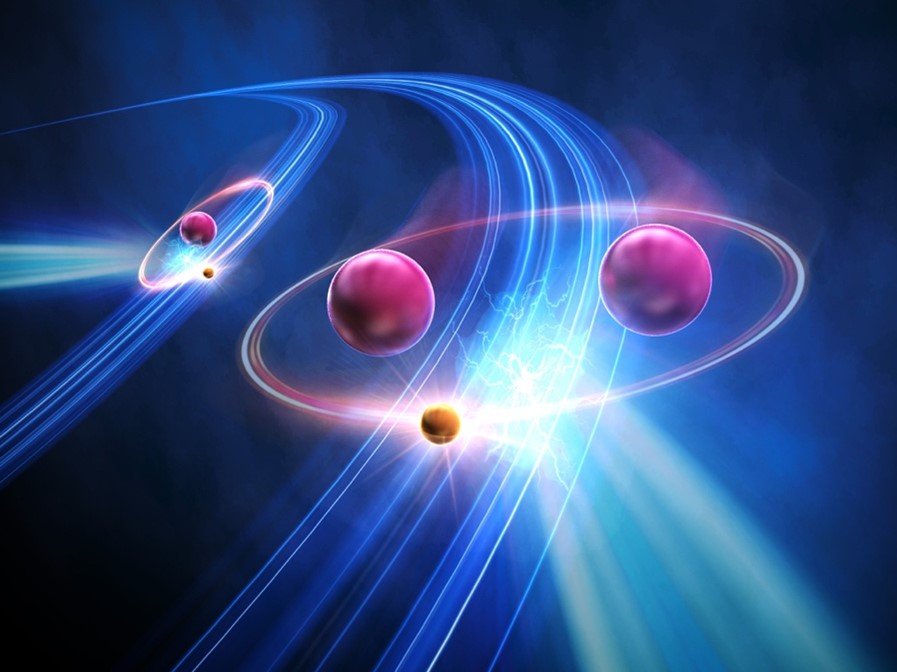
The trick is a particle called the muon. A muon is like a heavy cousin of the electron, same negative charge but about 207 times the mass. Replace one of the electrons in a hydrogen molecule with a muon. Orbit size shrinks in proportion to mass, so the muon hugs the nuclei roughly 207 times more tightly. That pulls the two nuclei close enough for quantum tunneling to finish the job. They fuse, at room temperature, with no plasma.
Better still, the muon usually pops back out afterward, ready to set off the next fusion. It behaves like a catalyst, which is where the name comes from. None of this is new: physicists have known about it since the 1950s.
Why 60 years of "beautiful but useless"
If μCF is this elegant, why isn't it powering anything?
Two stubborn walls.
The first is time. A muon survives only about 2.2 microseconds before it decays. That is the entire window for its catalytic work. Once the muon is gone, so is the fusion.
The second is sneakier, and it has a name: alpha sticking. Every fusion throws off an alpha particle, a helium nucleus. Roughly one percent of the time the muon latches onto that alpha particle and gets dragged out of the cycle permanently. That small leak caps how many fusions one muon can catalyze, in practice only around 150 to 200 before it disappears.
Now add the steep energy cost of making muons in an accelerator to begin with. You put in more energy than you get out, a state physicists write as Q below 1, and nobody has climbed out of it. For decades the verdict held: physically gorgeous, practically hopeless.
What the new measurement untangled
This is where the Japan-led work comes in.
A group led by Yuichi Toyama and Shinji Okada of Chubu University's Center for Muon Science and Technology, with Takuma Yamashita and Yasushi Kino of Tohoku University's chemistry department, joined by RIKEN, KEK/J-PARC, Tokyo Metropolitan University, Rikkyo University and others, went after a step in μCF that had always been inferred rather than seen: the formation of the muonic molecule, and in particular its resonance states. These are fleeting, in-between quantum configurations that set how fast the whole reaction runs.
The instrument was a cryogenic superconducting transition-edge sensor, or TES, with the resolution to pull apart X-rays from muonic molecules and from muonic atoms, something conventional detectors could not do. According to the institutions' announcements, the team made the first direct observation of the resonance states of the muonic deuterium molecule (ddμ*), separated down to vibrational quantum states, and quantified how the population divides among them. The finding: the resonance route, which earlier models had not even counted, is the main path by which the molecule forms. That closed a long-standing gap between theory and experiment. The work was published in Science Advances on April 16, 2026.
Source: Tohoku University press release (April 16, 2026)
There is a second finding here. The data point to a "fast track," a route that skips the slow, rate-limiting step of assembling the muonic molecule and heads straight for the fusing configuration. It matches what theory had predicted. If that pathway can be understood and steered, it is exactly the sort of lever any future efficiency gain would need.
So, does this plug into the grid?
Short answer: not yet, and not soon.
This is basic research. No one built a reactor, no one generated net power, and the fundamental walls (muon lifetime, alpha sticking, the cost of producing muons) are all still standing. What moved is understanding: for the first time, researchers can see and quantify a process they had only modeled.
And "fusion" is not a single race with one finish line. The hot-plasma giants like ITER are chasing net energy on a timescale of decades; ITER's operation with real fusion fuel has now slipped to 2039. μCF is a different game entirely, far earlier in its arc.
Japan's long bench in particle physics, from Chubu and Tohoku to the J-PARC accelerator complex, keeps turning out this kind of patient, foundational work. So which fusion does your country bet on: the giant hot machines, the exotic particle route, or something else altogether?




Global Discussion
4 comments