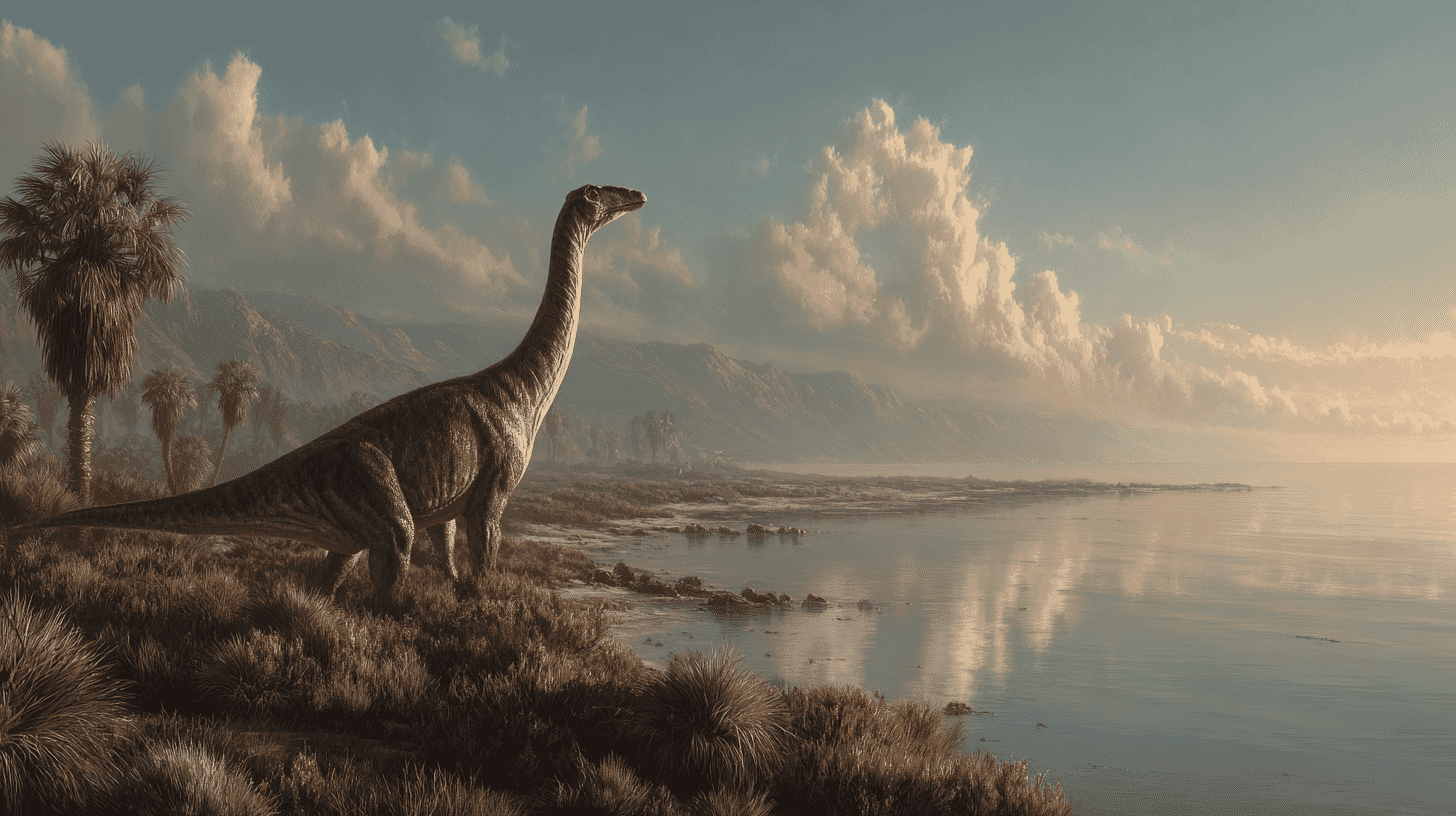
🦕 In 2004, a Japanese paleontologist sat down for a book interview to talk about the dinosaurs of his homeland. Back then, the country had named only a handful of its own species, and a full skeleton of a Japanese dinosaur had been reconstructed for the very first time barely a decade earlier. Two decades later, Japan has named its own giant: an eight-meter, multi-ton animal whose scientific name means "dragon god of Japan." Here's how a country once written off as a dinosaur dead zone earned its place on the global map.
A quiet chapter in a 2004 science book
There's a book from 2004 by the novelist Hideaki Sena, a collection of long conversations with leading Japanese researchers about the frontiers of their fields. One chapter sits down with Makoto Manabe, a paleontologist at Japan's National Museum of Nature and Science, to talk about the dinosaurs that once walked these islands.
In 2004, that was a short story to tell. Japan's dinosaur record was thin. The country had only recently started naming its own species: Fukuiraptor, a meat-eater described in 2000, and Fukuisaurus, a plant-eater described in 2003, both from the fossil beds of Fukui Prefecture on the Sea of Japan coast. A full skeleton of a Japanese dinosaur had been reconstructed for the first time only in the mid-1990s.
The comparison was unforgiving. Montana, Mongolia, and Argentina had been pulling spectacular skeletons out of the ground for generations. Japan was the polite latecomer: mountainous, heavily forested, short on the kind of exposed badlands where fossils weather out of hillsides. Some people half-jokingly called it barren ground for dinosaurs.
Manabe is worth knowing. Born in 1959, trained at Yale and Bristol, he became one of the public faces of Japanese paleontology, the scientist who would later supervise the blockbuster "Dinosaur Expo 2019" and spend years telling general audiences that dinosaurs weren't the sluggish, tail-dragging lizards of old textbooks, but warm-blooded animals, some of them feathered. But in 2004, Japanese dinosaurs were still a small footnote in a story dominated by finds from abroad.
What changed by 2019
In September 2019, a team led by Professor Yoshitsugu Kobayashi of Hokkaido University announced that a famous fossil, a near-complete skeleton dug from marine rock in the town of Mukawa, Hokkaido, was a brand-new genus and species. They named it Kamuysaurus japonicus. "Kamuy" is the Ainu word for a god or divine spirit; the name reads, roughly, as "dragon god of Japan."
The numbers are what stick with you. The animal was about eight meters long, weighed between four and five-plus tons, and was an adult of nine years or older. It is the largest dinosaur skeleton ever found in Japan. It belongs to the hadrosaurs, the duck-billed plant-eaters, and specifically to a branch called the Edmontosaurini, with close relatives in Russia and China. The shape of a bone above its snout even hints that it carried a thin, flat crest on its head.
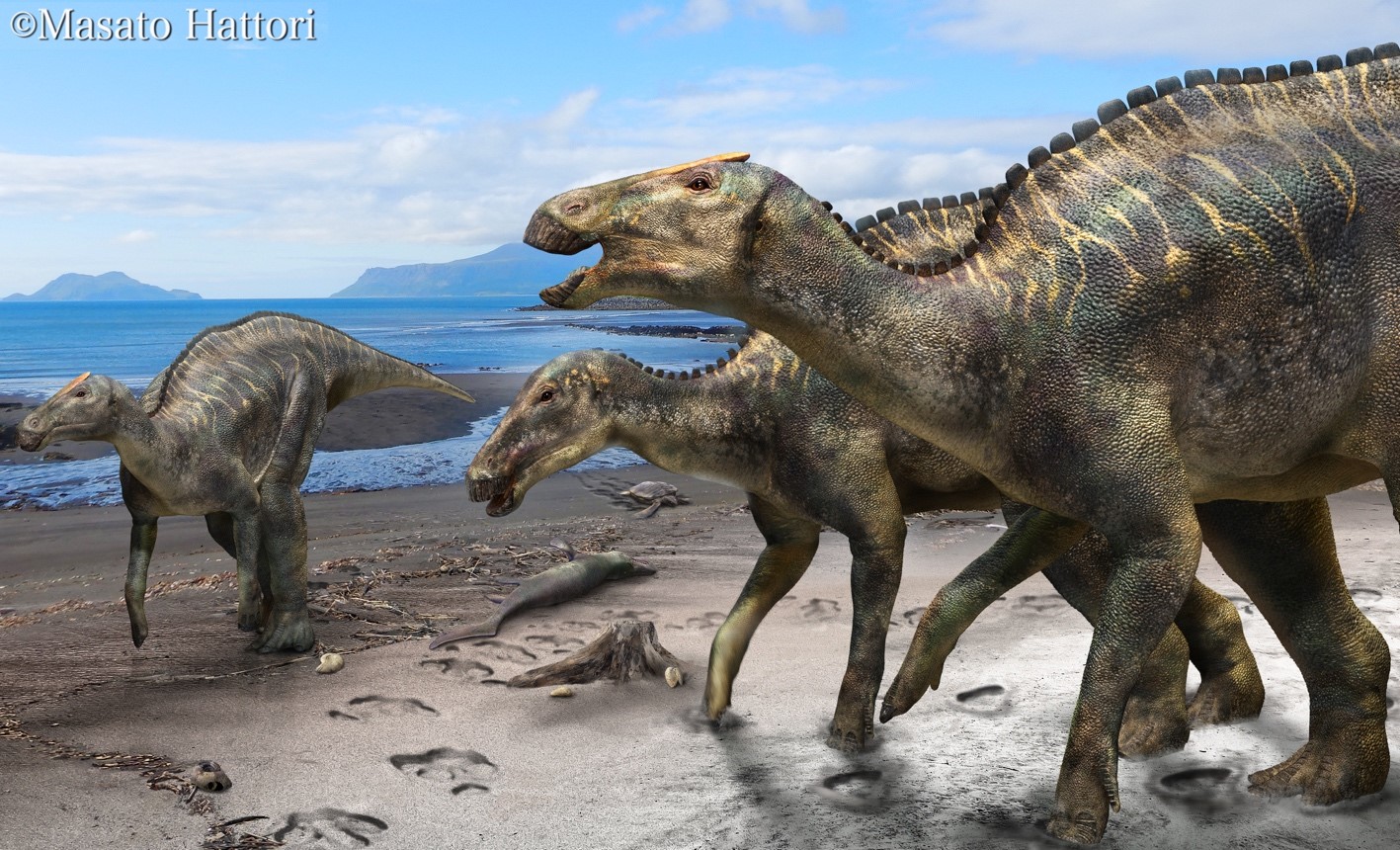
Source: Hokkaido University press release
One detail matters more than it first appears: Kamuysaurus came out of marine sediment. Kobayashi's team argued that for early hadrosaurs, living near coastlines was a major driver of how the group diversified. A Japanese fossil, in other words, wasn't just a local curiosity. It was helping rewrite a chapter of global dinosaur evolution.
A note on credit, because it's easy to blur: Kamuysaurus is the work of Kobayashi's team, a collaboration spanning Hokkaido University, the Hobetsu Museum, Okayama University of Science, the Perot Museum in the United States, and others. Manabe was one of the many people advancing Japanese paleontology in this era, not the lone discoverer of this animal. The story here isn't one hero. It's a whole field growing up.
Then a second dragon, hiding in a 2004 discovery
Here's the part that loops back to the book. In April 2021, the same Kobayashi group announced another new genus and species, this one from Awaji Island in western Japan. They called it Yamatosaurus izanagii, the "Yamato dragon," after an old name for Japan and the creator god Izanagi.
The fossil had actually been found in May 2004 by Shingo Kishimoto, an amateur fossil collector who heads a regional paleontology group, the very year Manabe's book interview was published. At first it was filed under the Lambeosaurinae, a derived branch of the hadrosaur family. Closer study revealed the opposite: a primitive hadrosaur unlike anything else, distinct enough to earn its own name. It was the ninth dinosaur ever given a formal scientific name from a Japanese discovery.
Put Yamatosaurus and Kamuysaurus side by side and you get something researchers had never confirmed in Asia before: a primitive form (Yamatosaurus) and an advanced form (Kamuysaurus) from the same late-Cretaceous time frame, hinting that different dinosaur lineages held different regional turf. A fossil quietly pulled from the ground the same year as a modest book interview turned out to be a missing piece in the puzzle of where duck-billed dinosaurs came from.
From "barren ground" to a name on the map
None of this means Japan suddenly out-fossiled Montana. The geology is still tough on fossil hunters, and big finds remain hard-won. What changed is harder to put a number on: confidence, infrastructure, and a generation of researchers who treated Japanese rock as worth the dig.
The culture followed, and one institution shows just how far. The Fukui Prefectural Dinosaur Museum, out in Katsuyama, is routinely ranked among the three great dinosaur museums on the planet, named in the same breath as Canada's Royal Tyrrell and China's Zigong. After a 2023 overhaul it mounts around 50 full skeletons under one vast, pillarless dome. For a certain kind of fan, it isn't a place you swing by while you happen to be in Japan. It's the reason you book the flight. Add a blockbuster like Dinosaur Expo 2019 in Tokyo, and the kids who grew up assuming all the good dinosaurs lived overseas now have homegrown ones, named for a god from Ainu cosmology and a deity from the country's oldest myths.
Read the 2004 chapter against today's headlines and you don't catch a scientist being wrong. You catch him standing at the start of something, describing a picture that was accurate for its moment, and that moment passed faster than almost anyone expected. Japan's dinosaurs were under everyone's feet the whole time. What's buried beneath your own country, and who's still out there, patiently digging for it?
References
- https://www.hokudai.ac.jp/news/2019/09/kamuysaurus-japonicus.html
- https://www.hokudai.ac.jp/news/2021/04/post-830.html
- https://natgeo.nikkeibp.co.jp/atcl/web/19/070300010/
- https://ja.wikipedia.org/wiki/%E7%9C%9F%E9%8D%8B%E7%9C%9F
- https://www.jstage.jst.go.jp/article/jsesc/2022/0/2022_T2/_pdf/-char/ja






Global Discussion
4 comments