
🔌 Electronic circuits usually don't move. A team at Kyushu University has built thin-film circuits that do: run a current through one and it curls and grabs another film. The two lock together mechanically and electrically, then let go when they are done. A Japanese newspaper story in November 2026 put "space development" in its headline. The research paper behind it never mentions space.
A circuit that bends like a bimetal strip
Fumihiro Sassa, an associate professor at Kyushu University's Faculty of Information Science and Electrical Engineering, and his group call their approach "kinetic electronics": building the moving parts and the circuit into a single thin film.
The film is made of two plastics. A layer of oriented polypropylene 25 micrometers thick is bonded to polyimide 12.5 micrometers thick, and heaters and wiring are patterned on top in gold. When current flows, the heaters warm up and the two layers expand by different amounts. That mismatch makes the film curl.
It is the bimetal strip from an old thermostat, with plastic in place of metal. What sets it apart from a thermostat is that the "muscle" and the circuit are the same film from the start.
The group had already shown in a 2021 paper that films like this can run on 5 volts, push with 5.7 times their own weight, and survive more than 8,000 cycles without degrading.
Grab, pass power, let go
The new paper, published on July 17, 2026, in npj Flexible Electronics and announced by Kyushu University on July 28, 2026, gives these bending films a way to connect. The first author is Shunsuke Uchima, who was a master's student at the time.
There are two designs. In the hook type, a hook on the film bends and catches a loop. In the finger type, three thin "fingers" at the tip of one film slide into holes in another film and lift it.
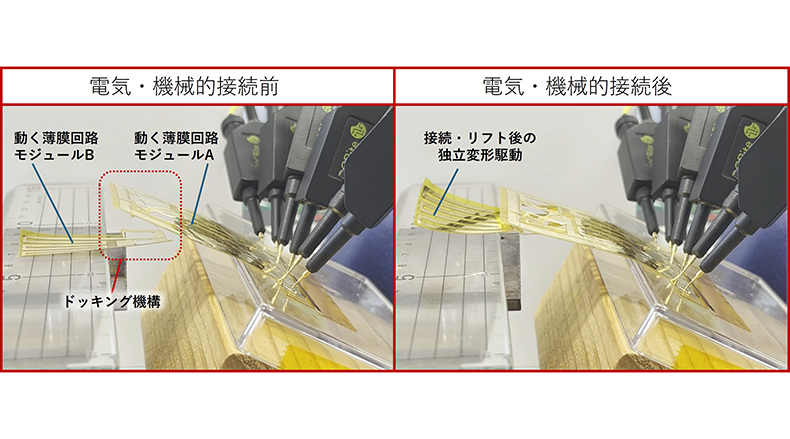
Source: Kyushu University
Once connected, both designs stay locked with the power off. The joint also works as a wire: the team sent power through it and used that power to make the second film bend on its own. To separate, the films are moved apart electrically.
Thin, soft electronics are hard to change once they are made. Adding or replacing a part usually means screws or connectors, and those undo the softness that made the device useful. Kyushu University describes the work as groundwork for devices whose parts can be swapped after they are built.
A 40-second handshake
The films are cut from sheets 6 centimeters square and run on 5 to 12 volts. The hook type moved about 10 millimeters at 1.1 watts. The finger type drew 0.43 watts on average and held up to 618 milligram-force, or 6.1 millinewtons. That is enough to hold up a bit over half a gram, about 4.8 times the 130 milligrams of the gripping film itself.
It is also slow. Docking takes about 40 seconds, undocking about 34 seconds, and the full sequence about 132 seconds. Anything driven by heat has to warm up and cool down.
The paper calls itself a proof-of-concept rather than a complete modular robotic system. The experiments were run only in air, and there is no long-term reliability study yet for repeated connecting and disconnecting. Speaking to the Nikkan Kogyo Shimbun, the Japanese industry daily behind the November story, Sassa said the team has only demonstrated the basic principle, and named a practical problem: films made from the same materials and the same design can still behave differently.
The space dream, and what the paper covers
According to the daily's Newswitch site in November 2026, Sassa's lab imagines printing thin modular robots in bulk, sending them to the site, and letting them combine and swap broken parts for spares as they work. Space development is one of the places the lab has in mind.
That vision came out of an interview, though. The university's release lists thin-film robots, wearable sensors and soft devices for medical and biological measurement as applications, and neither it nor the paper says anything about space. Nobody has tested whether the films work in a vacuum or at extreme temperatures. Since they move by heating, using them in space would likely mean rethinking how heat is managed. That last point is our own reading.
In 2014, a team from Harvard University and MIT reported in Science on a flat sheet that folded itself with heat in about four minutes and walked off as a robot. The sheet was paper and heat-shrinking polystyrene with a flexible circuit board inside. Its lead author, too, imagined stacks of robotic satellites sent to space to assemble themselves.
Both projects use heat to change shape. The difference is that the Harvard sheet hardened as it cooled and worked in that fixed form, while the Kyushu films are designed to grab and let go, again and again.
Japan's long habit of unfolding things in space
Japan has a long record of folding thin things for launch and opening them in space. The Miura fold, which University of Tokyo professor emeritus Koryo Miura came up with in 1970, was used on the Space Flyer Unit (SFU), launched in 1995, to stow and deploy a flat structure. JAXA's IKAROS solar power sail demonstrator, launched on May 21, 2010, spread a 14-meter-square membrane 7.5 micrometers thick in space and generated electricity with thin-film solar cells on it.
Both fold a membrane into a planned shape and open it again. The vision Sassa's lab describes is a different step, where films connect and rearrange themselves on site.
In Japan, circuits that stretch are already a medical product (related article). If thin robots could swap their own parts, where would you put them to work in your country?
References
- https://www.nature.com/articles/s41528-026-00606-9
- https://www.kyushu-u.ac.jp/ja/researches/view/1527/
- https://newswitch.jp/p/50691
- https://eetimes.itmedia.co.jp/ee/spv/2607/30/news029.html
- https://www.nature.com/articles/s41598-021-99500-9
- https://news.harvard.edu/gazette/story/2014/08/robot-folds-up-walks-away
- https://www.gov-online.go.jp/eng/publicity/book/hlj/html/202112/202112_05_en.html
- https://assl.isas.jaxa.jp/projects/ikaros/ikaros.html
- https://www.jstage.jst.go.jp/article/jasma/29/1/29_48/_article/-char/ja









Global Discussion
4 comments