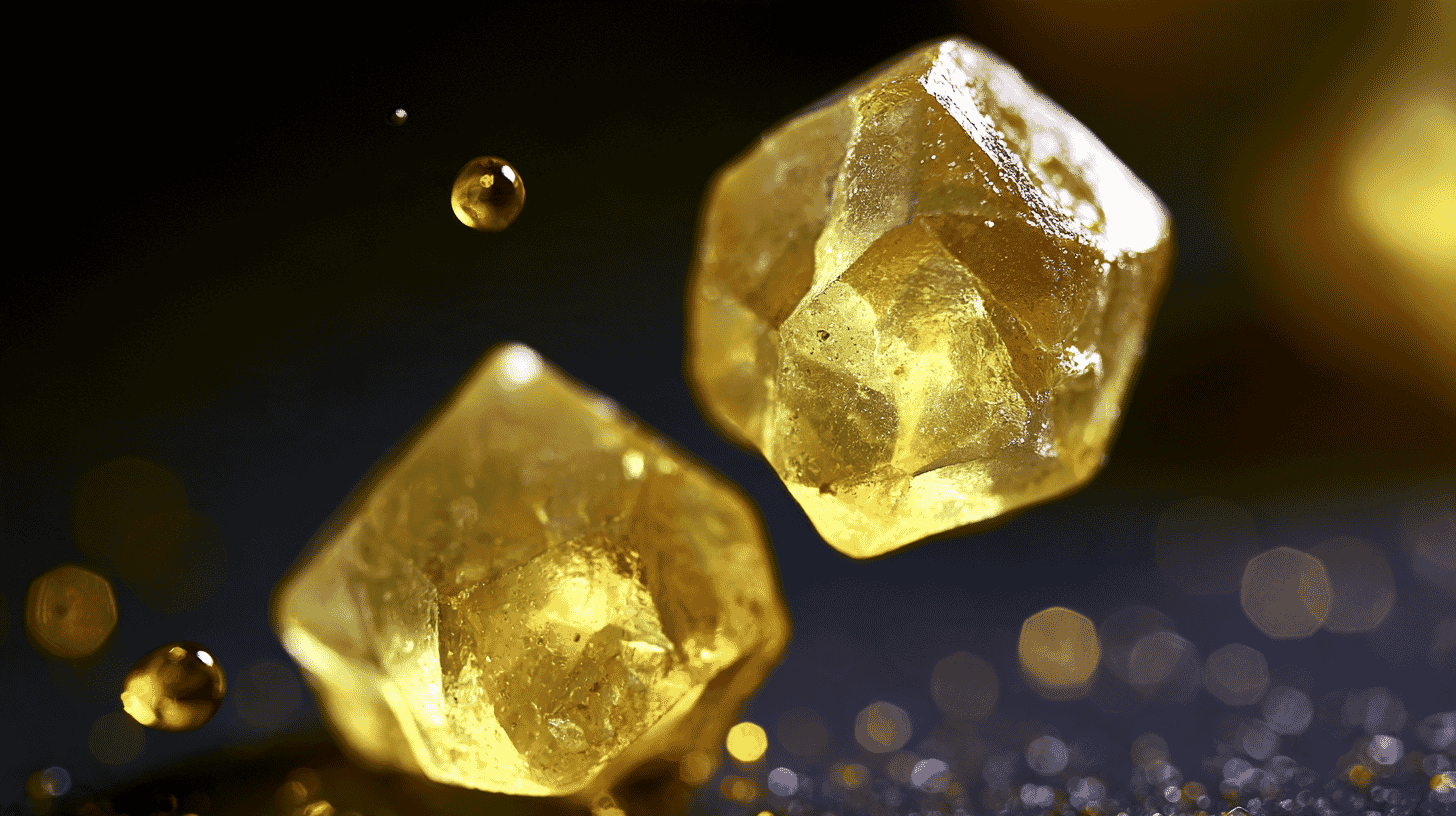
🧪 Picture the crust of yellow crystals around a volcanic vent. The same molecule, it turns out, is being made inside mouse and human cells and stockpiled in tiny droplets of fat. An international team led by Tohoku University reported the finding in Science on September 24, 2026. Something this ordinary went unconfirmed in mammals for a long time, and the reasons lie in the molecule's own chemistry and in the tools used to measure it.
A ring of eight sulfur atoms
The molecule is cyclo-octasulfur, or S8: a ring of eight sulfur atoms. It is the most stable allotrope of elemental sulfur, and also the most common form.
Until now, S8 was associated with volcanic regions, hydrothermal vents and certain sulfur-metabolizing bacteria. Microbes are known to make, store and use elemental sulfur for energy. Whether animals did anything similar was an open question.
The rotten-egg smell in volcanic gas is not S8, either. It comes from hydrogen sulfide, a colorless gas and a different molecule.
Stored in the body's fat
The research involved Tohoku University, Akita University and the Institute of Science Tokyo, together with the Max Planck Institute for Polymer Research in Mainz, Germany, and Shimadzu Corporation, among others. The corresponding authors are Takaaki Akaike, a professor at Tohoku University Graduate School of Medicine, and Uladzimir Barayeu, a group leader at the Max Planck Institute for Polymer Research who also holds a professorship at Tohoku University.
According to the paper's abstract, S8 builds up in mouse and human cells at millimolar levels, concentrated in the membranes of mitochondria and in lipid droplets. Mitochondria are the compartments that produce a cell's energy; lipid droplets are small globules where cells keep their fat.
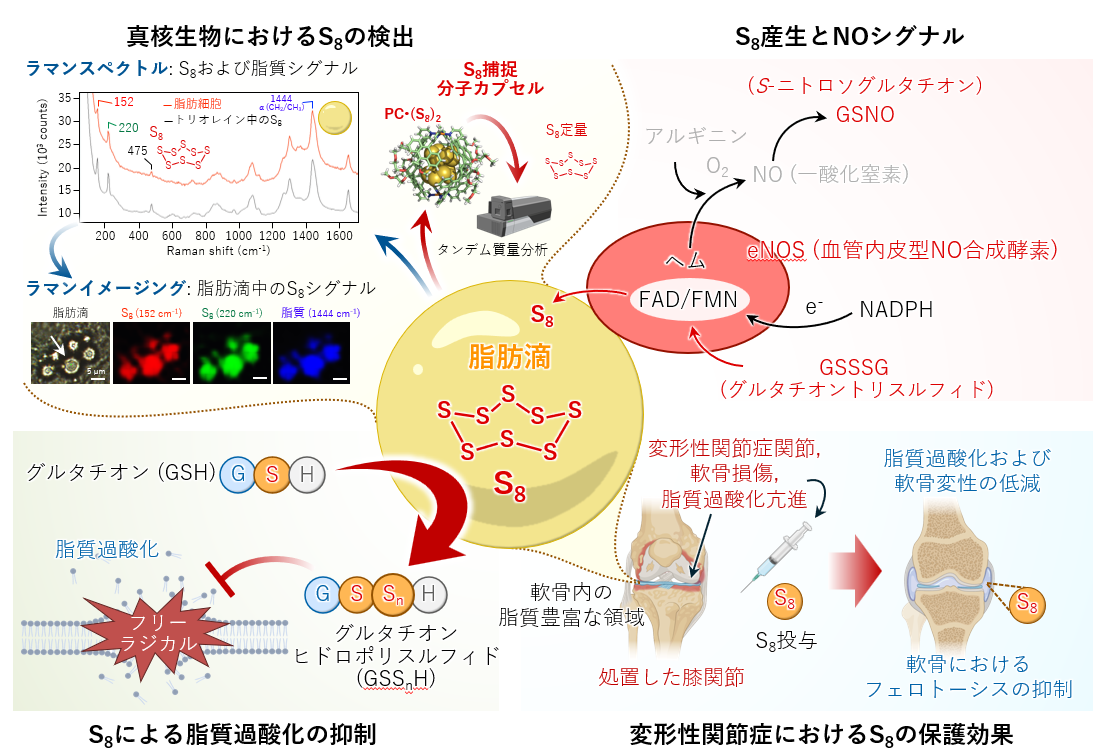
Source: Tohoku University press release
Endothelial nitric oxide synthase (eNOS) plays a part in making S8. The enzyme is best known for producing nitric oxide, which relaxes blood vessels and helps regulate blood pressure.
Why it took so long to confirm
S8 does not dissolve in water, which made it hard to study in mammalian tissue. In cells that are mostly water, it was tucked away where the lipids are.
It also falls apart when you try to weigh it. Mass spectrometry identifies molecules by their mass, and to do that it first has to give them an electric charge. A 2017 study from the Tokyo Institute of Technology showed that under conventional mass spectrometry even the stable S8 ring broke apart at that step, leaving only fragments such as S3+ and S4+.
The fix was a "molecular capsule." In 2017, Michito Yoshizawa's group, then at the Tokyo Institute of Technology, showed that a cage-shaped capsule could wrap S8 whole so its mass could be measured without breaking it. At the time it was framed as an analysis method for inorganic clusters used in materials and catalysts. The new study used a molecular capsule from Yoshizawa's group, now at the Institute of Science Tokyo: water-soluble, with a cavity about 1 nanometer across, and able to capture only S8 even inside cells crowded with other molecules. A chemistry tool became the key to a biology discovery nine years later. The team also used Raman microscopy, which tells molecules apart by the way they scatter light, to see directly where S8 sits in cells.
The summary of a government-funded research project that began in June 2022 already describes, with evident surprise, that S8 had been detected in abundance in humans and animals. The paper appeared about four years later.
So was it that no one looked, or that no one could? In chemical terms, S8 has long been seen as the place where the body's reactive sulfur compounds eventually settle. A group at the University of Leicester in the UK, in a preprint posted in September 2025, wrote that the role of elemental sulfur in biology still remained poorly defined because there was no robust way to measure it directly. The delay looks less like a lack of interest than a lack of tools.
From sulfur gas to sulfur rings
In sulfur biology, hydrogen sulfide has been studied as a signaling molecule. It is now regarded as the third gaseous signaling molecule after nitric oxide and carbon monoxide.
Akaike's group followed a slightly different thread. In 2014 they found large amounts of cysteine persulfide, an amino acid carrying an extra sulfur atom, in mammals. In 2017 they reported "sulfur respiration," in which sulfur metabolites stand in for oxygen in energy production. They call molecules with chains of sulfur atoms "supersulfides," and have been building out that idea over the past two decades. The new study was also supported by a Japanese government research-grant program known as Sulfur Biology.
This is not only a Japanese story. In 2020, chemists at the University of Oregon reported dissolving S8 in water with modified cyclodextrins (ring-shaped sugar molecules) and delivering it to live cells. The new paper includes researchers from Germany and the United States, and the University of Vermont has highlighted more than 25 years of exchange with Akaike's lab.
What it does is still being worked out
In cell experiments, less S8 meant more lipid oxidation and more ferroptosis, a form of iron-dependent cell death. Adding S8 suppressed ferroptosis in fat cells and in the cells that line blood vessels. S8 also reacts with glutathione, a molecule abundant in cells, to form supersulfides with antioxidant activity. The team thinks S8 in lipid droplets works as a reserve that stops lipid oxidation from spreading.
In animals, the researchers used mice in which knee osteoarthritis had been induced by surgery and injected a water-soluble form of S8 into the joint. At 2 weeks after surgery, a marker of lipid oxidation called 4-HNE was lower in the synovium, the membrane that lines the joint. The press release describes that change in the marker; it does not say whether symptoms improved.
In human breast cancer tissue, S8 was markedly higher than in the same patients' non-cancerous breast tissue, in some cases above 100 millimolar. Supersulfides were also higher in condensed breath from breast cancer patients than from healthy people. Why a molecule that seems to protect cells piles up around tumors, and whether that helps or harms the body, is not yet known.
Tohoku University's press release headline raised hopes for preventing and treating cancer, aging, inflammation and osteoarthritis. The Max Planck Institute's release, issued the same day, opens by noting that antioxidants are familiar from advertising. It mentions long-term possibilities for understanding and treating diseases such as neurodegenerative disorders, and closes by saying more research is needed before any medical use.
This study is about S8 that the body makes on its own, and the animal dosing described in the press release was an injection into mouse joints. Neither the press release nor the paper's abstract says anything about eating or drinking sulfur being good for you. If this research turns up in ads for "sulfur" or "antioxidant" products, that claim sits outside what the study showed.
Where you live, does "sulfur" bring volcanoes to mind, or hot springs?
References
- https://www.tohoku.ac.jp/japanese/2026/09/press20260925-02-octasulfur.html
- https://www.tohoku.ac.jp/japanese/newimg/pressimg/tohokuuniv_press20260925_web02_octasulfur.pdf
- https://doi.org/10.1126/science.aec5473
- https://www.mpip-mainz.mpg.de/1193435/PM2026-23
- https://www.uvm.edu/larnermed/medcommunications/news/25-year-scientific-exchange-leads-new-insights-cellular-stress
- https://www.titech.ac.jp/news/2017/039200
- https://kaken.nii.ac.jp/grant/KAKENHI-PROJECT-22K19397
- https://scienceportal.jst.go.jp/newsflash/20171113_01/index.html
- https://pmc.ncbi.nlm.nih.gov/articles/PMC9495975/
- https://www.biorxiv.org/content/10.1101/2025.09.26.678775v1
- https://doi.org/10.1039/d0sc04137h
- https://www.pref.kagoshima.jp/bc05/hakubutsukan/iimono/documents/98090_20220615105755-1.pdf









Global Discussion
4 comments