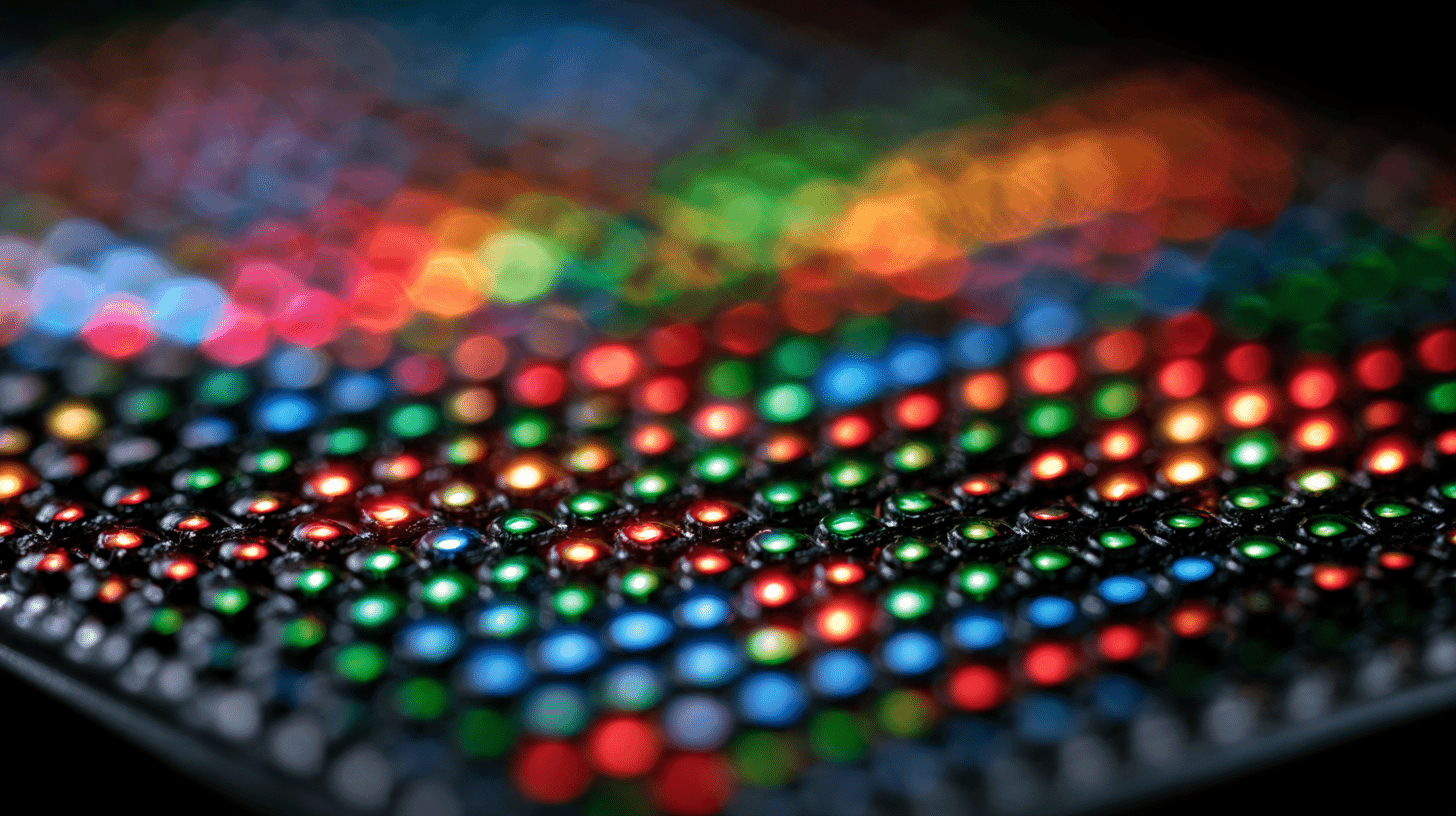
🎨 Look closely at a red on your phone screen. It looks vivid, but it is not actually one pure red. It is a small smear of reds, oranges and pinks, blended so smoothly that your eye reads it as a single color. That tiny blur has been baked into how organic screens make light for decades. A team at Kyoto University has now squeezed it down to almost nothing, close enough that the light starts to behave less like a glowing screen and more like a laser.
The color on your screen is a little bit fuzzy
Every glowing dot in an OLED screen gives off not one wavelength of light but a narrow band of them. Researchers measure the width of that band, called the full width at half maximum (FWHM), in nanometers. The narrower the band, the purer and more saturated the color.
A typical organic emitter has a band wider than 40nm. That width is, in effect, a muddy mix of neighboring colors. It also limits the range of colors a screen can reproduce, what engineers call its gamut. Manufacturers paper over the problem with optical filters that strip away the unwanted colors before they reach your eye, but filtering throws away brightness and burns extra power. The purer the light coming out of the material, the less a screen has to waste cleaning it up.
This is the problem Takuji Hatakeyama's group at Kyoto University has been chipping away at for years. In 2016 they built a family of organic emitters with boron and nitrogen woven into the molecular skeleton, a design that narrowed the emission band dramatically. According to Nikkei, materials descended from that 2016 work now sit inside more than 90% of the OLED displays on the market. (We have written about these boron-and-nitrogen "multiple resonance" materials before, in a completely different role: a single OLED that also generates electricity like a tiny solar cell.) Even so, the color from those materials was still far from laser-pure.
Why the blur is so stubborn
The band widens because the molecule physically wiggles. When an electron is kicked into a high-energy excited state, the molecule stretches and vibrates, and that vibration smears the emitted light across a range of nearby wavelengths.
The "multiple resonance" design that Hatakeyama pioneered fights this by locking the relevant electrons into a rigid arrangement, so the molecule barely flexes and the band stays narrow. The catch is that there is a limit to how rigid you can make one small molecule. Past a point, you cannot squeeze the blur out any further by stiffening a single unit.
Stringing the building blocks together
The new result gets around that limit with a different move. Instead of relying on one multiple-resonance unit, the team linked several of them together at carefully chosen positions. That kept the rigidity that suppresses vibration, while letting the excited electron spread out across the whole, larger molecule.
Measured in a low-polarity solvent, the new material emitted light with an FWHM of just 5.5nm. To put that in perspective, ordinary emitters sit above 40nm, and DABNA-1, the best-known multiple-resonance material, comes in at 22nm in toluene. The new molecule reaches 6.9nm in the same toluene and 5.5nm in the low-polarity solvent. In working OLED devices the team measured about 10nm. The headline 5.5nm figure is a solution number: in solid films and devices, interactions between molecules broaden the spectrum again, and controlling how the molecules pack in the solid state is the next problem on the list.
The deeper claim is right there in the paper's title: "Organic spontaneous emission approaching the monochromatic limit." A laser gets its razor-thin color from stimulated emission, a tightly choreographed process. An ordinary LED or OLED relies on spontaneous emission, which is inherently messier. What this work shows is that spontaneous emission, the cheap and simple kind, can be pushed surprisingly close to the single-color purity that was supposed to belong to lasers. The findings were published in the journal Science on June 11 (US Eastern time).
What near-laser color could change
The most obvious payoff is on screens. A purer source color means a screen can show more colors, reproduce them more accurately, and waste less light doing it, which points toward displays that are both more lifelike and more efficient. Hatakeyama put it in plainer terms when the work was announced: the payoff could be a picture vivid enough to be indistinguishable from looking at the real scene.
The researchers also see uses beyond displays. Because the trick works for spontaneous emission, it widens the territory where a simple LED could stand in for a laser, in any device that wants a clean, single color from a cheap light source. Lighting, sensing and optical communication are all on the list.
None of this lands in a product tomorrow. This is a materials advance plus a device demonstration, and the long grind of durability, manufacturing and cost still lies ahead before a 5.5nm emitter shows up in anything you can buy. But the direction is clear, and it is a little startling: the glowing organic films in our phones may be closer to laser light than anyone assumed.
Japan has supplied the color inside most of the world's OLED screens for a decade. If you are reading this on one, the red you are looking at may soon get a lot purer. What is the display industry like where you live, and would you actually notice the difference?






Global Discussion
3 comments