
At a corporate briefing held in Tokyo on October 6, 2026, the president of one of Japan's biggest heavy-industry groups asked a robot where he had left his smartphone. According to Jiji Press, the robot said it was on the table, went over, and fetched it.
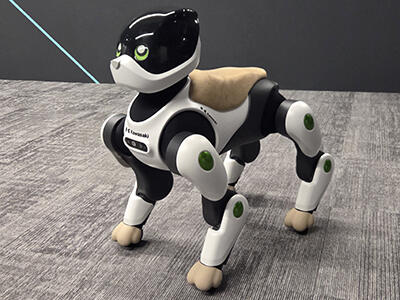
The robot is Home LEO, a prototype from Kawasaki Heavy Industries, a company that builds railcars, aircraft and motorcycles and was an early maker of industrial robots. Home LEO does not walk on two legs and is not built for a factory line. It is a four-legged machine meant to live with an older person at home, talk with them, and notice when something goes wrong.
What Home LEO is supposed to do
Kawasaki lists four main features. The robot holds everyday conversations and learns a person's habits and preferences over time. It watches for trouble, whether a fall, a sudden change in someone's health, a stove left on or a caller at the door, then speaks to the person and alerts family members or care workers. It moves around the home on its own and helps look for things. And it collects conversation, behavior and health data over a secure connection, to be shared with hospitals and care facilities "as needed."
Source: Kawasaki Heavy Industries
Kawasaki's own release, however, says the listed features include functions still to be built in future development. Launch is targeted for fiscal 2028, which in Japan runs from April 2028 to March 2029. Kawasaki adds that even the dimensions may change because this is a prototype. As of October 2026, there is no price, no weight, no battery spec and no list of sensors.
Jiji Press called it a dog-shaped robot, but Kawasaki's release never uses the word dog and calls it a "social robot." The photos show a white four-legged body with a rounded head and green lights for eyes.
The numbers behind the push
In July 2024, Japan's health ministry published prefecture-level estimates of how many care workers the country will need. The answer was about 2.40 million in fiscal 2026 and about 2.72 million in fiscal 2040. That means about 250,000 and 570,000 more than the 2.15 million working in fiscal 2022. These figures are often reported as a "shortage," but strictly they are additional hires needed over the 2022 level, not a forecast of how many posts will go unfilled.
The ministry's head counts put the care workforce at 2.154 million in fiscal 2022 and 2.126 million in fiscal 2023, the first decline since Japan's long-term care insurance began in 2000. In fiscal 2024 the number was essentially flat, at 2.126 million. Over the same two years, the number of people officially certified as needing care rose from 6.97 million to 7.20 million.
Kawasaki aims Home LEO at that gap. Its stated goal is to extend the time older people can live safely in their own homes, which it says improves quality of life and also helps curb medical and care spending. Kawasaki already supplies hospitals and care facilities with hinotori, a surgical robot; FORRO, which carries items around buildings; and Nyokkey, a semi-humanoid. Home LEO is meant to take that support into people's homes. (The broader physical-AI strategy behind it, including Kawasaki's Silicon Valley base, is covered in our earlier piece.)
Two kinds of robots heading into the home
Home LEO is not the only robot aimed at the home. In its July 2026 quarterly filing, Tesla calls Optimus a general-purpose, autonomous humanoid robot and says it is preparing for large-scale production. Figure AI unveiled Figure 03 on October 9, 2025, saying it was designed for the home and aiming for a general-purpose robot that can perform human-like tasks. TechRadar, which saw the launch footage, described it folding laundry and loading a dishwasher. Japan is testing labor humanoids as well, including Chinese-made robots on the tarmac at Haneda Airport.
Those machines are built around one question: who does the work? They have human-shaped hands because their stated goal is to take on tasks designed for human bodies.
Home LEO is built around a different one: who notices when nobody else is there? Most of its listed jobs are about noticing, such as a fall or a stove left on, and about talking, such as asking the person how they are. Kawasaki's promotional images do show it opening a door with a fixed hook and climbing stairs, but those are ways of getting around the house, not housework.
Smaller than a person, bigger than a pet
Home LEO is 640 mm (25.2 in) long, 675 mm (26.6 in) tall and 390 mm (15.4 in) wide, and it can raise itself on its knees to 830 mm (32.7 in). That is smaller than a humanoid but much bigger than Sony's aibo (ERS-1000), which stands about 293 mm (11.5 in) and weighs about 2.2 kg. Home LEO is more than twice as tall.
Sony launched the original AIBO in 1999 as an entertainment robot, not a care device. On June 25, 2026, it announced it would stop selling aibo in Japan once stock ran out (sales continue in the US; more on that here).
Kawasaki has not explained why it chose this size. One possible reason is the kneeling height: 830 mm brings the head up to roughly table level, which is exactly where the smartphone was.
Who holds the data from inside the home?
Home LEO is designed to keep collecting what a person says, how they move and how their health changes, and to share it with medical and care institutions. Kawasaki's release says this happens on the premise of the user's consent and proper data management.
What the release does not describe is how consent works when the user's memory and judgment are changing. The health ministry's research estimates put the number of older people with dementia at about 4.716 million in 2025, 12.9% of those aged 65 and over, rising to about 5.842 million by 2040. Another 5.643 million are estimated to have mild cognitive impairment.
Older people who live alone with a robot like this will include people in those groups. Can consent given at the start be withdrawn later, and how would the robot know? Does a family member's agreement stand in for the person's? Who decides which conversations count as "care data"? Kawasaki has not said. For a prototype that is understandable, but the trials will have to answer these questions before fiscal 2028.
What happens before fiscal 2028
Kawasaki says it will run demonstration trials with the Ministry of Health, Labour and Welfare, the Ministry of Economy, Trade and Industry, local governments, care providers and AI companies. As of October 2026, it has not announced where or when.
It also has not said whether Home LEO will be sold, rented or provided through care services, or how many of the features still in development will be in the launch version.
Would you want a robot that remembers what you said living with your parent? Would you want it living with you?
References
- https://www.khi.co.jp/pressrelease/detail/20261006_2.html
- https://global.kawasaki.com/en/corp/newsroom/news/detail/?f=20261006_6729
- https://global.kawasaki.com/en/corp/profile/division/index.html
- https://www.nationthailand.com/news/world/40071983
- https://sp.m.jiji.com/article/show/3883993
- https://www.watch.impress.co.jp/docs/news/2146117.html
- https://www.mhlw.go.jp/stf/newpage_41379.html
- https://www.mhlw.go.jp/content/12000000/001616652.pdf
- https://www.mhlw.go.jp/content/001279920.pdf
- https://www.sec.gov/Archives/edgar/data/1318605/000162828026049270/tsla-20260630.htm
- https://www.figure.ai/news/introducing-figure-03
- https://www.techradar.com/ai-platforms-assistants/figure-03-might-be-the-home-robot-that-changes-everything-if-it-ever-goes-on-sale
- https://aibo.sony.jp/feature/spec.html
- https://info.aibo.sony.jp/info/2026/06/20260625-01.html
- https://www.watch.impress.co.jp/docs/news/2119925.html








Global Discussion
3 comments