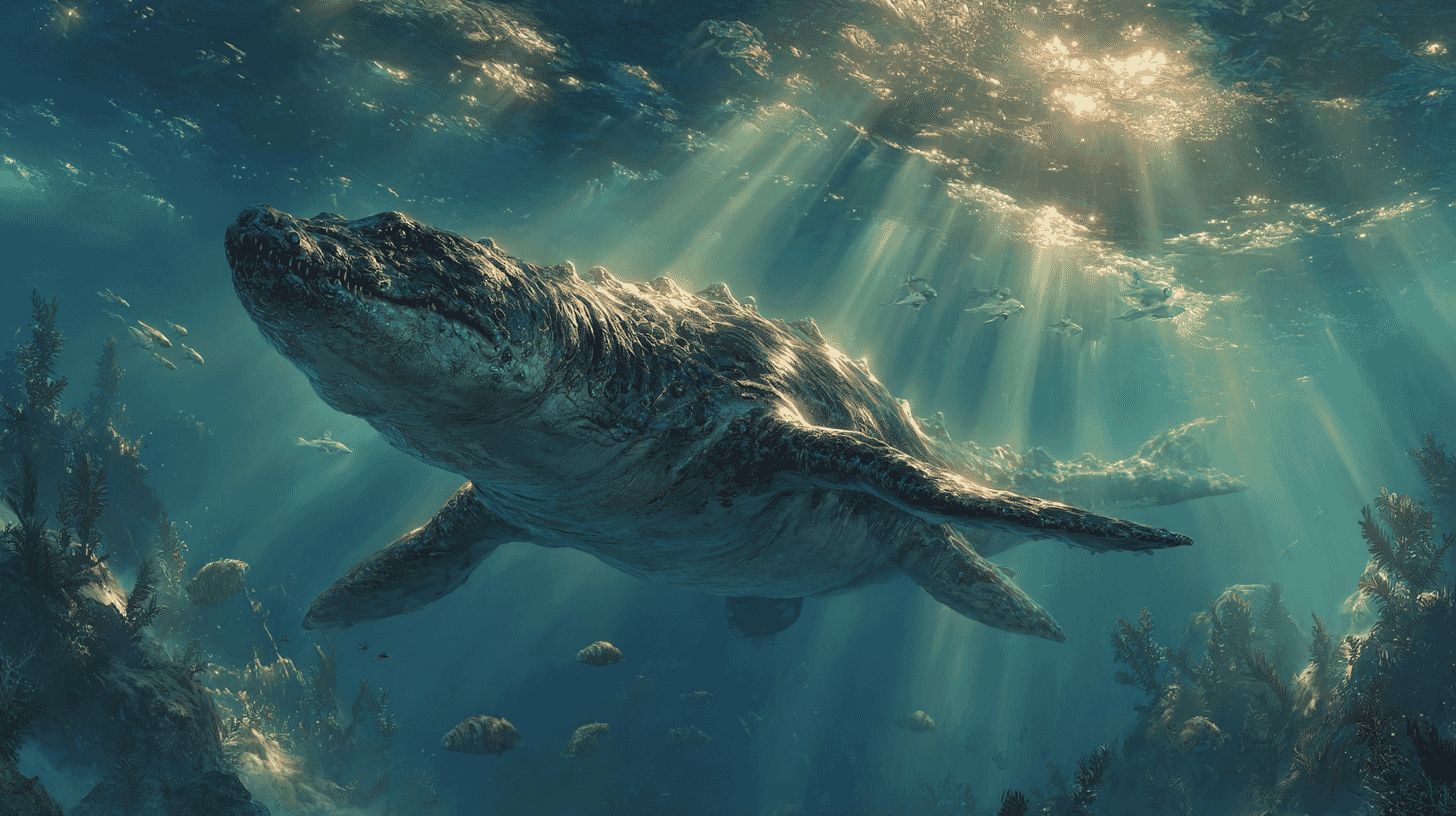
🌊 You probably remember the sea monster from Jurassic World, the one that erupts out of a lagoon and swallows a shark in a single bite. Its real-life cousins once ruled the oceans. And one of them spent the last 35 years as a plain lump of rock in the back room of a small museum near Osaka. When researchers finally chipped it open this year, they found a bone no Japanese mosasaur had ever shown before, and possibly a species new to science.
The "T. rex of the seas"
First, a quick correction that surprises a lot of people: mosasaurs were not dinosaurs. They were giant marine lizards, closer kin to today's monitor lizards and snakes, that took to the water and became the top predators of the Late Cretaceous (roughly 98 to 66 million years ago). They swam with paddle-like limbs, some species grew past 10 meters, and they hunted fish, ammonites, and sometimes each other.
The Osaka fossil belongs to a heavyweight branch of that family called Prognathodon, a group so thickly built around the jaw that paleontologists nickname it the "T. rex of the seas." Where some mosasaurs were slender fish-chasers, Prognathodon had the kind of blunt, powerful bite that could crack shells and bone.
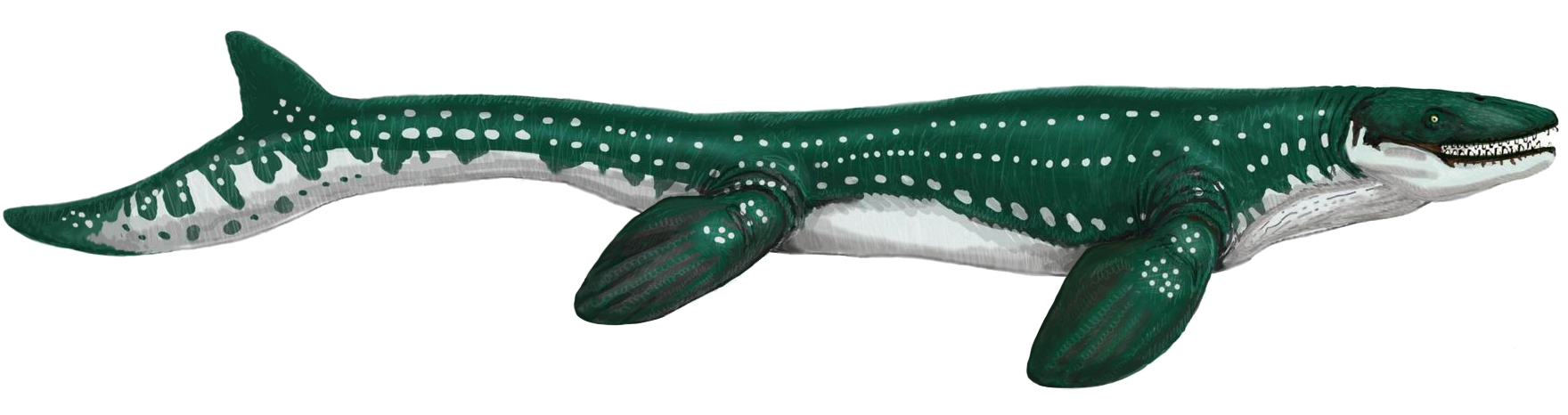
Illustration: Dmitry Bogdanov / Wikimedia Commons (CC BY 3.0)
Thirty-five years inside a rock
The fossil itself has a much quieter origin story than the animal. It was collected in Kaizuka, in southern Osaka Prefecture, sometime between the end of 1990 and 1992, out of a layer of Late Cretaceous rock about 70 million years old. Then it went into storage at the Kishiwada Natural History Museum, still locked inside its surrounding stone, unprocessed, for roughly three and a half decades.
What broke the wait was an ordinary act of attention. Utsunomiya Satoshi, a company employee on the research team, noticed the cross-section of a fossil poking out of the rock. The group began the slow work of cleaning, shaving away the surrounding stone grain by grain, and out came pieces of upper and lower jaw. In total, four new bone fossils emerged from that one block.
One of them mattered more than the rest. It was the premaxilla, the bone that forms the very tip of the upper jaw. It was the first time that particular bone had ever been confirmed in a mosasaur found in Japan. Back when the rock was first collected, there simply weren't enough comparable specimens around to say what any of it was. So it waited.
Why it took decades to become a "new species" candidate
The thing that changed wasn't the fossil. It was the rest of the world. Over the past couple of decades, mosasaur research advanced quickly, more specimens were described, and the framework for sorting one type from another finally matured. That progress is what made a dormant Osaka rock worth a second look.
Okayama University of Science associate professor Hayashi Shoji and graduate student Takano Yasuaki, who is from Osaka himself, compared the bones against fossil data from around the world using a computer, and estimated the animal at about 6 meters long. From the heavy build of the upper jaw and the forward-jutting teeth, they concluded it sits firmly within Prognathodon. That part is a definite call. Notably, it's the first time the genus has been reported anywhere along the northwest Pacific coast.
The "new species" part is more careful. The basisphenoid, a bone sitting just under the braincase, carries two short, horn-like projections that jut out sideways, and it's missing a groove that mosasaurs normally have there. Those traits don't match any species already on the books, which is why the team thinks this may be an undescribed species: a real possibility, not yet a conclusion. The findings were presented on June 27, 2026, at the Palaeontological Society of Japan's 177th meeting at Osaka Metropolitan University, and the study continues.
A museum's back room might be a treasure vault
For all the talk of Cretaceous seas, the lesson the researchers keep returning to is a very present-day one. Tokyo City University associate professor Nakajima Yasuhisa put it plainly: there are mountains of fossils whose identity nobody has pinned down, sitting in museums and archives that struggle just to keep the lights on and the shelves maintained. Sometimes, as here, the science catches up and the unknown finally speaks. That, he argues, is exactly why the unglamorous work of preserving specimens is worth defending.
The Osaka mosasaur is no longer hidden. Since June 27, the new specimen has been on display at the Kishiwada Natural History Museum, out of the drawer and under the lights at last.
Japan kept a sea monster filed away as a rock for 35 years without knowing it. So what's sitting unlabeled in the back rooms of the museums in your own country, waiting for someone to finally take a closer look?

Global Discussion
4 comments