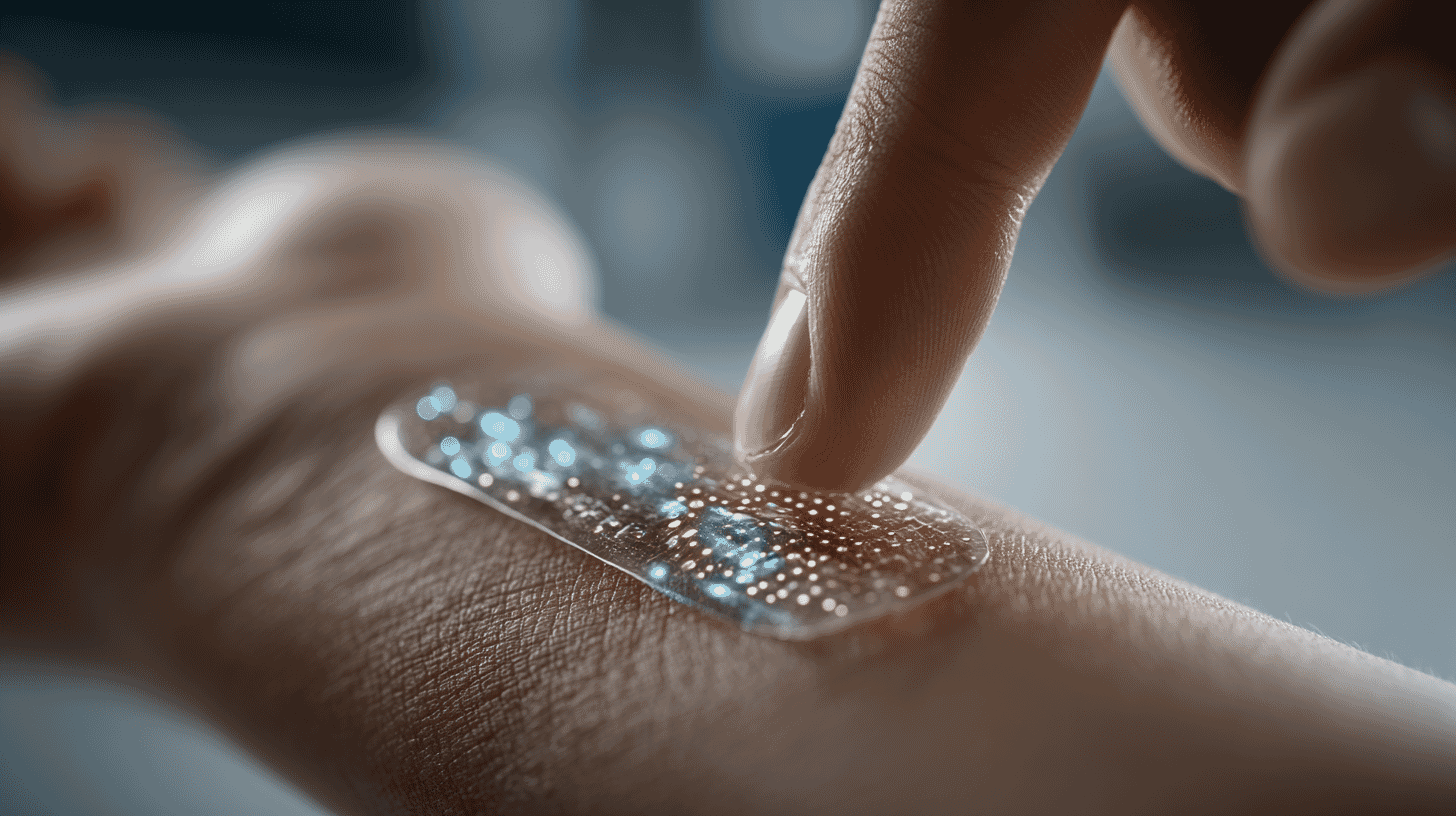
Scared of needles? You might never need one again for your vaccine. A team at the University of Tokyo and partners has developed a microneedle patch that delivers COVID-19 vaccines just by sticking it on your skin. Little pain, room-temperature shipping, self-application: that is the device the team is aiming for. After roughly 170 years of the syringe, the way we get vaccinated may be about to change.
What Is a "Stick-On Vaccine"? The Basics of Microneedle Technology
A microneedle is exactly what it sounds like: an incredibly tiny needle, just a few hundred micrometers long (a fraction of a millimeter), arranged in arrays on a small patch. These needles are so short they don't reach the pain receptors in your skin, meaning you barely feel anything when the patch is applied.
Hyaluronic acid beauty patches, popular in Japanese skincare, already use the same basic idea. This research applies the principle to vaccine delivery.
What makes the skin such an attractive target for vaccination is its rich population of immune cells. The outer layers of skin, the epidermis and dermis, contain large numbers of Langerhans cells and dendritic cells, which are essentially the body's first responders for detecting and processing foreign invaders. By delivering vaccine antigens directly to these cells, microneedle patches can potentially trigger a stronger immune response than traditional intramuscular injections, which deposit the vaccine deep in muscle tissue far from these immune sentinels.
The Tokyo Innovation: A "Pillar-Guided" Patch Design
The research was led by a collaborative team including Professor Beomjoon Kim, Assistant Professor Jongho Park, and Technical Specialist Hoshimi Aoyagi from the University of Tokyo's Institute of Industrial Science, along with graduate student Kotaro Shobayashi from the Graduate School of Engineering, and researchers Michinori Kohara and Fumihiko Yasui from the Tokyo Metropolitan Institute of Medical Science.
While the idea of delivering vaccines through microneedles has existed for years, three major technical barriers had prevented it from becoming practical.
First, it was extremely difficult to load vaccine solution precisely into just the tips of the microneedles. When the solution spread to other parts of the needle structure, the dose delivered to the skin became unpredictable. Second, the lengthy drying process required during manufacturing caused significant loss of viral potency, with the virus dying before the patch was ever used. Third, valuable vaccine material would diffuse into the backing layer of the patch, resulting in wasted doses.
The team solved all three problems at once by designing what they call a "Pillar-Guided Microneedle Array Patch" (PG-MAP). Using a 3D printer, they created a backing layer with a series of tiny plastic pillars. Think of it as inserting popsicle sticks into a mold: each pillar guides the vaccine solution so it concentrates only at the needle tips rather than spreading throughout the structure.
The vaccine loaded onto the patch is a recombinant vaccinia virus (r-DIs-S) carrying a SARS-CoV-2 antigen gene, developed by Michinori Kohara's group at the Tokyo Metropolitan Institute of Medical Science. Vaccinia is the strain used for smallpox vaccination and the origin of the word "vaccine."
Historically, vaccinia vaccines were given with a bifurcated needle: a fork-tipped needle that holds a droplet between its prongs and is jabbed into the skin several times. It was the standard tool of the WHO smallpox eradication campaign in the 1970s. It is also invasive, painful, prone to bleeding, and hard to reproduce in dose and depth. That is part of what a microneedle patch is meant to fix.
8.3x Better: The Numbers Behind the Breakthrough
The pillar-guided design raised tip-loading efficiency to 16.5%, roughly 8.3 times better than conventional molding.
Viral potency retention during manufacturing also improved. Conventional fabrication saw potency fall to 40.4%; the new approach held 50.4%. For the immunogenicity tests, patches were loaded with 9.4 to 11.6 million PFU (plaque-forming units, a measure of infectious virus) each.
Mice vaccinated with the patch showed an antibody response 1.2 times higher than mice given the same vaccine by conventional intradermal injection. In a SARS-CoV-2 challenge model, every mouse that received the patch survived under the experimental conditions used. The institute's own wording is careful: the patch showed a "tendency" toward higher antibody response than injection.
Needle vs. Patch: What's Really Different?
Comparing the two approaches side by side reveals just how transformative this technology could be.
Pain: The thinnest medical injection needles are still about 180 micrometers in diameter, thick enough to trigger pain receptors. Microneedles are comparable to a mosquito's proboscis (roughly 60 micrometers), producing virtually no sensation.
Transportation and Storage: mRNA vaccines used during the pandemic required ultra-cold storage down to -70°C (-94°F), which made distribution to countries with limited cold-chain infrastructure extremely hard. A patch that ships at room temperature would remove that bottleneck. This is the team's stated objective rather than a result of the current study.
Less Dependence on Medical Staff: Injections require trained healthcare workers, a severe bottleneck during mass vaccination campaigns. A patch is intended to be self-applied like a bandage, which would loosen that constraint considerably.
Less Sharps Waste: Used needles create biohazardous waste, pose needlestick injury risks to healthcare workers, and in some countries improper reuse of syringes has spread disease. Dissolving microneedles leave no sharps behind.
Still a Mouse Study
The work was announced on February 5, 2026 and published in Scientific Reports. It was carried out with approval from the University of Tokyo's Life Science Research Ethics Support Office, funded through AMED's UTOPIA young researcher programme and JST SPRING.
The institute states plainly that this is a basic research result in mice, and that human application will require careful examination of safety and ethics along with long-term research. It is too early to name a timeline.
However, the global microneedle vaccine field is advancing rapidly. Australia's Vaxxas has been running clinical trials of an influenza microneedle patch, with reports of strong immune responses at reduced doses. In the United States, BARDA (Biomedical Advanced Research and Development Authority) has been supporting the development of microneedle patch-based vaccines. Governments are beginning to take the technology seriously.
In Japan itself, several research groups are pursuing microneedle vaccine studies, with some reporting comparable antibody levels at lower doses than standard subcutaneous injection.
In his comment accompanying the announcement, Kim said that a vaccination technology able to travel at room temperature would make it easier to reach countries and regions without adequate medical infrastructure, moving toward a society where everyone benefits from vaccines equally. Shobayashi, the graduate student who led the paper, said the pandemic is what turned his attention to equitable vaccine access.
A Needle-Free Future, Made in Japan
The hypodermic syringe was invented roughly 170 years ago, and the fundamental method of vaccine delivery has remained largely unchanged since then. Now, researchers in Tokyo are working to rewrite that story.
Professor Kim's team envisions applying this technology not just to COVID-19, but eventually to influenza and other infectious diseases. Microneedles aren't simply "painless injections." They represent a potential transformation of the entire vaccine value chain, from manufacturing to distribution to administration.
Needle fear is often dismissed as a children's problem. It affects a meaningful share of adults too, and researchers have pointed to it as one contributor to vaccine hesitancy. A stick-on vaccine would lower that barrier.
Vaccination without a syringe. The first step has been taken, in a lab in Tokyo.
What vaccination challenges exist in your country? Do you think a painless stick-on vaccine would change people's willingness to get immunized?






Global Discussion
15 comments