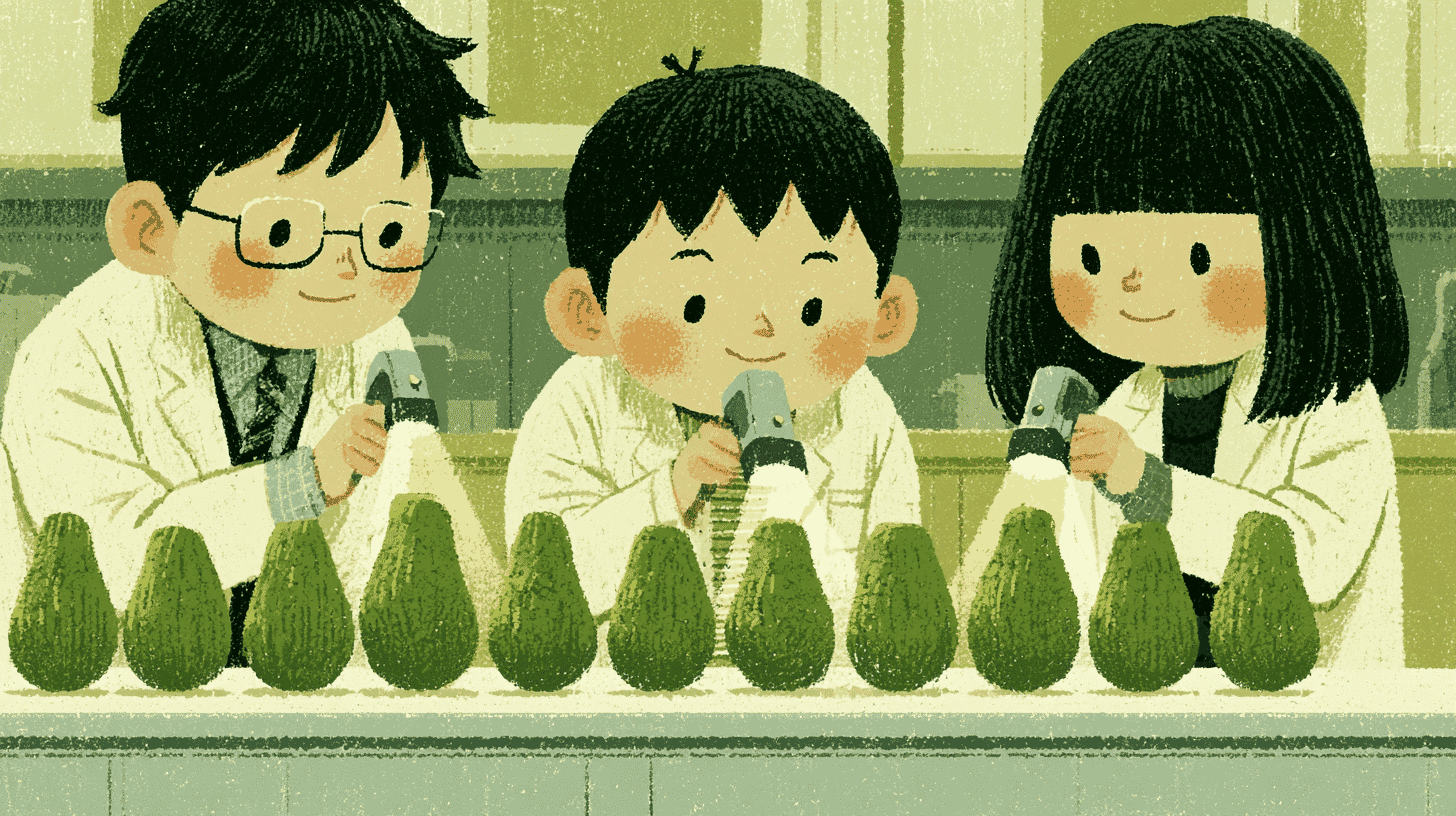
🥑 "I should have waited another day." That tiny moment of disappointment, the instant you cut into an avocado a touch too early or a touch too late, turns out to be universal. What if you could see past the skin before slicing? A group of students at a rural Japanese university, who call themselves the "Avocado Squad," just published a method that does exactly that. And it doesn't only tell you whether the fruit is ready now. It tells you when it will be.
A student squad takes on a quietly global problem
The research came out of the Crop Physiology Lab at Akita Prefectural University, in northern Japan. Under Professor Atsushi Ogawa, three fourth-year students from the Faculty of Bioresource Sciences, Masaru Terakado, Rento Chiba, and Ryoei Nakadate, formed a self-styled group called Avocado Tankentai, which translates roughly as the "Avocado Exploration Squad." They have been at this since their freshman year. The paper also lists Nana Yamamoto of OAK Co., Ltd. as a co-author.
Their paper landed on April 1, 2026 in MDPI's AgriEngineering, with the unglamorous title "A Practical Approach for Predicting Avocado Ripeness Using a Portable Vis-NIR Device and Sensory-Based Indexing Under Various Storage Temperatures." The problem they tackled is anything but unglamorous, though. One industry estimate cited in the paper suggests roughly one-third of avocados purchased for home use are discarded, primarily because of bad ripeness timing, and another 5–15% are wasted at retail and food service.
For a crop the FAO recorded at 10.5 million tons produced globally in 2023, that is not a rounding error. Avocado farming is water-thirsty and the fruit travels far. Every discarded one is wasted irrigation, wasted shipping fuel, wasted shelf space. Hence the steady search, in agricultural engineering circles, for a reliable way to read ripeness without slicing the fruit open.
What the skin can tell you, in the right wavelengths
The Avocado Squad's setup is, charmingly, the opposite of imposing. Two palm-sized portable spectrometers, one covering the visible range (400–700 nm), one covering near-infrared (900–1700 nm), point at the avocado's skin and measure how light bounces back. Each fruit is sampled at three random spots on the peel; both devices have built-in light sources, so the test happens at ordinary indoor temperature.
The idea: the chemistry of ripening changes how the skin reflects different wavelengths. By reading the curve, you can read the fruit's state without ever touching the flesh.
After running 67 Hass avocados through the system, each scored on a sensory panel of 13 university members, the team built a partial least squares regression model and then trimmed it down to a remarkably short list of useful wavelengths. Six bands carried the signal: 570, 977, 1120, 1161, 1398, and 1655 nanometers. Each one has a physical story:
- 570 nm corresponds to the absorption band of chlorophyll, that is, the green color of the skin fading as the fruit ripens.
- 977 nm and 1398 nm sit on the O-H water bands, reflecting how moisture redistributes inside the fruit.
- 1120, 1161, and 1655 nm track the C-H bonds of fats, the oil that accumulates in the flesh as a Hass avocado ripens.
Three signals, color loss, water shifts, oil buildup, read through the skin in seconds. Those, conveniently, are exactly the three things that determine an avocado's eating quality.
A simplified six-wavelength model reached an RPD (residual predictive deviation) of 1.43, which in this field is the territory of "acceptable for preliminary screening", strong enough to sort unripe from ready-to-eat from over-ripe, not yet strong enough for precise grading. The authors are clear that a commercial handheld would need a larger, more varied dataset. Still, the proof-of-concept holds.
The trick: predicting when it will be ripe
The truly useful piece of the paper, the one that turns this from a curiosity into a logistics tool, is the temperature-dependent half.
The team took another 25 avocados and stored five of them at each of five temperatures, 15, 20, 25, 30, and 35 °C, for two days, tracking ripening progress. The relationship between storage temperature and the daily increase in ripeness followed a logarithmic curve with a correlation of 0.9965. That is unusually clean for biological data.
Translated into kitchen terms: an unripe fruit (ripeness index 3) stored at 25 °C reaches its peak (index 5) in about 1.1 days, while the same fruit at 15 °C takes about 3.1 days. And by extrapolating the curve, the team found a striking threshold: ripening progression is essentially suppressed at temperatures of approximately 12 °C or below.
That 12 °C number is the long-suspected sweet spot put on the page with a coefficient. Refrigerator vegetable drawers are too cold; room temperature is too warm. The right number sits in the middle, and now, with a portable reader giving you the current state, distributors can in principle dial in arrival ripeness from the moment a shipment leaves the warehouse.
A $10,000 problem with a $500 answer
What lifts this study out of the academic-niche category is the cost gap it implies.
High-precision lab spectrometers run well past $10,000, the paper notes, and they don't move. The portable devices the team used to read each fruit are nothing like that. From there, the authors take one more step: with only six wavelengths actually carrying the signal, a multispectral approach using key wavelengths could plausibly be built for under $500, in the form of a small LED-based reader.
That price tag matters. Ten-thousand-dollar instruments stay in labs. Five-hundred-dollar tools sit on retail shelves, in warehouse aisles, in farmer co-op offices in producing countries. A device that travels with the fruit is a different kind of device.
Funding for the work, incidentally, came from no external source, the paper notes the research received no outside funding. Three undergraduates and one professor took the idea from freshman year through to a special issue on post-harvest food-loss technology, on no grants. Whatever else this is, it is a notably clean origin story.
A patent application has been filed. According to Akita's local paper, the Sakigake Shimpo, the team is now actively looking for industry partners to commercialize the work.
"We think the same idea could work for other fruits"
The closing line of the paper points outward. The authors suggest the same framework should apply to other climacteric fruits like mangoes and papayas, which share the same fundamental ripening biology.
A quick distinction worth holding onto: fruits split roughly into two camps. Climacteric fruits, avocado, banana, mango, papaya, melon, apple, pear, keep ripening after harvest by producing the plant hormone ethylene. Non-climacteric fruits, grapes, citrus, strawberries, must ripen on the plant. The Avocado Squad's approach is naturally suited to the first group, which happens to include almost every fruit that gives you the same "did I time it right?" anxiety as avocado.
So somewhere on the road from Akita to your kitchen, perhaps via a Mexican packing house, perhaps via a Tokyo supermarket, that quiet little anxiety might one day end at a $500 handheld.
The clever methodological move
One more detail worth pausing on, because it shows what makes this paper distinctive among non-destructive fruit studies.
Most prior work in this field treats firmness, oil content, or dry matter as the "ground truth", physical measurements the instrument is trying to predict. The Avocado Squad instead used the score given by a human sensory panel as the reference. The reason becomes obvious from Figure 3 of the paper: at a firmness of around 2 kgf/cm², the same physical hardness corresponded to ripeness scores ranging from 3 (unripe) all the way up to 7 (overripe). Firmness, in other words, is a leaky proxy for how an avocado actually eats.
By anchoring the model to taste judgments rather than mechanical properties, the team aimed at what the buyer actually cares about. If this technology ever scales, what it will be reading, through the skin, is essentially a consensus of consumer tongues.
In Japan, the avocado went from "exotic import" in the 1990s to a default item on supermarket shelves in about two decades. The mystery of when to eat one, though, never quite resolved. Japanese social media has a recurring genre of "lost the avocado lottery again" posts, complete with photos of black flesh.
If you live somewhere with a longer avocado history, Mexico, the U.S., Spain, the U.K., Australia, your relationship with this fruit may run deeper, but the timing problem is probably no less familiar.
So a couple of honest questions, before we close. What fruit in your part of the world would you most want a "ripeness reader" for? And if a 500-dollar handheld really did show up in supermarkets, would you reach for one, or just go on trusting your thumb?
Note
Prices in dollars follow the paper. Yen equivalents in the Japanese edition use the exchange rate at the time of writing, 159 yen to the dollar.








Global Discussion
5 comments