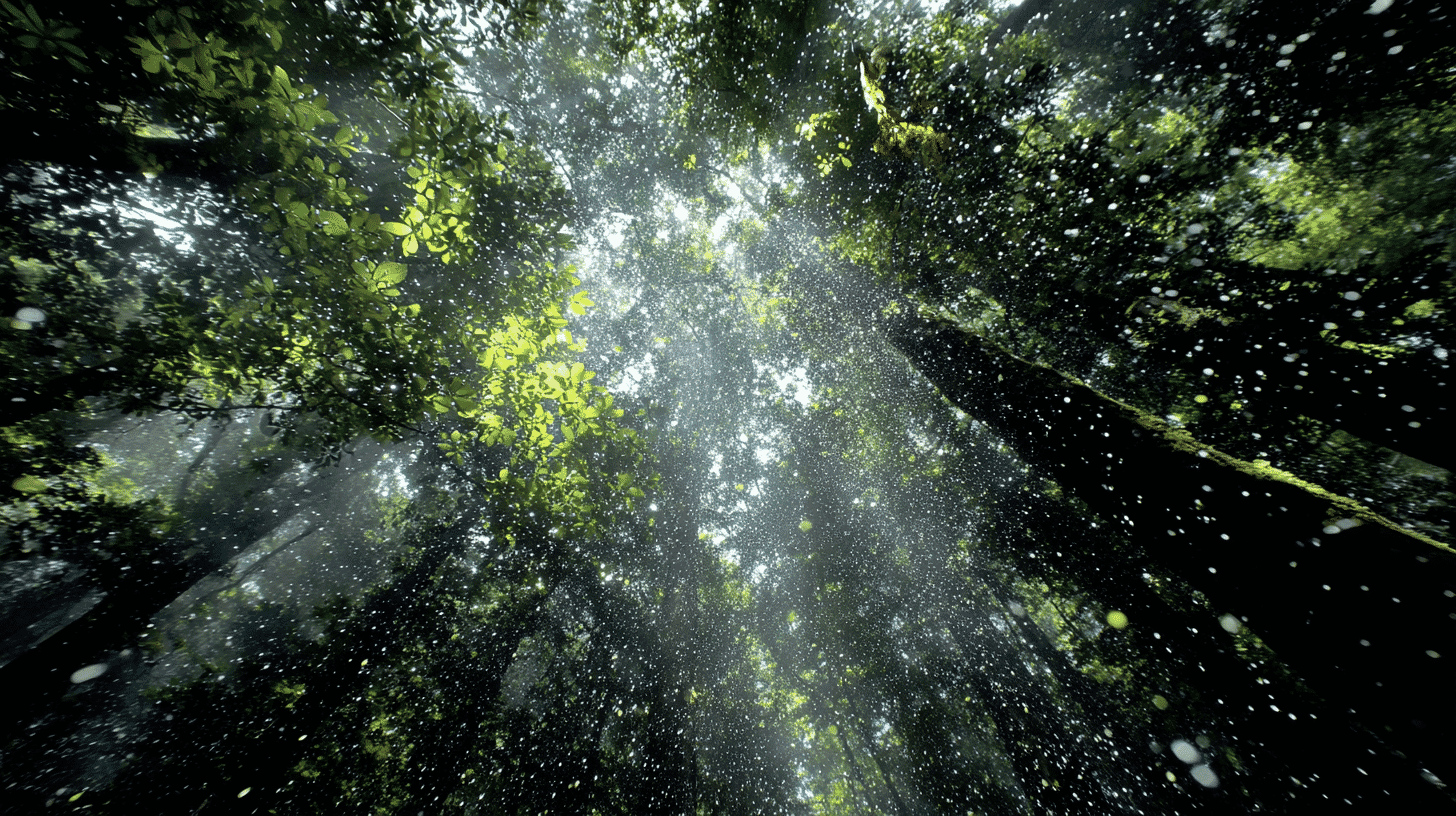
The microplastic crisis isn't just an ocean story anymore. Tiny plastic particles drifting through the air are landing on forest canopies, washing down with rain and fallen leaves, and accumulating deep in the soil. Groundbreaking research from Germany and Japan has revealed that forests have become "hidden reservoirs" of airborne pollution. For Japan, where 67% of the land is covered in forest, the implications are enormous.
This article is a sequel to our previous report on ocean microplastic pollution near Japan (27 times the global average), expanding the story from the sea to the land.
German Study Proves How Forests Become Contaminated
In August 2025, geoscientists at TU Darmstadt in Germany published a landmark study in Nature Communications Earth & Environment. Analyzing samples from four forest sites east of Darmstadt, they provided the first scientific proof that most microplastics in forest soil come from atmospheric deposition, not from local sources like litter or agriculture.
The mechanism works like this: airborne microplastics (AMPs) carried by wind reach the forest canopy, where leaves act like combs, filtering particles from the air. Researchers call this the "comb-out effect." Once trapped in the canopy, these particles are washed to the ground by rain or carried down with autumn leaf fall. On the forest floor, the breakdown of fallen leaves buries the plastic particles deeper into the soil, where they accumulate over long periods.
The numbers are striking. Forest soils contained between 120 and over 13,000 microplastic particles per kilogram, comparable to urban soils and actually higher than farmland or wetlands. In some areas, concentrations reached nearly one million particles per square meter. The team also built models estimating atmospheric inputs since the 1950s, meaning today's forest soils may already contain over seven decades of accumulated plastic pollution.
Japanese Researchers Cracked the Mechanism First
While the German team established the "what" and "where," Japanese researchers had already revealed the "how" at the molecular level.
In March 2024, a team led by Professor Akane Miyazaki of Japan Women's University and Professor Hiroshi Okouchi of Waseda University published their findings in Environmental Chemistry Letters. Working in a forest on the Japan Women's University Nishiikuta campus in Kawasaki, Kanagawa Prefecture, they collected approximately 150 oak (konara) leaves and analyzed how airborne microplastics attach to them.
Their discovery: AMPs are strongly adsorbed, essentially glued, to a waxy coating on the leaf surface called "epicuticular wax." Standard cleaning methods used in previous international studies (rinsing with ultrapure water or ultrasonic baths) couldn't remove these particles. Only an alkaline treatment the team developed specifically for this purpose could recover them. This means earlier studies worldwide likely underestimated the amount of microplastics on forest leaves.
The team's estimate is staggering: Japan's konara oak forests alone (approximately 32,500 square kilometers) capture an estimated 420 trillion airborne microplastic particles per year through their canopy. That number reflects forests functioning as massive air filters, but also means an enormous volume of trapped plastics eventually reaches the soil through leaf fall.
Why Japan's 67% Forest Coverage Matters
Japan's total land area is approximately 37.8 million hectares, of which roughly 25 million hectares is forest. That puts Japan's forest coverage rate at about 67%, third among OECD nations after Finland and Sweden, and more than double the global average of around 31%.
Combined with the TU Darmstadt findings, this means Japan's vast forests are functioning as a continent-scale "sink" for airborne microplastics. Decades of plastic particles have likely been accumulating in forest soils across the entire archipelago.
There's another dimension that makes Japan's situation particularly concerning. As we reported in our previous article on ocean microplastics, microplastic concentrations in Japan's coastal waters are 27 times the global average. Research by Professor Okouchi's team at Waseda has confirmed that ocean microplastics can be launched back into the atmosphere through sea spray and wave action. This creates a cycle: sea to air, air to forest. Japan may face a "double burden", receiving airborne plastic particles from both atmospheric transport and marine re-emission.
Forests as Environmental Indicators
One of the most intriguing findings from the TU Darmstadt study is that forests can serve as natural indicators of atmospheric pollution.
Unlike farmland (which receives plastic directly from fertilizers and plastic mulch) or cities (tire dust, litter), forests have almost no local plastic sources. This means the microplastic concentration in forest soil directly reflects how much plastic pollution is in the air above. Dr. Collin J. Weber, the study's lead author, concluded that forests function as reliable gauges of "diffuse" atmospheric pollution, as opposed to "direct" input from human activities nearby.
In practice, this could revolutionize environmental monitoring. Instead of expensive atmospheric sampling stations, researchers could analyze forest soil samples to reconstruct long-term trends in airborne microplastic levels for any region.
Climate Change and Microplastics: A Compound Threat
Dr. Weber warned that forests already face enormous pressure from climate change, and microplastic accumulation may add yet another layer of stress.
The concerns are multifaceted. Plastic particles may disrupt microbial communities in the soil, interfering with nutrient cycling that trees depend on. Microplastics can also leach chemical additives into surrounding soil. Additionally, soil organisms like earthworms, essential for decomposition and soil health, may ingest microplastics, with cascading effects throughout the ecosystem.
If forests weakened by drought and heat are further undermined by soil contamination from microplastics, the result could be a dangerous feedback loop. Forests currently absorb roughly 30% of human-caused CO₂ emissions. Any reduction in that capacity would accelerate the very climate change that is already threatening them.
European and Japanese Research Compared
Germany and Japan are leading the world in forest microplastic research through complementary approaches.
The TU Darmstadt study (2025) is a macro-scale investigation, establishing how much plastic accumulates where, and proving the atmospheric pathway through field data and modeling. The Japan Women's University / Waseda study (2024) operates at the micro-scale, revealing the molecular mechanism by which leaf surfaces capture airborne particles. Together, the European work answers "how much and where" while the Japanese work answers "how and why."
Meanwhile, a Cardiff University and University of Manchester study estimated that European farmlands receive 31,000 to 42,000 tonnes of microplastics annually through sewage sludge fertilizer, concentrations comparable to ocean surface waters. This underscores that terrestrial soils, not just oceans, may be the planet's largest microplastic reservoirs.
Our previous report showed that Japan's oceans contain 27 times the global average of microplastics. Now the stage has expanded: from the sea to the sky, and from the sky to the forest. Japan is positioned to be a microplastic "hotspot" on both land and sea, a country where invisible plastic particles are quietly infiltrating what many consider nature's last refuge.
Does your country have discussions about forest pollution from airborne microplastics? Are there any measures being taken to address atmospheric plastic contamination? We'd love to hear what the situation looks like where you live.
References
- https://www.nature.com/articles/s43247-025-02712-4 (TU Darmstadt - Forest soils accumulate microplastics through atmospheric deposition)
- https://www.sciencedaily.com/releases/2026/03/260323005535.htm (ScienceDaily - Microplastics are falling from the sky and polluting forests)
- https://www.waseda.jp/inst/research/news/76900 (Waseda University - First proof that forests capture airborne microplastics)
- https://univ-journal.jp/243249/ (University Journal Online - Japan Women's University demonstrates forest microplastic capture)
- https://tabi-labo.com/312471/worldtrend-micropla-forest (TABI LABO - Invisible plastic falling on forests)
- https://kantenna.com/topic/japan-microplastic-concentration-27-times-world-average (Related: Microplastic Levels 27x the Global Average in Japan's Oceans)









Global Discussion
14 comments