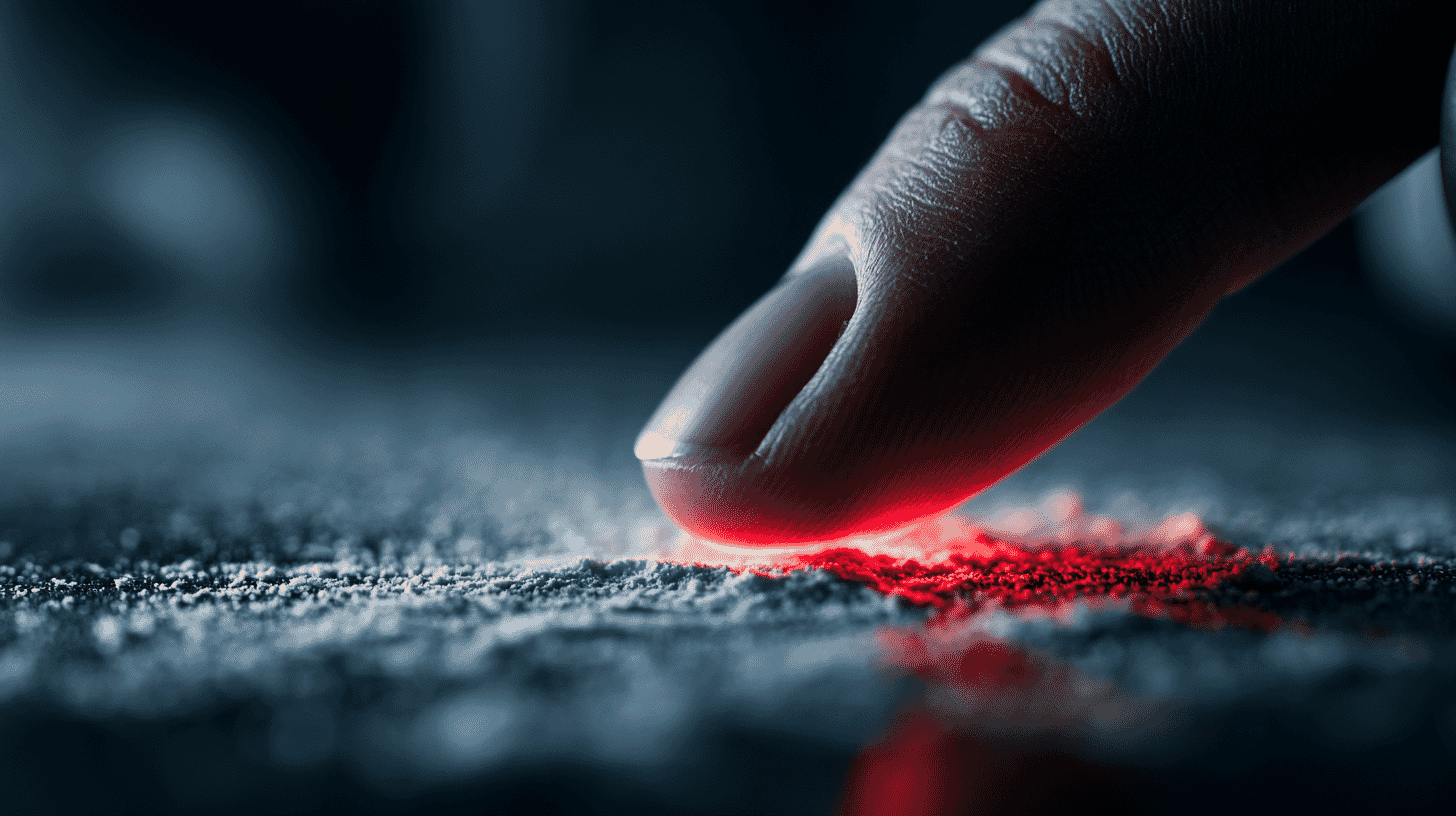
✨ No battery. No plug. No rare metals. Just press it with your fingertip, and the material glows with light your eyes can't even see.
It sounds like a magic trick. It's actually a speck of zinc oxide, the same harmless white powder that's in your sunscreen, re-engineered by a team in Japan to turn a gentle touch into near-infrared light. And the reason that matters reaches all the way from the inside of your body, to the bridges you drive over, to one of the tensest supply-chain fights on the planet.
Press here, and something invisible happens
Materials that turn force into light aren't new. The effect is called mechanoluminescence, and Japan has deep roots in it: Chao-Nan Xu, now a professor at Tohoku University, first demonstrated a repeatable version of it back in 1999. Squeeze, bend or scratch the right crystal and it flashes.
The catch was always the "squeeze" part. To get a bright, useful glow, older materials typically demanded two things most people would rather avoid: rare-earth elements baked into the recipe, and brute force: pressures on the order of a gigapascal, the kind of crushing load you'd associate with an industrial press, not a fingertip.
Xu's group, working with the University of Tsukuba and Saga University, set out to dodge both. They landed on plain zinc oxide (ZnO), cheap, abundant, and so benign it's already in cosmetics, sunscreen and skin ointments. Using what they call "defect engineering," they tuned the material's electronic structure at the nanoscale and added only a trace of sodium.
Under an electron microscope, the particles turned out to be covered in tiny crater-like pits. That rough surface, the team believes, soaks up an outside force and funnels it into internal strain, which is what makes the glow so easy to trigger. Calculations on Tohoku's MASAMUNE-弐 (MASAMUNE-Two) supercomputer filled in the rest of the story: the sodium creates a stable defect that briefly stores electric charge, and the near-infrared light itself comes from spots where zinc atoms are simply missing from the crystal, what physicists call "zinc vacancies." As a bonus, the tweaked oxide behaves as a p-type semiconductor, a trick that's notoriously hard to pull off with ZnO.
The payoff: the material lights up clearly at just a few kilopascals, roughly the pressure of a soft fingertip press. That's orders of magnitude gentler than the gigapascal-class forces older materials demanded. The paper is titled, fittingly, "Stress-to-Light Conversion in an Earth-Abundant Oxide Semiconductor," and it ran in the journal Advanced Science in May.
Making the invisible visible
Here's where the parlor trick starts to matter.
The glow peaks around 750 nanometers, in a band scientists call the "first biological window": wavelengths that slip through skin and muscle relatively easily. So picture this: a tiny amount of the material somewhere inside the body, and a pulse of ultrasound from outside gently "pressing" it. No wires, no implanted battery, just sound going in and faint light coming out, carrying information about what's happening in there. The team frames it as a building block for a new kind of power-free medical sensor.
Now scale it up. Paint the same material onto a bridge girder or the blade of a wind turbine. The strains that eventually crack steel and composite are invisible until they're a problem. A coating that lights up exactly where stress concentrates would let an inspector, or a passing drone, literally watch trouble forming before the first crack appears. Same idea, wildly different scale: from the inside of a single cell to a kilometer of highway.
That's the throughline. A material that converts a force you can feel into light you can't see, so that engineers and doctors can finally see the things that have always stayed hidden.
A quiet answer to a very loud problem
And then there's the part that drops the lab demo straight into today's headlines.
Most of the high-performance glowing materials the world relies on lean on rare-earth elements: the phosphors in older mechanoluminescence research, persistent "glow-in-the-dark" pigments and a great many near-infrared emitters all use terbium, europium, dysprosium and their cousins. Which is awkward, because those are exactly the elements at the center of the global supply standoff.
China processes roughly 90% of the world's rare earths, and since April 2025 it has required case-by-case licenses for seven medium and heavy rare earths: samarium, gadolinium, terbium, dysprosium, lutetium, scandium and yttrium. A broader second wave of controls announced in October 2025 was suspended for a year, but that pause is set to lapse on November 10, 2026. Prices have lurched (yttrium reportedly spiked several times over), and governments have started playing hardball: Australia moved in May 2026 to push Chinese investors out of its domestic rare-earth mines.
Against that backdrop, a glowing material whose entire ingredient list reads "zinc oxide plus a pinch of sodium" is more than a chemistry curiosity. It's a small, quiet way of stepping out of the line of fire. The team explicitly pitches earth-abundant elements as a route to "sustainable material design that doesn't depend on expensive resources." Materials science rarely shares a front page with trade wars, but this is one of those rare cases where the lab is answering the headline.
Where Japan is actually out front
It's worth being precise about the claim, because mechanoluminescence is a crowded, international field, and a lot of the fastest-moving work is in China. Recent advances there and elsewhere have produced genuinely impressive infrared emitters, but many of them buy their performance the traditional way, by doping with lanthanides. Workhorse systems like CaZnOS tuned with terbium and samarium, the classic SrAl₂O₄:Eu,Dy persistent phosphor, even 2025 work on chromium-sensitized lanthanide emitters reaching deeper into the infrared: all of them, in one way or another, spend rare earths to buy brightness.
The Tohoku result points the other way: comparable usefulness from an earth-abundant oxide, at fingertip pressures, with no rare earths at all. That's the lane this work is staking out: not "brighter at any cost," but "good enough without the scarce stuff." Whether it scales is the open question, and the honest answer is that nobody knows yet. The group is now handing samples to companies and research partners to push toward real devices.
So, over to you
A pinch of the white powder from sunscreen, re-tuned until a fingertip makes it whisper in infrared. It's a small light. But it might end up shining on tumors, on cracking bridges, and on a dependency that's been keeping trade negotiators awake at night.
In your country, how do you keep an eye on the slow, invisible decay of aging infrastructure? And how much does the rare-earth squeeze actually come up in everyday conversation? I'd genuinely like to know.






Global Discussion
0 comments