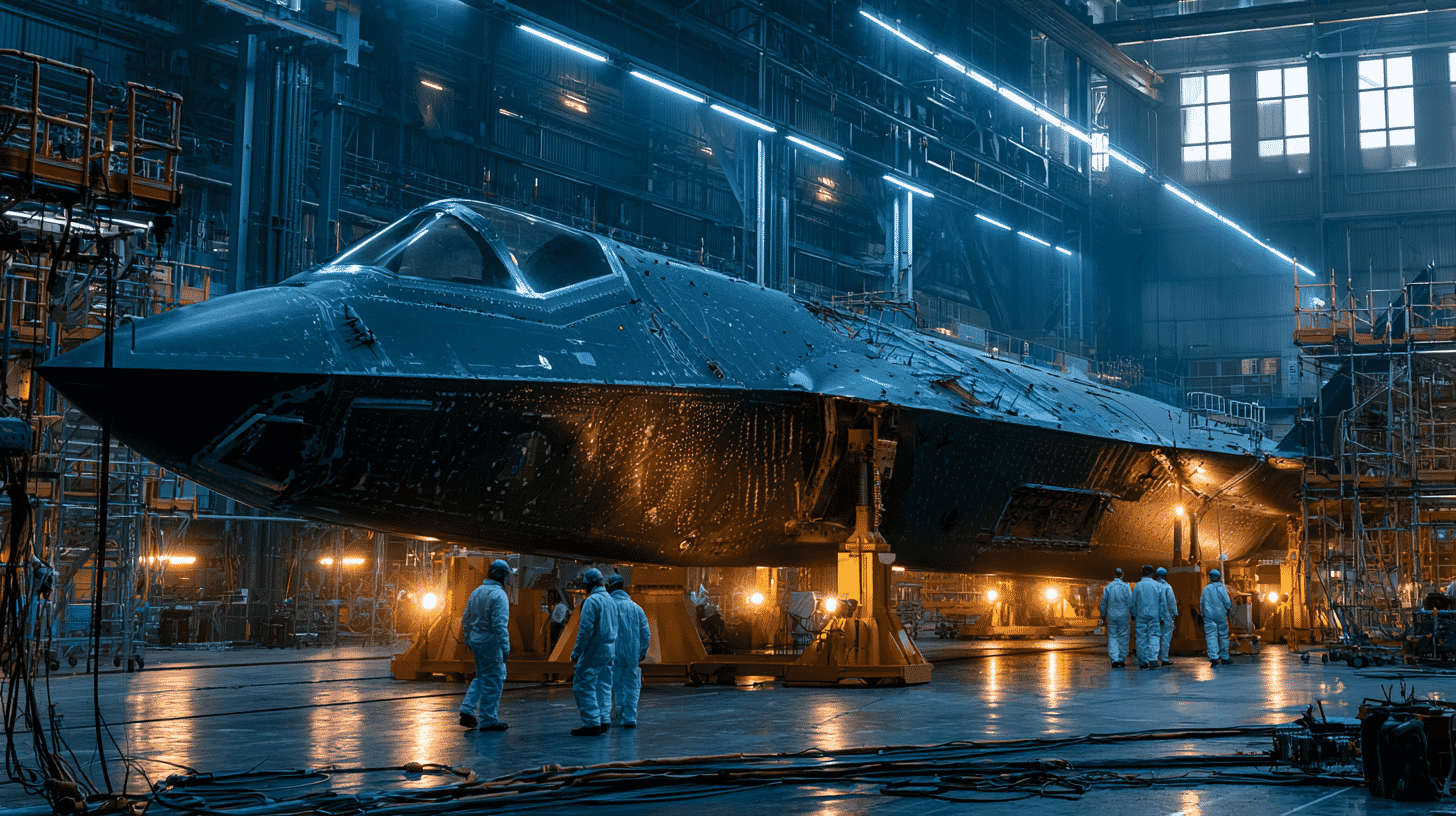
🛩️ In the corner of a fighter factory in Lancashire, England, sits a fuselage that engineers have nicknamed "the cigar." It's three-quarters of a jet that will shape the aircraft defending Japan's skies from 2035, the demonstrator for GCAP, the sixth-generation fighter Japan, the UK and Italy are building together. In mid-June, BAE Systems let reporters see it for the first time. What struck them first wasn't the stealth shaping. It was the sheer size of the thing.
The Jet They Call "the Cigar"
The reveal happened quietly. BAE Systems invited a small group of aviation and defense journalists, outlets like Aviation Week, FlightGlobal and the Royal Aeronautical Society, to its Samlesbury plant in northwest England, where the demonstrator (BAE calls it the Combat Air Flying Demonstrator, or CAFD; trade press also uses FCAD) is taking shape in a corner of the same facility that builds Eurofighter Typhoon sections.
What they saw: the front, center and rear fuselage of an aircraft that is now roughly 75% manufactured by volume, with its major structural sections having been in production for the past 12 to 18 months. BAE is targeting a rollout by the end of 2027, with flight testing to follow.
Later this year, according to BAE, the fuselage, that's the "cigar", will travel by road to the company's Warton site for final assembly, where it will be mated with wings and twin vertical tails. Three wings and three tails have already been built: two of each for the aircraft, and a spare of each for structural testing. The composite skins, BAE says, are among the largest carbon-fiber structures British aerospace has ever produced.
Tony Godbold, BAE's delivery director for the UK's future combat air effort, described the aircraft as "a critical de-risk program for GCAP", a flying testbed that generates real-world data feeding directly into the design of the actual fighter.
A Third Longer Than a Typhoon

Source: Royal Aeronautical Society (@AeroSociety)
The aircraft's exact dimensions remain officially secret. But based on what reporters were shown, Aviation Week estimates the demonstrator is at least one-third longer than the Eurofighter Typhoon, making it the largest aircraft assembled in the UK since the Nimrod MRA4 patrol plane.
Do the math and the scale becomes vivid. A Typhoon is about 16 meters long, so a third longer puts the demonstrator past the 20-meter mark, bigger than an F-22 (18.9 m), far bigger than an F-35A (about 15.7 m), and in the same size class as Russia's Su-57 (20.1 m). Its wingspan will exceed the Typhoon's 10.9 meters, on a planform BAE describes as a "cropped delta," which some reports render as a double delta. And the production GCAP fighter is expected to be larger still.
Why build a fighter this big? The fuselage itself answers the question. Two deep internal weapons bays sit just ahead of the main landing gear, large enough, according to Aviation Week's reporting, to carry roughly double the internal load of an F-35, with room for missiles of a larger diameter. Add the internal fuel a fuselage this long can hold, and the design priorities are easy to read: fly farther and carry more, without external stores that would wreck the stealth profile. For Japan, whose fighters cover vast stretches of the Pacific where aerial tankers may not survive a real conflict, those two qualities sit at the very top of the requirements list.
The stealth engineering shows in the details, too. Serpentine air intakes, curved ducts that hide the radar-reflective engine fans, run through much of the airframe's length, which BAE describes as one of the build's toughest integration challenges. The twin vertical tails may approach the size of those on the Panavia Tornado, an aircraft British crews nicknamed "The Fin."
A Demonstrator, Not the Fighter Itself
One distinction matters here: the demonstrator is not a GCAP prototype. It's a UK national project designed to rebuild skills the country hasn't exercised in four decades, Britain hasn't flown a domestically designed combat jet since the EAP demonstrator, which first took off on August 8, 1986, broke the sound barrier that same day, and paved the way for the Typhoon. It is meant to do for GCAP exactly what EAP did for the Typhoon, almost 40 years to the day later.
That's why it will fly with two EJ200 engines borrowed from the Typhoon, fitted with modified nozzles, rather than the new powerplant being co-developed by Japan's IHI, Rolls-Royce and Italy's Avio Aero. The cockpit uses a sidestick controller and a single large-area display. Test pilots have already logged more than 300 hours in the simulator, and much of the fly-by-wire software is being generated by automated coding tools. BAE is also putting the aircraft through military airworthiness certification from scratch, a first for the company. Planned trials include validating stealth techniques in actual flight and firing a missile from the internal weapons bay. Godbold says the effort has already saved years of development risk on the main program.
Japan, incidentally, knows this playbook well. Mitsubishi Heavy Industries flew the X-2 Shinshin demonstrator back in 2016, testing the stealth shaping and composite materials that now feed into Japan's contribution to GCAP. The actual GCAP fighter is being designed by Edgewing, the joint venture of BAE Systems, Leonardo and Japan's JAIEC, against a schedule dictated by Tokyo: the F-2 fleet retires around 2035, so the new jet must be operational by then, roughly half the time it took to field the Typhoon.
Rivals: America Races Ahead, Europe Falls Apart
How does this stack up against the other sixth-generation programs? The contrast could hardly be sharper.
The United States is furthest along, and the most secretive. Boeing won the F-47 contract in March 2025, and the first airframe is already in production in St. Louis, with the Air Force targeting a first flight in 2028. The service plans to buy at least 185 jets with a combat radius beyond 1,000 nautical miles and speeds above Mach 2. Classified X-planes supporting the program have reportedly been flying since 2019, though no genuine photograph of the F-47 has ever been released.
Europe's FCAS went the other way entirely. On 8 June 2026, German Chancellor Friedrich Merz confirmed that the joint Next Generation Fighter at the heart of the Franco-German-Spanish program was dead, having conveyed the decision to President Macron two days earlier. Defense Minister Boris Pistorius formally announced the end of the nine-year effort on 9 June and said the outcome surprised no one. Nine years after launch, a program with ambitions in the €100 billion class ended without a single prototype ever being built, sunk by a leadership fight between Dassault and Airbus and by requirements that never really matched, France needed a carrier-capable, nuclear-armed jet, Germany wanted an air-superiority fighter. The program's combat cloud and drone elements survive, while defense media report that German industry is exploring alternatives, including an Airbus-led consortium with Sweden's Saab; some in Berlin have even floated joining GCAP.
Which leaves GCAP in a distinctive position: of the three Western programs, it's the only one whose airframe journalists can walk around and photograph. Not as far along as the F-47, but with real hardware, a functioning three-nation structure, and a delivery clock fixed by Japan's F-2 retirement, the first fighter Japan has ever co-developed without the United States.
Next Stop: A 2027 Rollout
The milestones from here are concrete: fuselage to Warton for final assembly, rollout by the end of 2027, then a first flight that will mark Britain's return to flying its own fighter designs, carrying lessons that flow straight into the jet Japan's pilots will fly from 2035.
Update: the plan has firmed up since publication. At the Farnborough air show in July 2026, a senior BAE executive put the demonstrator's first flight in the "early part" of 2028. In early July the three partners announced a GCAP international development contract worth about £4.6 billion, and on 21 July Canada joined the programme as its first observer.
Japan spent decades buying or licensing American fighters, and its one previous attempt at a homegrown jet, the F-2, ended up as a Japan-US joint project shaped by heavy American pressure. GCAP is the country's bet that three mid-sized powers can build together what none could build alone. How does your country approach that same dilemma? Develop its own weapons, team up with partners, or simply buy off the shelf?
References
- https://aviationweek.com/defense/aircraft-propulsion/bae-combat-air-demonstrator-progresses-critical-gcap-de-risk-efforts
- https://www.flightglobal.com/fixed-wing/2026/06/bae-systems-to-launch-fuselage-final-assembly-on-uks-combat-air-flying-demonstrator/
- https://www.aerosociety.com/news/new-uk-stealth-fighter-demonstrator-takes-shape/
- https://www.af.mil/News/Article-Display/Article/4131345/air-force-awards-contract-for-next-generation-air-dominance-ngad-platform-f-47/
- https://www.defensenews.com/global/europe/2026/03/04/french-german-fighter-program-on-life-support-as-dassault-blames-airbus/
- https://trafficnews.jp/post/683355







Global Discussion
4 comments