🧠 About 30% of people with ADHD get only limited benefit from methylphenidate, a first-line ADHD medicine. A team at Japan's University of Fukui has built mice in which methylphenidate alone did little, and found a drug pairing that did work. The paper also contains a result that neither press release mentions.
A mouse missing one protein in one kind of cell
The study was published in Neuropsychopharmacology on September 15, 2026. The lead author is Min-Jue Xie, an assistant professor at the university's Research Centre for Child Mental Development, working with professor Hideo Matsuzaki and colleagues.
The team looked at the striatum, a region deep in the brain involved in movement control, choosing actions, reward and habit formation. Many of its neurons carry the dopamine D2 receptor, one of the docking points dopamine uses to pass on its signal. The researchers bred mice in which a protein called NSF was switched off only in those D2-carrying cells.
The striatum came out smaller, D2 cells were sparser, and at 21 days old the mice had striatal dopamine about 90% lower than their normal littermates. They were also restless and impulsive. In a test where a mouse is placed on a raised platform, 86% of the modified mice had jumped off by the end of the 7-minute test, against 31% of controls. Researchers call this profile "ADHD-like": a model of certain traits, not a diagnosis.
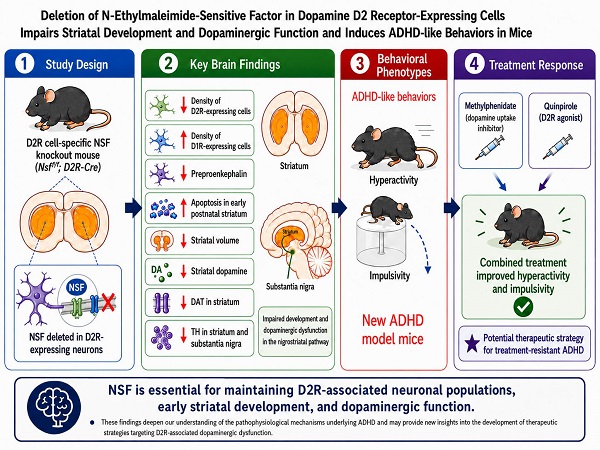
Source: University of Fukui
An old protein with a famous past
According to the Nobel committee's scientific background for the 2013 Nobel Prize in Physiology or Medicine, NSF (short for N-ethylmaleimide-sensitive factor) was the first protein James Rothman purified while working out how cells move cargo around in tiny membrane bubbles called vesicles. That machinery is also what brain cells rely on to release chemical messengers.
In this study, that old, essential piece of cell machinery turned out to matter for maintaining one group of dopamine-sensing cells while the young brain develops. Earlier lab-dish experiments had shown NSF binds to the D2 receptor. What the Fukui team added was a test in a living animal.
It is also not the first time this group has tied NSF to a developmental condition. The paper notes that the same team earlier reported that mice with only half the normal amount of NSF showed autism-like behaviors.
When methylphenidate alone wasn't enough
Given on its own, methylphenidate barely dented the modified mice's hyperactivity, and the change was not statistically significant. The team then added quinpirole, a compound that switches on D2 receptors. Quinpirole alone produced only a modest reduction. Given together, the two calmed the mice down, and the share of modified mice jumping off the platform fell from 78% to 11%.
The authors frame the pairing as complementary: the stimulant raises the amount of available dopamine, and the second drug targets the receptor problem directly.
Quinpirole is a lab compound, used in rodent behavior studies since at least 1989, and has never been approved as a medicine. Xie was careful in the English press release, calling the work basic research that won't turn into a new treatment any time soon.
The same combination, the opposite effect
The researchers also gave the combination to normal mice. In this experiment, before treatment, 78% of the modified mice jumped off the platform compared with 9% of the normal ones. After the two drugs, the modified mice dropped to 11% and the normal mice rose to 60%. The normal mice's time before the first jump roughly halved, from about 408 seconds to about 202.
Our reading, not the authors' wording: whether this approach helps or harms depends heavily on what is going on in the individual brain.
The authors are upfront about other limits. The activity test with the combination used 9 mice per group. In females there were too few animals to detect a significant effect. They also write that the links between the lost cells, the low dopamine and the behavior have not been shown to be causal, and that why the combination works remains undefined.
Approved drugs that work like quinpirole carry a warning
If this idea ever reaches people, it would need a medicine that stimulates D2-type receptors. The paper does not propose one. Approved drugs that do this include dopamine agonists such as pramipexole and ropinirole, used for Parkinson's disease and restless legs syndrome.
Those drugs come with a well-documented catch. In a 2010 study of 3,090 people with Parkinson's in the US and Canada, impulse control disorders such as problem gambling, compulsive buying and binge eating were found in 17.1% of dopamine agonist users versus 6.9% of non-users. A review of adverse event reports filed with the FDA between 2003 and 2012 found 710 such cases linked to dopamine agonists, 410 for pramipexole and 188 for ropinirole. Japan's own label for pramipexole warns of pathological gambling and compulsive buying, asks doctors to explain these risks to patients and families, and notes that no clinical trials in children have been done in Japan.
For a condition defined partly by impulsivity, and one whose symptoms often begin in childhood, that history is hard to wave away. Any real treatment would likely need a way to identify patients whose D2 system is the problem before giving them anything.
Where you live, what happens when the first ADHD medicine doesn't work?
References
- https://www.nature.com/articles/s41386-026-02526-8
- https://www.u-fukui.ac.jp/result/118240/
- https://www.u-fukui.ac.jp/en-research/118238/
- https://www.nobelprize.org/uploads/2018/06/advanced-medicineprize2013.pdf
- https://doi.org/10.1016/0014-2999(89)90837-6
- https://doi.org/10.1001/archneurol.2010.65
- https://doi.org/10.1001/jamainternmed.2014.5262
- https://www.kegg.jp/medicus-bin/japic_med?japic_code=00049841








Global Discussion
3 comments