🤖 The years when generative AI made text and pictures on a screen are over. Investment has moved to AI that moves things, and in that world it doesn't matter how clever the model is if nothing physically swings an arm. Japanese manufacturers have been building those arms for decades. In 2026, Yaskawa bet 120 billion yen, FANUC bet its closed control stack, and Mujin bet 36.4 billion. Nobody has yet shown what these bets pay off on.
Yaskawa Puts 120 Billion Yen on Physical AI
Yaskawa Electric, founded in 1915 in Kitakyushu, Fukuoka, holds a world-leading share in servo motors and inverters and has been building MOTOMAN industrial robots for a very long time.
On June 10, 2026, it laid out a medium-term plan running to the fiscal year ending February 2030. Roughly 250 billion yen of investment over four years, of which 120 billion goes to Physical AI, mostly through M&A and capital tie-ups. The target for the final year is consolidated operating profit of 100 billion yen, 2.1 times the previous year, on revenue of 650 billion, up 20%. Executive officer Ayumu Hayashida says he wants profit contribution to show up from the year ending February 2029.
The company's center of gravity has already shifted. In the March-August 2025 half, robot sales hit 46% of company revenue and passed the motion control business for the first time. Selling systems, not components.
The run-up was fast. In 2023 Yaskawa partnered with NVIDIA and launched MOTOMAN NEXT with a GPU as standard. In 2025 it bought a Waseda University spin-out to get into humanoids, and it has run proof-of-concepts with over 100 companies in two years. With SoftBank, it is building a system where a humanoid sets up office meeting rooms.
US production is moving too. A new campus in Franklin, Wisconsin, over 74,000 square meters, is under construction with about $180 million of investment across the next eight to ten years, consolidating the current Illinois headquarters. President Masahiro Ogawa told Nikkei he wants AI robot production running in the US by the fiscal year ending February 2029.
FANUC Opened Its Closed Empire
FANUC, headquartered at the foot of Mt. Fuji in Oshino, Yamanashi, holds roughly 50% of the world CNC market and about 20% of industrial robots. If you see a yellow robot in a factory, it's probably theirs.
The company built its reputation on doing everything in-house. That has been coming apart for a year.
On December 2, 2025, FANUC published a driver on GitHub that runs its robots on ROS 2, the open-source robotics framework. It covers everything from 3 kg cobots to 2.3-ton machines, supports 1 ms control, and the robots ship with Python as standard. Any lab or startup in the world can now talk to FANUC hardware directly.
The same day it announced its NVIDIA partnership: FANUC's ROBOGUIDE simulator integrated with NVIDIA Isaac Sim, reproducing identical trajectories and cycle times to real machines inside a virtual factory. The control system uses NVIDIA's AI infrastructure and its Jetson embedded computer. In May 2026 the two deepened it, giving ROBOGUIDE access to NVIDIA's PhysX physics engine so that bin picking and the handling of soft parts like cables can finally be simulated.
Then on May 13, 2026, Google. FANUC robots get full support for Flowstate, the development environment from Google's robotics group Intrinsic, and AI agents built with Gemini Enterprise can understand plain-language instructions and drive multiple robots. FANUC also joined Google DeepMind's Gemini Robotics Trusted Tester program.
What FANUC did not do is get locked into either camp. Brain from Google, simulator from NVIDIA, body from FANUC. A factory automation industry that used to compete on hardware specs is being redefined by software.
Mujin: 15.5 of That 36.4 Billion Was Debt
If the incumbents represent the pivot, the University of Tokyo spin-out Mujin represents the enthusiasm.
On December 2, 2025, Mujin announced 36.4 billion yen in the first close of its Series D. The breakdown matters: 20.9 billion in equity through a third-party allotment, and 15.5 billion in debt from a group of banks. NTT Group and the Qatar Investment Authority were joint lead investors, with Mitsubishi HC Capital Realty and Salesforce Ventures also in the equity. Cumulative funding reached 59.6 billion yen.
The product is MujinOS. Industrial robots use different control systems per manufacturer, which makes mixing them painful. MujinOS sits above that, unifying robot arms from FANUC, Yaskawa and others, plus AGVs and sensors, under one architecture. Underneath it is a digital twin: sensors map reality into a virtual space, motion plans get computed there, machines move, and the results feed back in. Run that loop tens of thousands of times a second and the robot moves autonomously without being taught.
Co-founder Issei Takino puts it flatly: Mujin isn't a robot maker, it's a company building the common OS for robots. It says it has deployed over 2,000 platforms with a 72% compound annual growth rate.
Japan Probably Still Owns the Joints
Focus on the robots and you miss where Japan's real fortress is. It's in the joints.
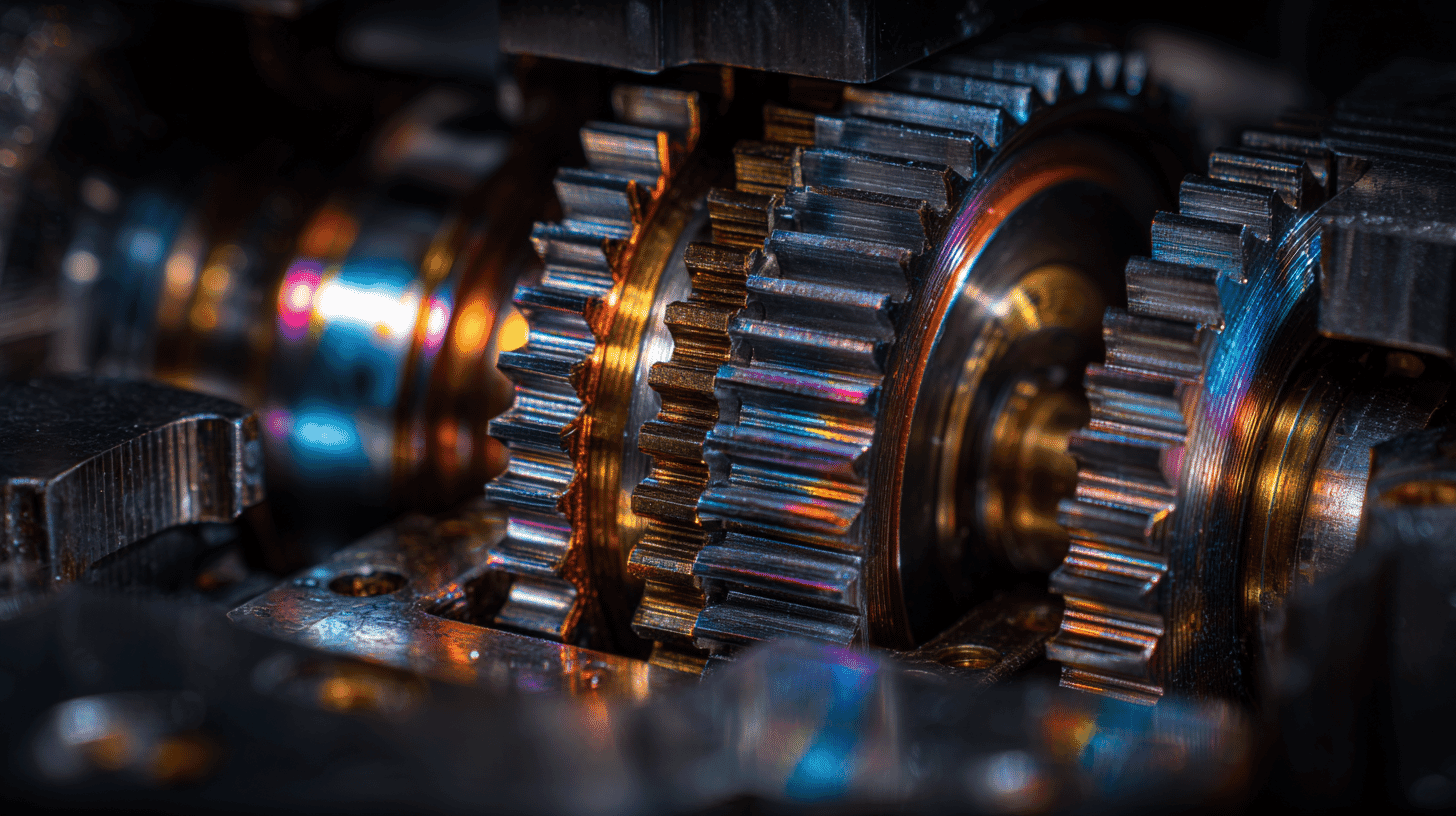
What determines an industrial robot's performance is the precision reducer, which trades a motor's high rotation speed for dozens of times the torque. Elbows and knees, essentially. Nabtesco reports about 60% of the global market for precision reducers used in medium and large industrial robot joints, and over 90% in RV reducers for medium and heavy loads. From waist to elbow on a six-axis robot, every load-bearing joint is likely theirs. The lighter wrist joints go to Harmonic Drive Systems, which holds roughly half the market in strain wave gearing. Sumitomo Heavy Industries, known for cycloidal drives, sits second in RV reducers.
ResearchInChina's breakdown puts controller, servo motor and reducer at about 70% of an industrial robot's cost, split 35% reducer, 20% servo, 15% controller. However clever the AI gets, a third of the bill of materials still goes to Japanese gears.
That fortress is not permanent. Suzhou Leaderdrive is said to have taken over 60% of China's strain wave gearing market and built out to 600,000 units a year. Nantong Zhenkang is scaling RV reducers. High-end durability and reliability still favor Japan, but a market that was a complete Japanese monopoly until around 2013 isn't one anymore.
And Yet Nobody Has Found the Killer App
None of this justifies ending on how great Japan is.
The numbers do look like a tailwind. Grand View Research projects the Physical AI market at $960.4 billion by 2033. China installed 295,000 industrial robots in 2024, 54% of the world, making it the largest market by far. The money is moving.
The question is who collects it. Yaskawa's own target puts profit contribution at the year ending February 2029, which is another way of saying Physical AI is still in the investment phase. Analysts point out that no killer application has emerged. Loading explosives at tunnel excavation sites, sorting medical instruments, setting up meeting rooms. All still demos.
The competition is not gentle. Inovance and Nanjing Estun are rising in China, and Tesla and Hyundai-owned Boston Dynamics both intend to put humanoids in factories. If Japanese firms stay in precision components and hardware, someone else owns the OS of the physical world. That is probably why Mujin keeps calling itself the common OS for robots.
Do you see robots in factories or warehouses where you live? Have you ever actually watched one decide something for itself?
References
- https://www.yaskawa.co.jp/newsrelease/news/1422177
- https://xtech.nikkei.com/atcl/nxt/column/18/03352/122500011/
- https://www.fanuc.co.jp/ja/product/new_product/2025/202512_robot_physicalai.html
- https://monoist.itmedia.co.jp/mn/articles/2605/15/news087.html
- https://monoist.itmedia.co.jp/mn/articles/2605/18/news048.html
- https://www.mujin.co.jp/news/10444/
- https://monoist.itmedia.co.jp/mn/articles/2512/03/news059.html
- https://www.automation-news.jp/2020/11/51977/
- https://www.precision-reducer-guide.com/market/world.html








Global Discussion
15 comments