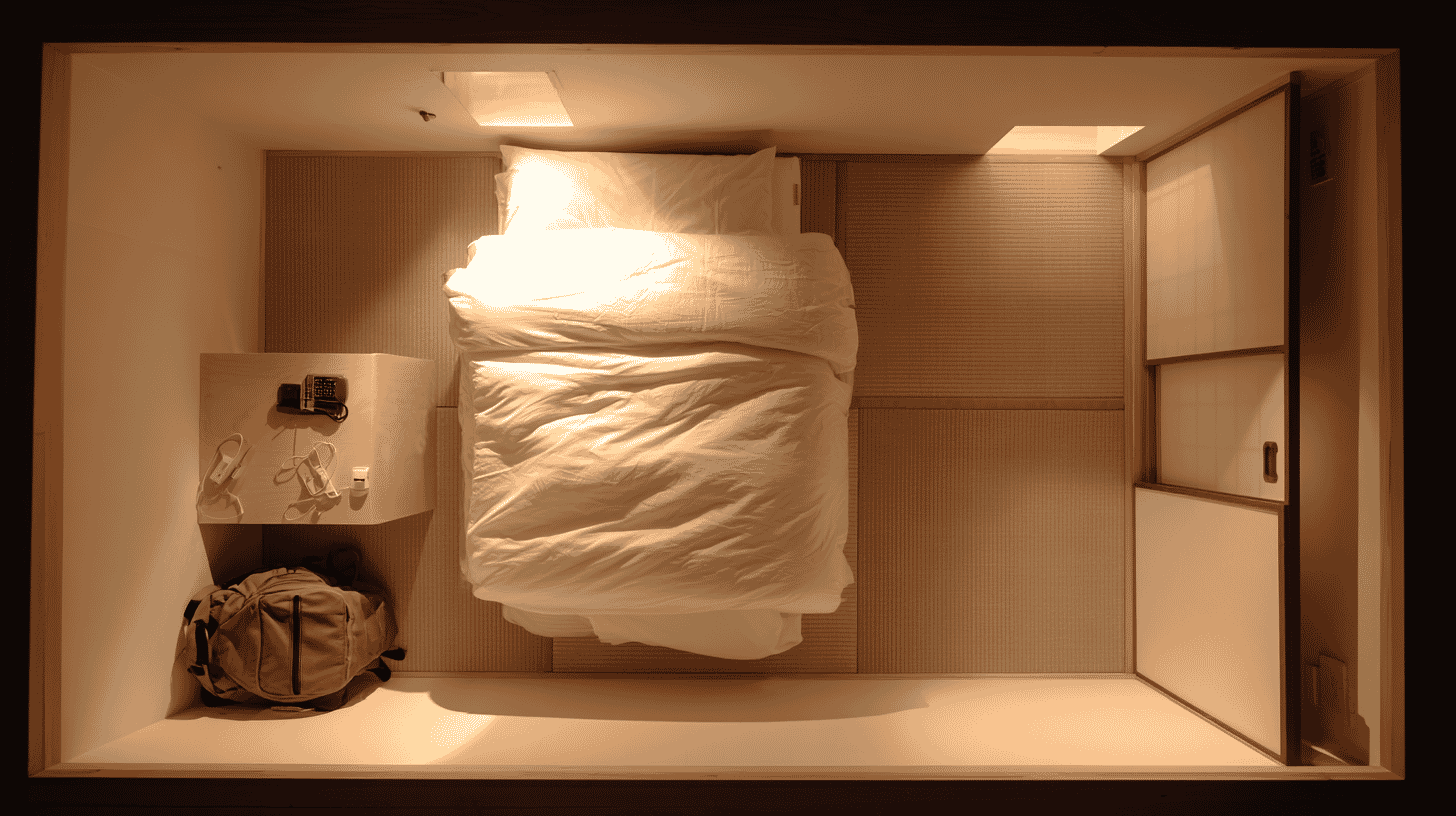
Imagine your entire living space being smaller than a king-size bed. In Japan, one man has gone viral for living in a room measuring just 1.5 tatami mats, roughly 28 square feet (2.6 square meters). His futon fills 90% of the room, and he says he couldn't be happier. Welcome to the extreme end of Japan's minimalist revolution.
A Room Where the Futon Is the Room
A single photo posted on X (formerly Twitter) by a user called "Unemployed, Year 7" (@nojob_zz) has drawn a big response. It shows a tiny room almost entirely covered by a futon, with a simple caption: "People can live in 1.5 tatami mats, you know."
The room measures 2.6 square meters. It is not a regular studio apartment but a room in a share house: the kitchen, shower and toilet are all shared, and the only private space is this 1.5-mat room. The poster chose it for "the balance of location and rent." Asked whether he had any worries before moving in, he gave an unexpected answer.
"I thought the smaller the better, because then I wouldn't accumulate stuff. So I decided without even viewing it. As long as it keeps out the wind and rain, that's enough."
His impressions after moving in are positive too. "Nothing is particularly hard. It's small, so my things don't pile up and I don't lose anything. Cleaning is over in no time, so it's easy." A friend who once came by out of morbid curiosity took a commemorative photo, was satisfied, and left right away.
"Standing Needs Half a Mat, Sleeping Needs One"
The poster's life embodies an old Japanese saying: "Tatte hanjo, nete ichijo," or "Standing, you need half a tatami mat; lying down, one mat." It means the space a person occupies is half a mat when standing and just one mat even when sleeping. The full saying continues, "and even if you rule the realm, you eat only two and a half go," meaning that even someone who conquers the country can eat no more than about 375 grams of rice a day.
The saying is believed to date back to the Edo period and has also been attributed to Oda Nobunaga or Toyotomi Hideyoshi. At its root is the Buddhist-influenced idea of "taru wo shiru," knowing what is enough. The spirit of not seeking more wealth or status than necessary, and valuing a life in proportion to oneself, connects to modern minimalism.
Why Micro-Living Works in Japan
To understand why someone would choose to live in 28 square feet, it helps to understand Japan's unique housing landscape.
Share houses as affordable urban living. In major Japanese cities like Tokyo, Osaka, and Yokohama, share houses have become an increasingly popular option, especially for young professionals and those seeking to minimize living costs. A room in a share house can cost as little as $200–$350 per month, compared to $600–$800 or more for a standard studio apartment in central areas. The trade-off is personal space: kitchens, bathrooms, and common areas are shared, and private rooms can be extremely small.
The cultural foundation. Traditional Japanese rooms were inherently multi-purpose. A single tatami room would serve as living room, dining room, and bedroom, the family would bring out a low table (chabudai) for meals and lay out futons for sleeping. The Western concept of dedicated rooms for each function is relatively recent in Japan. This flexibility means that Japanese people have a long cultural memory of making small spaces work.
The rise of "kyosho jutaku." Kyosho jutaku (狭小住宅), or "micro-housing," has become a recognized category in Japanese real estate. In Tokyo, real estate developer Spilytus has built over 100 buildings under its "Ququri" brand, offering units as small as 9 square meters (about 97 square feet), roughly three tatami mats, near trendy transit-rich neighborhoods like Shibuya and Harajuku for around $350–$500 per month. Over 1,500 people live in these units, attracted by the combination of prime location and low rent.
A growing demographic shift. Over 50% of Tokyo households are now single-person households. Young adults are marrying later, prioritizing independence and urban convenience over space. Recent surveys show that over 11% of Tokyo residents in their twenties now live in ultra-small apartments under six tatami mats (about 108 square feet), deliberately trading square footage for location and savings.
The Practical Upsides (and Downsides) of Extreme Small Living
The poster says he hardly feels any inconvenience in daily life. "I've always liked manga cafes with tiny private booths, and just as the saying 'standing, half a mat; lying down, one mat' goes, I realized again that this much space is enough."
About the future, he joked: "I'm not unhappy with the size, but I travel out of the prefecture quite a lot, so I thought it would be nice to have three or so 1.5-mat rooms around the country... Actually, maybe manga cafes are enough."
Micro-living has its challenges, though. People point out that it is unsuited to working from home, leaves no room for hobbies and makes it impossible to have guests, and some worry about its effect on mental health. Housing experts have also questioned whether tiny private rooms in share houses are adequate in terms of privacy and comfort.
Japan's Minimalism: Philosophy Meets Necessity
Japan's minimalist movement exists at the intersection of ancient philosophy and modern economic reality. The country's high urban density, expensive real estate, and aging population create practical incentives to live small. But there's also a genuine cultural appreciation for simplicity, from the spare aesthetic of tea ceremony rooms to the popularity of Marie Kondo's decluttering philosophy, which took the world by storm.
The concept of mottainai (もったいない), a sense of regret over wastefulness, and wabi-sabi (侘び寂び), finding beauty in imperfection and transience, also contribute to a cultural environment where living with less is not just tolerated but sometimes admired.
That said, it's important not to over-romanticize. Not everyone who lives in a tiny space does so by choice. Rising housing costs, wage stagnation, and precarious employment (particularly among young people and non-regular workers) mean that for some, micro-living is less a philosophical choice and more an economic necessity.
A Conversation Starter Across Cultures
The viral post sparked a lively debate in Japan, with reactions ranging from admiration to disbelief. Many people were amazed that someone could be genuinely content in such a small space, while others saw it as a reflection of broader economic pressures or questioned whether this represented healthy living.
What makes this story compelling beyond Japan's borders is the universal question it raises: How much space do we really need to be happy? In an era of rising housing costs worldwide, from London to San Francisco to Sydney, Japan's extreme micro-living experiment offers one provocative answer.
So here's a question for you: What's the smallest space you could imagine living in comfortably? Does your country have its own version of micro-housing culture?
References
- https://maidonanews.jp/article/16317644
- https://e-housing.jp/post/tiny-apartments-in-tokyo-for-foreigners-rental-costs-and-where-to-find-them
- https://www.surfacemag.com/articles/tokyo-micro-apartments-spilytus-ququri/
- https://e-housing.jp/post/explore-tokyos-revolutionary-micro-apartments-tiny-apartments-redefining-urban-life-discover-why-many-have-decided-to-live-in-these-compact-apartments-transforming-the-citys-housing-landscape-and-pushing-the-boundaries-of-minimalist-living-in-tokyo
- https://kotowaza-dictionary.jp/k1235/








Global Discussion
15 comments