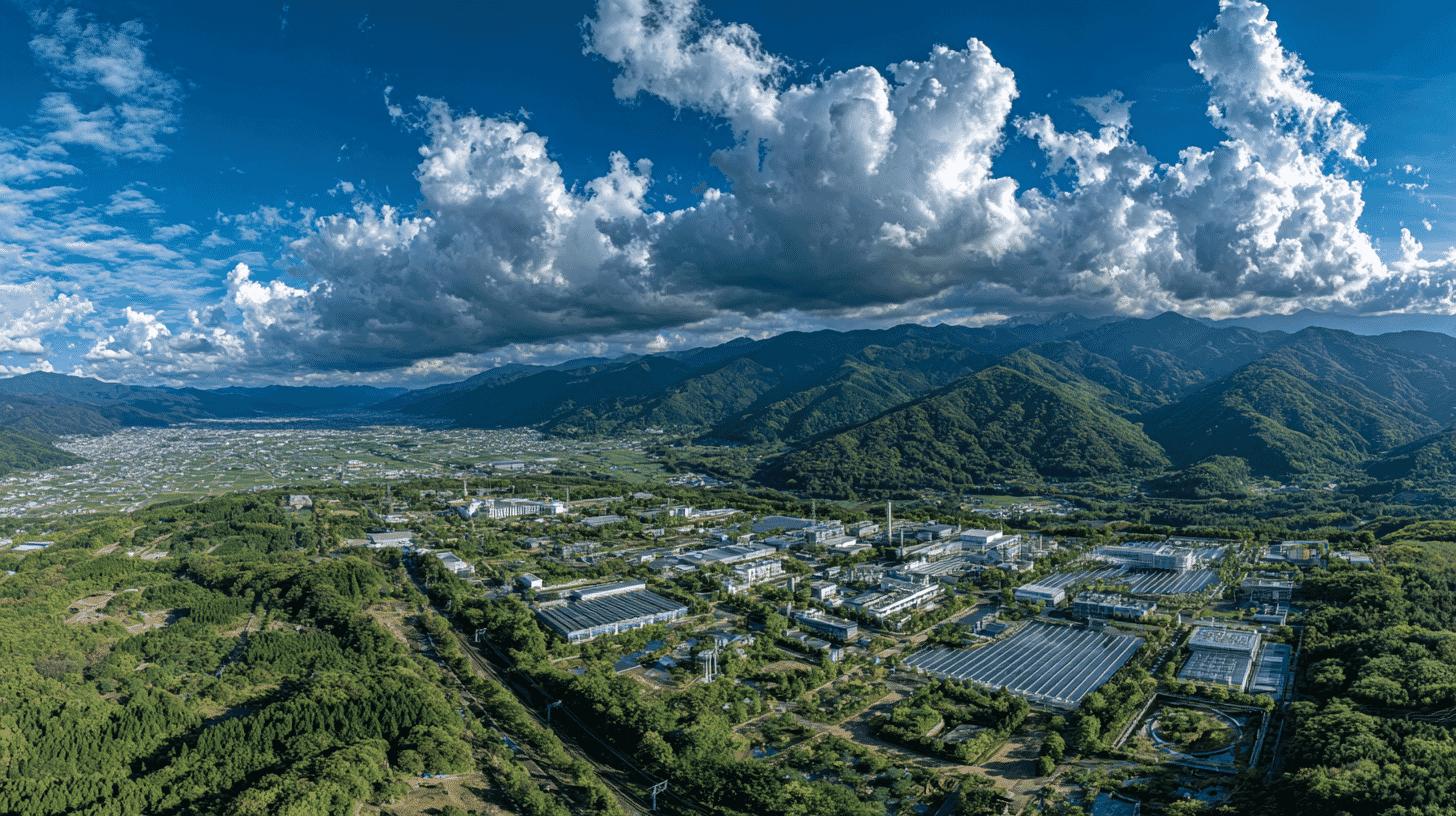
Why are the world's biggest tech companies rushing into a country with a shrinking population? Australia's data center giant AirTrunk has expanded its Japan investment to over $8 billion. Japan's demographic weakness has paradoxically become one of its greatest assets for the AI data center industry. Empty land, shifting energy dynamics, and bold policy are reshaping Japan's digital future.
AirTrunk's $8 Billion Bet on Japan
AirTrunk, an Australian hyperscale data center operator now backed by U.S. investment firm Blackstone, has pushed its total investment in Japan past $8 billion (approximately ¥1.2 trillion). In an interview with Japan's Nikkei newspaper, CEO Robin Khuda stated the figure would reach ¥1.3 trillion, making it one of the largest investments by an Australian company in Japan's history.
The scale of the commitment is staggering. AirTrunk currently operates or is developing four campuses across Japan. TOK1, located in Inzai City, Chiba Prefecture east of Tokyo, is designed to scale beyond 300 megawatts (MW), making it one of the largest hyperscale facilities in the country. TOK2 in western Tokyo offers over 110MW of capacity and opened in late 2024. In Osaka, the company runs OSK1 (20MW) and is planning OSK2, a new eastern Osaka campus with up to 100MW capacity. At full build-out, the four campuses will deliver approximately 530MW of total capacity.
In March 2026, AirTrunk secured a record-breaking ¥191.6 billion ($1.24 billion) green loan for TOK1, the largest data center financing deal ever completed in Japan. SMBC, MUFG, Crédit Agricole CIB and Société Générale acted as global coordinators, with 12 banks in total participating.
A consortium led by Blackstone and the Canada Pension Plan Investment Board acquired AirTrunk in 2024 for approximately $16.1 billion, making it the largest data center acquisition on record. The firm views Japan as a centerpiece of its global data center strategy.
The Population Decline Paradox
Japan's population peaked at roughly 128 million in 2008 and has been declining ever since. As of February 2026, the total population stands at approximately 122.86 million, a drop of about 580,000 from the previous year. The fertility rate fell to 1.15 in 2024, with no signs of recovery.
Conventionally, population decline is seen as an economic headwind. But for the data center industry, Japan's demographic trajectory creates several distinct advantages.
Available land at accessible prices. Data centers require vast tracts of land with solid geological foundations. As populations shrink in suburban and rural areas, industrial and residential land demand drops, making large parcels available at relatively affordable prices. This stands in sharp contrast to land-scarce markets like Singapore, where space constraints have historically been the primary bottleneck for data center development.
A shifting electricity equation. Japan's overall electricity consumption had been declining due to population shrinkage and energy-saving efforts. However, the construction of new data centers and semiconductor factories is reversing this trend. Japan's Organization for Cross-regional Coordination of Transmission Operators (OCCTO) projects that electricity demand will increase from 2026 onward, with data center and chip fabrication demand outweighing population-driven reductions.
Aggressive government policy. Japan's Ministry of Economy, Trade and Industry (METI) is offering subsidies to attract data centers to Hokkaido and Kyushu, regions rich in renewable energy. The government has also streamlined land-use regulations, a rezoning process that previously took four to five years is being significantly shortened. Japan's 2025 Basic Plan for Artificial Intelligence identifies hyperscale data centers as essential national computing infrastructure.
Inzai: The "Data Center Ginza"
AirTrunk's flagship TOK1 campus is located in Inzai City, Chiba Prefecture, known as "Data Center Ginza", Japan's largest concentration of data center facilities. Around 30 facilities currently operate there, with more than 10 additional buildings planned.
The story of how Inzai became a data center hub is a direct product of Japan's demographic reality. The "Chiba New Town" development, launched in 1966, was originally planned to house 340,000 residents. But by 2025, the actual population had reached only about 109,000. Decades of unfilled residential and industrial lots left vast empty spaces, spaces that proved ideal for data center construction.
Beyond available land, Inzai offers solid geological foundations with low earthquake risk, excellent connectivity (40 minutes to central Tokyo, 20 minutes to Narita International Airport), and robust power infrastructure. Tokyo Electric Power Grid is constructing a massive ultra-high-voltage substation capable of supplying up to 1,000MW to the area. Google opened its first proprietary data center in Japan in Inzai in 2023, and Amazon Web Services operates major facilities there as well.
However, growing pains have emerged. Residents near the Chiba New Town Chuo station have protested plans for large data centers in the station area, and the Inzai city council unanimously passed a resolution in August 2025 to restrict new data center construction near railway stations. The city, which has benefited enormously from data center tax revenue, now faces the challenge of balancing economic growth with livability.
Japan vs. the Asian Competition
Japan's data center market was valued at approximately $11–12.5 billion in 2025 and is projected to grow at an annual rate of 8–14% through the early 2030s. How does Japan stack up against its regional competitors?
Singapore, long the dominant data center hub in Southeast Asia with roughly 60% of the region's capacity, has faced severe supply constraints. A construction moratorium imposed in 2019 pushed vacancy rates to just 1.4%, among the lowest in the world. While the government launched a new 200MW capacity allocation program (DC-CFA2) in December 2025, it mandates a strict Power Usage Effectiveness (PUE) of 1.25, limiting growth potential.
Indonesia and Malaysia (particularly Johor state) are rapidly emerging as alternatives, offering cheaper land and power. Southeast Asia as a whole attracted over $55 billion in AI infrastructure commitments in 2025. However, these markets often lack the power grid stability, network maturity, and regulatory predictability that Japan provides.
Japan's competitive edge lies in political stability, world-class network infrastructure, advanced earthquake-resistant engineering, and the government's Green Transformation (GX) strategy, which aims to mobilize ¥150 trillion ($950 billion+) in public-private investment for decarbonization and next-generation infrastructure. AirTrunk's green loan directly aligns with this national initiative.
The Green Energy Connection
AirTrunk has made sustainability a core business principle. TOK2 employs direct air-free cooling technology, achieving a PUE of 1.15, among the best in the industry. The TOK1 green loan was structured under AirTrunk's Green Financing Framework, which requires its data centers to run significantly more efficiently than the regional average and ties directly into the company's 2030 net zero targets for Scope 1 and 2 emissions.
Japan's government is also promoting data center development in regions with abundant renewable energy. Hokkaido offers strong wind and solar resources, while Kyushu has geothermal power capacity, making these areas increasingly attractive for energy-intensive hyperscale operations.
The financing structure further supports AirTrunk's sustainability goals. Margin incentives from the green loan are directed to the company's Social Impact Fund in Japan, supporting STEM education, digital equity, biodiversity conservation, and disaster relief initiatives.
Is data center construction growing in your country? How does your nation handle the tension between land use, population change, and digital infrastructure? Share your thoughts in the comments.
References
- https://airtrunk.com/airtrunk-secures-largest-financing-for-a-data-centre-in-japan-with-us1-2-billion-green-loan-for-its-flagship-tokyo-campus/
- https://prtimes.jp/main/html/rd/p/000000010.000085416.html
- https://www.lightreading.com/finance/airtrunk-goes-green-with-record-1-24b-loan-in-japan
- https://www.mordorintelligence.com/industry-reports/japan-data-center-market
- https://www.stat.go.jp/data/jinsui/new.html
- https://www.scsk.jp/sp/netxdc/column/inzai_datacenter.html








Global Discussion
15 comments