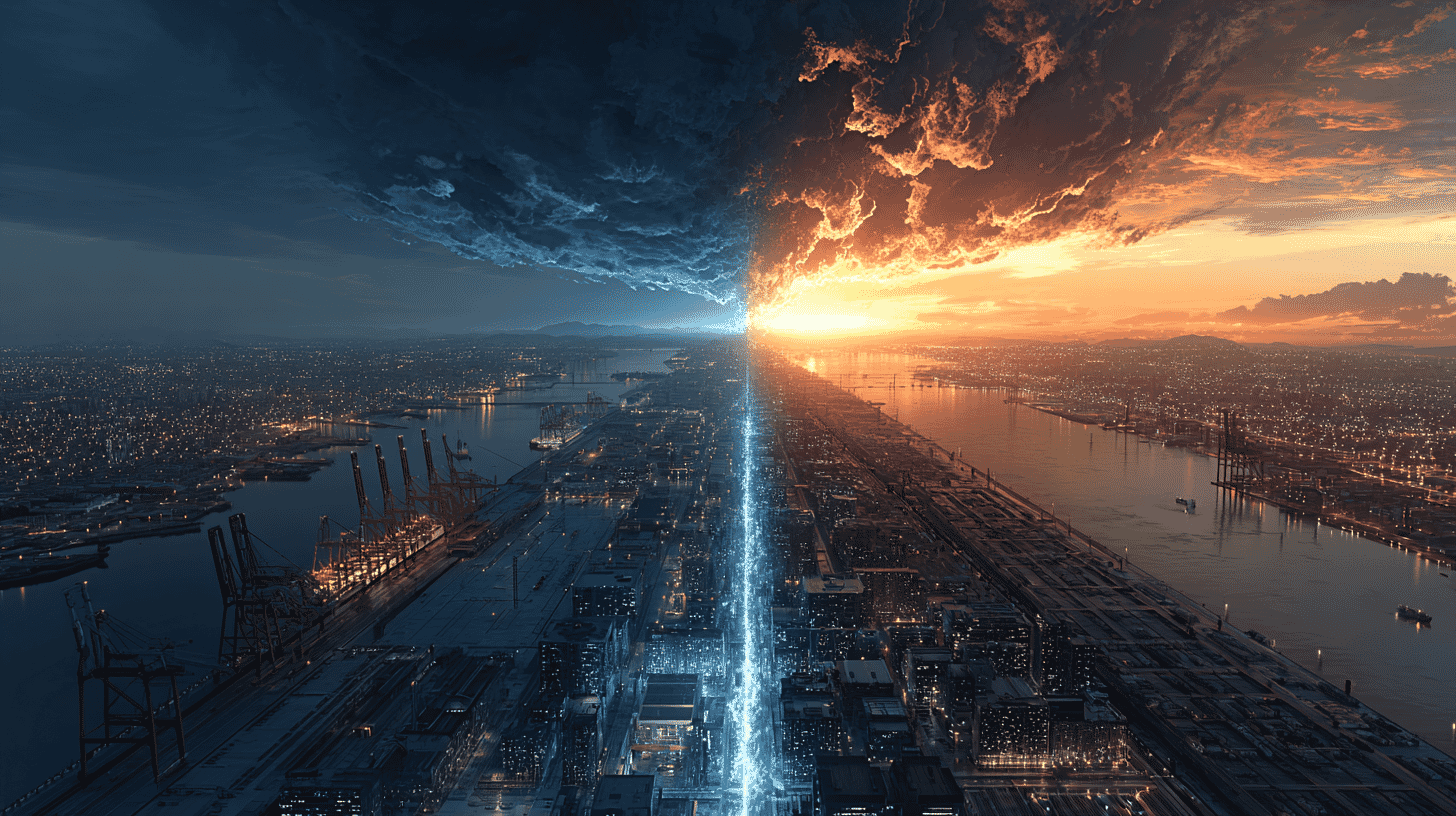
Once the world's most advanced LCD panel factory, built with a ¥430 billion investment, Sharp's Sakai plant is now becoming one of Asia's largest AI data centers, converted by telecom giants KDDI and SoftBank. The twilight of "LCD Sharp" and the dawn of the AI era meet on the same ground, a striking symbol of Japan's industrial transformation.
What Was the Sakai Factory? A Journey from Glory to Decline
Sharp's Sakai factory began operations in 2009 as the world's first Generation 10 (G10) LCD panel manufacturing facility. With the capability to produce eight 60-inch panels simultaneously from a single mother glass sheet, it represented the pinnacle of Sharp's LCD business following the success of the "Kameyama Model."
However, the 2008 financial crisis, intense price competition from Chinese and Korean manufacturers, and the industry shift toward OLED technology caused the LCD panel market to rapidly contract. The Sakai factory struggled with profitability almost immediately after opening, and by 2012, Sharp accepted investment from Taiwan's Hon Hai (Foxconn) group.
In 2016, Sharp itself became a subsidiary of Hon Hai. While this initially led to a business recovery, prolonged weakness in the LCD panel market resulted in consecutive losses exceeding ¥100 billion in fiscal years 2022 and 2023. On May 14, 2024, Sharp announced the cessation of large LCD panel production at Sakai. Lines were wound down product by product from June, and by the end of September 2024 roughly 15 years of manufacturing had come to an end.
Acquisition by Two Telecom Giants: Unprecedented Speed
Plans for repurposing the factory site began even before production ceased.
SoftBank reached a basic agreement with Sharp in June 2024 and completed the acquisition in March 2025, paying approximately ¥100 billion for about 60% of the site (approximately 450,000 square meters) and buildings (840,000 square meters of floor space). They plan to construct an AI data center with a power capacity of 150 megawatts, initially targeting operations within 2026, with potential expansion to over 250 megawatts.
[Update] In the mid-term plan announced on May 11, 2026, SoftBank moved the Sakai launch target to fiscal 2027. The site is now framed as an "AX Factory" at 140 megawatts and 110 exaFLOPS, roughly 100,000 GPUs in NVIDIA H200 terms. The company's Tomakomai site in Hokkaido opens first, in fiscal 2026, at 50 megawatts with room to scale to 300. (As of August 2026)
KDDI reached its basic agreement in December 2024 and completed its acquisition in April 2025 for ¥10 billion, obtaining a portion of the site (approximately 33,000 square meters) and buildings (57,000 square meters). The "Osaka Sakai Data Center" began operations on January 22, 2026, about nine months after the acquisition, with a power capacity of roughly 50 megawatts. KDDI puts the build time at six months.
The "Turnkey" Approach: Key to Success
KDDI President Koji Matsuda described this rapid implementation as a "turnkey" conversion.
LCD panel manufacturing requires massive amounts of electricity and precise temperature control, so the Sakai factory was already equipped with substantial power infrastructure and cooling systems. Multiple transformers capable of receiving 77,000 kilowatts from Kansai Electric Power, along with extensive piping systems throughout the buildings, could be directly repurposed for data center operations.
Typically, large transformers take about three years from procurement to installation and cost several hundred million yen each. By reusing this existing equipment, KDDI dramatically shortened construction time and "made it in time for the AI era," as Matsuda put it.
State-of-the-Art AI Infrastructure
The Osaka Sakai Data Center features NVIDIA's latest "GB200 NVL72" GPUs, high-performance chips optimized for generative AI training and inference, capable of supporting the development of large language models with trillions of parameters.
The cooling system employs a hybrid approach combining direct liquid cooling and air cooling. This efficiently cools high-heat GPU servers while minimizing power consumption. Additionally, 100% of the facility's electricity comes from renewable energy sources, contributing to carbon neutrality.
KDDI positions this data center as infrastructure for "Sovereign AI", AI systems whose governance and control remain within national borders. The facility enables secure processing of sensitive data within Japan and includes "Gemini for GDC (Google Distributed Cloud)," allowing on-premises use of Google's generative AI model.
Industrial Applications on the Horizon
Several use cases have already been announced. In pharmaceuticals, KDDI is partnering with Takeda Pharmaceutical Company and its subsidiary Medical Engineering Institute (MEI) to conduct medical big data analysis projects starting in April 2026. They will develop healthcare-specialized LLMs in a domestic-only environment to securely train on data and visualize indicators of rare diseases.
SoftBank also plans to use its data center for generative AI development and AI-related businesses while providing services broadly to universities, research institutions, and corporations. Their vision is to create "a model case for industrial clustering centered on AI data centers," advancing AI adoption across various industries including primary sectors.
Strategic Importance for Japan's AI Infrastructure
The Sakai AI data center was developed with support from the Ministry of Economy, Trade and Industry's "Cloud Program," positioning it as a crucial hub in Japan's national AI strategy.
Currently, data centers in Japan are concentrated in specific areas of the Kanto and Kansai regions, creating challenges related to power supply constraints and disaster risk. The government has set forth plans under the "Digital Garden City Nation Concept" to develop over a dozen regional data center hubs nationwide, with Sakai serving as a pioneering example.
According to the International Energy Agency (IEA), global data center electricity consumption is expected to double by 2030 due to AI proliferation. In Japan, consumption could increase more than fivefold by 2050. Meeting this massive power demand with renewable energy while securing domestic AI development infrastructure is directly tied to Japan's industrial competitiveness.
From "LCD Sharp" to "AI-Era Infrastructure"
The factory is located in Sakai City's "Takumi-cho" (Craftsman Town), a name chosen through public nomination in 2007 when Sharp decided to build the factory, expressing hopes for development through "monozukuri" (manufacturing). Physical manufacturing of LCD panels has ended, but the site keeps supporting Japanese industry, now as a place where value is made out of AI instead.
How is your country approaching factory site repurposing or AI infrastructure development?
References
- https://www.itmedia.co.jp/aiplus/articles/2601/22/news115.html
- https://k-tai.watch.impress.co.jp/docs/news/2080020.html
- https://www.nikkei.com/article/DGXZQOUC208II0Q5A021C2000000/
- https://www.softbank.jp/corp/news/press/sbkk/2025/20250314_01/
- https://xtech.nikkei.com/atcl/nxt/news/24/02365/
- https://en.wikipedia.org/wiki/Sharp_Corporation

Global Discussion
15 comments