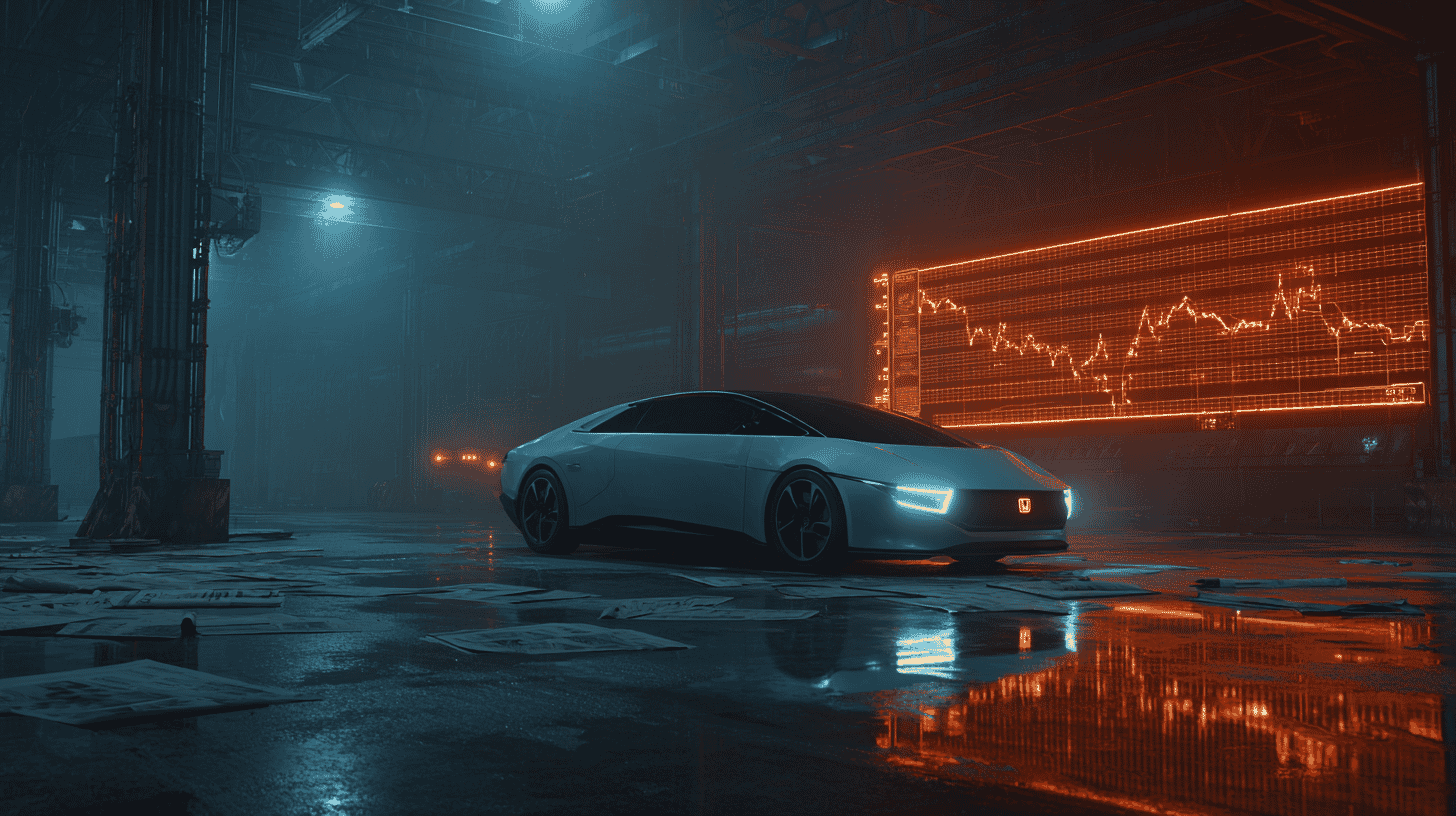
For 69 years as a public company, Honda never posted a loss. That streak just ended. A bet-the-company EV strategy has left Honda facing up to $15.7 billion in losses, three flagship EVs cancelled months before production, a dream partnership with Sony in ruins, and its once-thriving China business in freefall. Here's what went wrong, and whether Honda can recover.
The Bombshell: Honda's First Loss in 69 Years
On March 12, 2026, Honda Motor held an emergency press conference to announce a sweeping reversal of its electric vehicle strategy. The company cancelled three North American EVs, the Honda 0 SUV, Honda 0 Saloon, and Acura RSX, that were supposed to carry the brand into an all-electric future.
The financial impact is staggering. Honda now expects a net loss of up to ¥690 billion ($4.3 billion) for fiscal year 2026, its first annual loss since going public in 1957. Just one month earlier, on February 10, the company had projected a ¥300 billion ($1.9 billion) profit.
But the worst number is yet to come: when factoring in supplier compensation costs, battery joint venture write-downs, and ongoing restructuring charges into fiscal 2027, cumulative losses could reach ¥2.5 trillion, approximately $15.7 billion. That's roughly 12% of Honda's annual revenue.
Breaking Down the $15.7 Billion
The losses fall into several categories. For fiscal year 2026 (ending March 2026), Honda expects ¥600–800 billion ($3.8–5.0 billion) in non-cash EV asset impairments and development write-offs, up to ¥500 billion ($3.1 billion) in costs from the strategy shift, and ¥110–150 billion ($690–940 million) in losses on Chinese joint ventures.
For fiscal year 2027, an additional ¥1.2 trillion ($7.5 billion) is expected, primarily for supplier compensation, the contracts for parts, materials, and components that were already in the pipeline for vehicles that will never be built.
A critical detail: the losses are heavier in 2027 than in 2026 itself. That's because Honda was within months of starting mass production when it pulled the plug. The Ohio factory retooling was complete. The battery plant with LG Energy Solution in Jeffersonville was ramping up. Supply chains had been structured. Honda came closer to the finish line than any automaker that has retreated from EVs, and still walked away.
Five Years of Miscalculation: From "Zero Engine" to Zero EVs
To understand how Honda got here, you need to go back to April 2021. Newly appointed CEO Toshihiro Mibe made a bold declaration: by 2040, every single new Honda sold globally would be electric or fuel-cell powered. No more gasoline engines, period. It was the most aggressive electrification target among Japanese automakers, more aggressive than Toyota, Nissan, or any other traditional manufacturer.
Honda poured resources into this vision with remarkable conviction. The company partnered with GM on affordable EVs, signed a battery joint venture with LG Energy Solution in Ohio, began developing a proprietary next-generation EV platform, and created the "Honda 0 Series" brand as the flagship of its electric future. The 0 Series was set to feature Tesla-style gigacasting, a 2,000 TOPS AI chip co-developed with Renesas, and Honda's own vehicle operating system called "ASIMO OS."
Then the ground shifted beneath Honda's feet.
Miscalculation #1: U.S. policy whiplash. When the Trump administration took office in 2025, it systematically dismantled Biden-era EV support. Federal tax credits were eliminated. California-led emissions standards were rolled back. The U.S. EV market, which Honda had bet everything on, contracted sharply. By 2026, American EV sales were running at roughly half of 2025 levels.
Miscalculation #2: China collapsed faster than anyone predicted. Chinese automakers, led by BYD, captured massive market share with aggressively priced EVs packed with cutting-edge software. Honda's China sales plummeted from 1.62 million vehicles in 2020 to just 645,300 in 2025, a 60% decline. As of early 2026, Honda had posted 25 consecutive months of year-over-year sales declines in China. After visiting a supplier in Shanghai, CEO Mibe reportedly said, "We have no chance against this."
Miscalculation #3: Neglecting what was actually making money. In its rush toward EVs, Honda starved its conventional and hybrid vehicle lineups of development resources. In Asian markets, Honda's traditional profit centers, the company's product competitiveness deteriorated. Lineup gaps emerged. The auto division's operating margin in fiscal year 2025 was a razor-thin 1.7%, compared to 18.3% for Honda's motorcycle division. The bikes were literally keeping the company afloat.
AFEELA: Dead 60 Days After Its Biggest Show
The fallout wasn't limited to Honda's own vehicles. On March 25, 2026, Sony Honda Mobility announced the complete cancellation of AFEELA, both the $90,000 sedan that was weeks from customer deliveries and the SUV prototype unveiled at CES 2026 just two months earlier.
AFEELA represented Sony's vision of the car as an entertainment platform: PlayStation Remote Play, spatial audio, anime streaming, turning commute time into content consumption time. But with Honda pulling its EV platform out from under the project, the vehicle's physical foundation simply disappeared. Sony concluded it couldn't continue alone.
The joint venture had accumulated an estimated $362 million in losses. Dissolution appears likely.
Not Just Honda: The Global EV Winter
Honda is far from alone. The world's automakers are experiencing what analysts call an "EV winter."
Ford has booked $19.5 billion in EV-related write-downs and ended F-150 Lightning production. Stellantis has taken over $26 billion in battery-electric charges. More than 20 brands, including Hyundai, Nissan, Volkswagen, Volvo, Kia, and Polestar, have delayed or cancelled EV projects.
The contrast with market leaders is stark. Tesla's vertically integrated model, controlling everything from batteries to sales channels to software, gives it structural cost advantages that traditional automakers can't replicate. BYD leverages China's deep EV supply chain to sell compelling vehicles at $15,000 to $30,000, a price range that Honda, Ford, and GM struggle to match while maintaining profitability.
Toyota Vindicated, but Not Home Free
Honda's collapse has validated Toyota's much-debated "multi-pathway strategy", developing hybrids, plug-in hybrids, hydrogen fuel cells, and battery EVs simultaneously rather than going all-in on any single technology.
Toyota was relentlessly criticized for being "too slow on EVs." Environmental groups, Wall Street analysts, and even some shareholders accused the company of clinging to outdated technology. But with hybrid demand booming globally, Toyota now sits in the strongest competitive position among Japanese automakers.
That said, Toyota still faces challenges. In China, the combined market share of Japan's Big Three (Toyota, Honda, Nissan) has fallen from a peak of 23.1% to less than 9%. Toyota's own March 2026 China sales were down 8% year-over-year. And in pure EV technology, Toyota significantly trails Tesla and BYD. The hybrid advantage won't last forever.
The Nissan Merger That Never Was
Honda's massive loss raises uncomfortable questions about the failed merger with Nissan. In December 2024, the two companies signed a memorandum of understanding for a potential merger that would have created the world's third-largest automaker. By February 2025, talks had collapsed over governance, Honda wanted Nissan as a subsidiary; Nissan insisted on equal partnership despite weaker financials.
Now Honda must absorb $15.7 billion in losses alone, without the scale benefits a merged entity could have provided. Meanwhile, Nissan is fighting its own crisis: 9,000 job cuts, 20% production capacity reduction, and Taiwan's Foxconn circling Renault's stake.
Honda's Recovery Plan: The Hybrid Pivot
Honda's rebuilding strategy rests on three pillars.
Pillar 1: Hybrid vehicle comeback. Honda plans to launch 15 next-generation hybrid models globally from 2027 onward, with 50% lower development costs and 10% better fuel efficiency. However, Honda currently offers only about 4 hybrid models in North America, far behind Toyota's 17 and Hyundai's 15.
Pillar 2: India as the new growth market. With China in structural decline for Japanese brands, Honda is pivoting toward India, where its dominant motorcycle network (40% global market share, 18.3% operating margins) provides a foundation for four-wheel expansion.
Pillar 3: Motorcycle-powered financial stability. Honda's two-wheeler business, selling over 20 million units annually, generates the cash flow to fund the auto division's recovery period. Honda has maintained its dividend forecast, using a DOE (Dividend on Equity) ratio to reassure shareholders.
The May 2026 Strategy: Make or Break
All eyes are now on Honda's medium-to-long-term strategy announcement scheduled for May 2026.
Market reaction has been mixed. Honda's stock dropped roughly 9% in after-hours trading following the March 12 announcement, but rebounded 4.2% the next day as some investors viewed the write-down as a rational "rip the band-aid off" decision. Honda's Vice President Noriya Kaihara stated that "fiscal 2026 and 2027 represent the earnings trough," and that underlying operating profit remains at the ¥1 trillion level when one-time charges are excluded.
But skeptics aren't convinced. One analyst at Tokai Tokyo Intelligence Lab warned that "fiscal 2027 is also likely to be in the red, and a V-shaped recovery in fiscal 2028 isn't visible yet." Whether Honda can regain market confidence in May depends on three things: the specificity of its hybrid roadmap, the realism of its China and North America recovery plans, and a credible answer to the question of when, and how, it will return to profitability.
CEO Mibe Stays, but the Pressure Is Immense
CEO Mibe has declined to resign, stating that "delivering results is my greatest responsibility." He and other executives will return portions of their compensation (30% of monthly pay for three months; performance bonuses forfeited). But the irony is unavoidable: Mibe himself announced the "zero engine" pledge in 2021, and now he's the one dismantling it.
Inside Honda, the mood is grim. One employee told Diamond editorial staff, "As a manufacturer, this is shameful." Whether Mibe can transform Honda's crisis into a comeback, or whether a leadership change becomes inevitable, may well be decided by the market's reaction to the May strategy.
Honda was built on a philosophy of challenge. But this crisis shows how costly it can be when the challenge is pointed in the wrong direction. The next few months will determine whether "the Power of Dreams" can survive the reality of a $15.7 billion wake-up call.
Update: May 14 "2026 Business Update" Confirms the Hybrid Pivot
On May 14, 2026, Honda unveiled its medium-term strategy, the "2026 Business Update." It formally dropped the goal of making EVs and fuel-cell vehicles 100% of sales by fiscal 2040 and confirmed that hybrids will anchor its auto business through fiscal 2030. Of the ¥6.2 trillion in resources planned over the next three years, EV spending is capped at ¥0.8 trillion, with ¥4.4 trillion for internal-combustion and hybrid vehicles and ¥1 trillion for software. Honda plans 15 next-generation hybrid models globally by fiscal 2029 and targets a recovery to operating profit of ¥1.4 trillion or more in the year ending March 2029. The actual net loss for fiscal 2026 came in at ¥423.9 billion, below the ¥690 billion the company had feared. Investors welcomed the plan, and the stock climbed into early June.
In Japan, debate is fierce, some say Toyota's balanced approach was right all along, others argue Honda should focus on its world-leading motorcycle business, and many believe EVs remain the long-term answer but Honda simply mistimed its bet. What's the EV conversation like in your country? Are automakers there also pulling back from electrification? We'd love to hear your perspective.
References
- https://global.honda/en/newsroom/news/2026/c260312eng.html
- https://www.nikkei.com/article/DGXZQOUC126MK0S6A310C2000000/
- https://www.businessinsider.jp/article/2603-what-happened-in-honda-re/
- https://xtech.nikkei.com/atcl/nxt/column/18/00050/00237/
- https://finance.yahoo.com/markets/stocks/articles/why-honda-suddenly-looks-company-153019385.html







Global Discussion
12 comments