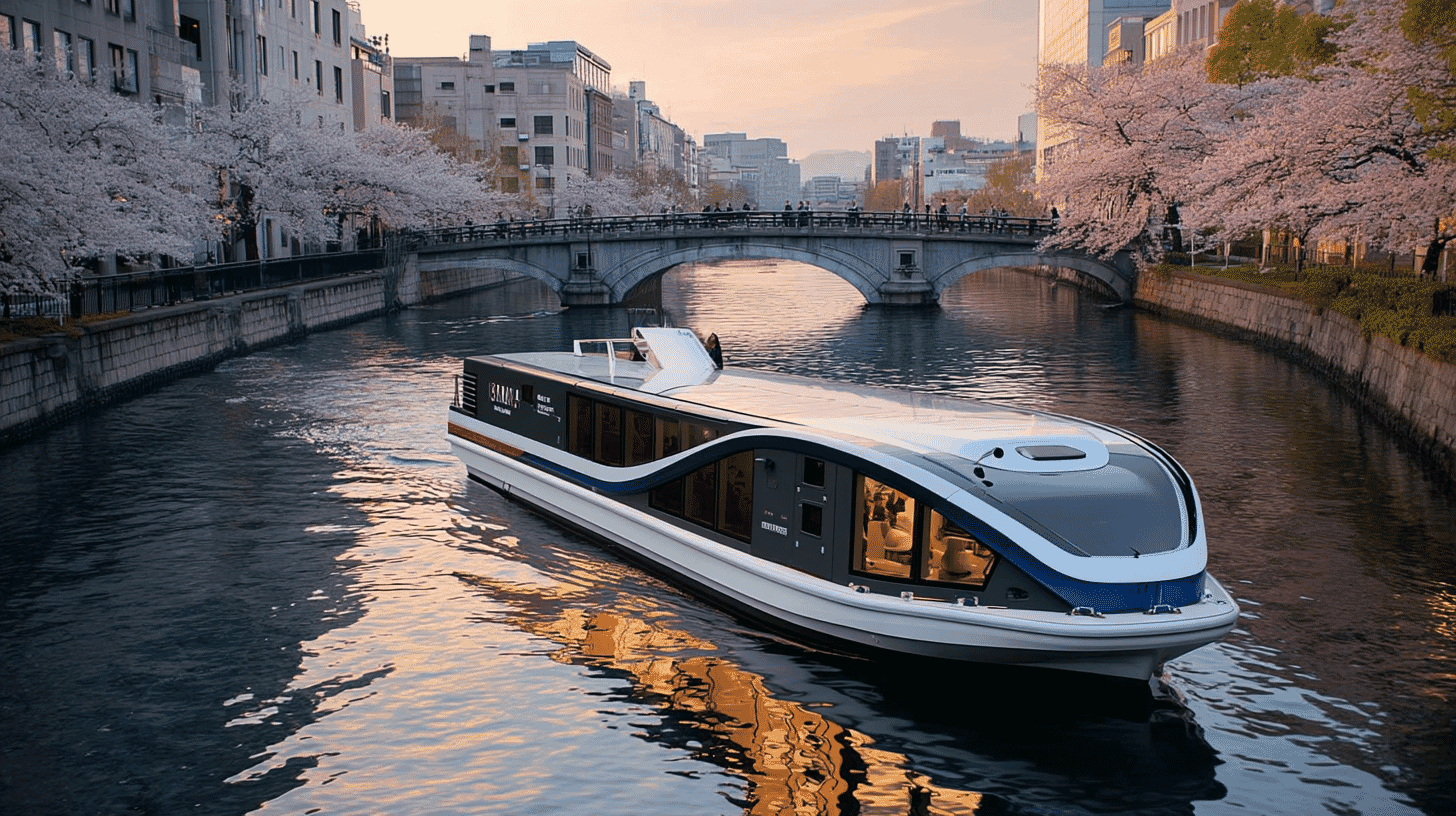
An electric boat is now gliding quietly along Tokyo's rivers. In April 2026 Japan's first scheduled service with fully electric passenger boats opened between Nihonbashi and Toyosu, with no engine noise, no exhaust and little rocking. It is an attempt to revive the city's centuries-old waterway culture as an everyday way to commute and shop.
"&CRUISE" Launches Japan's First Private Electric Ferry Route
On January 28, 2026, Mitsui Fudosan announced the launch of "&CRUISE" (And Cruise), its waterway transportation project. This marks the first time a private company in Japan will operate a regular route using fully electric passenger vessels.
Kanko Kisen Kogyo will handle operations, running two electric ships named "Nihonbashi e-LINER" between Nihonbashi pier and the pier at LaLaport Toyosu.
The "e" in e-LINER carries five meanings: Edo (honoring the historical water transport heritage), Experience (feeling the sky, water, and wind), Expand (future network expansion), Emergency (disaster response), and Ecology (environmental performance).
Japan's Largest Marine Battery for Small Vessels
The vessel measures 17 meters long, 4 meters wide, with a gross tonnage of about 17 tons. It accommodates up to 62 passengers and supports bicycle storage and barrier-free access.
Power comes from a lithium-ion battery pack of approximately 300kWh, the largest in Japan for vessels under 20 gross tons. Two 90kW permanent magnet water-cooled electric motors achieved speeds exceeding 8 knots during trials.
There are no internal combustion components at all: no main engines, no generators. CO2 emissions during operation: zero. No noise, no vibration, no fuel odors. Media representatives at trial voyages praised the remarkably quiet, smooth ride.
Operating time exceeds 8 hours per charge (at 6 knots, no AC, battery at 25°C). Charging uses newly installed facilities at LaLaport Toyosu, supplied with renewable energy. Specially appointed professor Tsuyoshi Ode of Tokyo University of Marine Science and Technology supervised the electric propulsion system.
Sustainable Materials Throughout
The interior follows the same environmental philosophy. Seats use recycled polyester free from harmful PFAS chemicals. Ceilings and window frames incorporate "Ultrasuede HP," an artificial suede made partly from industrial waste. Floor carpeting comes from 100% recycled materials including discarded fishing nets and PET bottles.
From Commuting to Disaster Response
This isn't a sightseeing boat. It's designed for daily use: commuting, shopping, waterfront tourism. Free Wi-Fi and charging outlets are standard. As a low-profile vessel, it can operate 24/7 year-round except during abnormal tides.
During disasters, the ferries can transport personnel and supplies. They support V2L (Vehicle to Load) reverse power supply for charging smartphones. When land transportation shuts down, these water routes could become lifelines. The project expects to receive Tokyo Metropolitan Government subsidies.
Expansion to Tsukiji and Haneda in the 2030s
Mitsui Fudosan envisions expanding the waterway network with Nihonbashi as the hub. In the 2030s, following the Tsukiji market site redevelopment, plans call for connecting Nihonbashi, Toyosu, and Tsukiji, Tokyo's three great marketplaces, by water. Routes to Haneda Airport are under consideration.
Along the Nihonbashi River, "Nihonbashi River Walk" is advancing waterfront-oriented urban development. The goal: making water transport an ordinary part of city life.
Electric Ferries: A Global Movement
Electric passenger vessels are spreading worldwide. Copenhagen has operated seven fully electric ferries in its harbor since 2020, recharging in just 6-7 minutes per stop. They cut exhaust and noise, becoming a symbol of the city's carbon-neutral ambitions.
In 2025, Amsterdam turned its central canals into a zero-emission zone, admitting only electric, hydrogen, or human-powered boats. Norway is electrifying ferries on a national scale. Venice is advancing water taxi electrification targeting 2028. New York's monthly ferry ridership topped one million in August 2025.
Tokyo's electric ferry marks Japan's serious entry into this global "silent water revolution."
Update: Scheduled service began on April 26, 2026. The route links Toyosu pier (Urban Dock LaLaport Toyosu) and Nihonbashi pier (Chuo Ward's emergency landing) in about 25 minutes each way, with regular adult fares of 1,000 to 1,500 yen. A launch campaign from April 26 to May 31 offered a flat 900 yen one way, 450 yen for elementary school children (Mitsui Fudosan, April 15, 2026).
During the Edo period, water transport was the backbone of logistics and mobility. Now, these traffic-free routes are making a comeback, in an environmentally friendly way. Does your country use water transport for daily commuting?







Global Discussion
0 comments