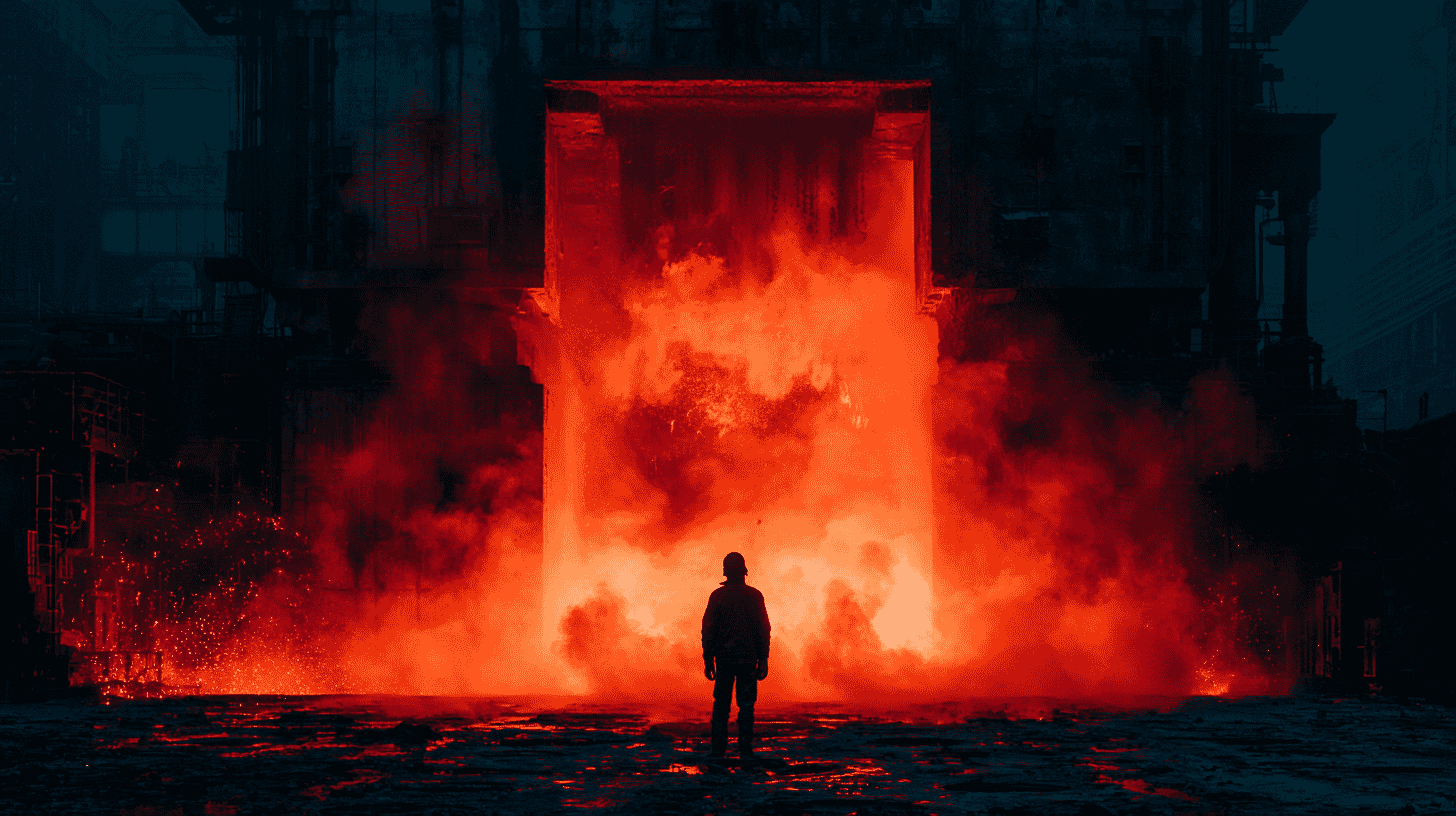
🏎️ In March, 315,000 fans poured into Suzuka over three days for the Formula 1 Japanese Grand Prix, the biggest crowd since the race returned in 2009. Almost nobody in the stands knew that the wheels under every car on the grid had been forged by hand-judgment in a quiet city on the Sea of Japan coast, a place better known for 400 years of bronze casting.
From a casting town to the F1 grid
The city is Takaoka, in Toyama Prefecture. Its metalworking roots run deep. In 1609 the warlord Maeda Toshinaga, the second lord of the Kaga domain, built a castle here, and in 1611 he invited seven foundry masters to settle in the Kanaya district to keep the new town prosperous. Four centuries later, Takaoka still makes around 90 percent of Japan's copperware, from temple bells to Buddhist altar fittings.
One important distinction sits underneath this story. Takaoka's heritage is casting, pouring molten metal into a mold. The wheels are forged, shaped by crushing solid metal under enormous pressure. They are different crafts. So it is not that an old bronze technique somehow became an F1 wheel. It is that this particular patch of Japan has spent 400 years being a place where metal is worked, and that density of skill is the soil the rest of the story grows in.
The company is BBS Japan. The name trips up a lot of people, so it helps to untangle it. BBS was founded in Germany in 1970, the initials standing for its founders and hometown of Schiltach. Michael Schumacher ran BBS wheels through his dominant years at Ferrari, and the brand became shorthand for the lightweight mesh look that car enthusiasts still chase. But the German company went through repeated financial collapse. Its forged-wheel business and production were moved to Japan, and today the forged side is run by BBS Japan, a subsidiary of the Fukui-based industrial materials maker Maeda Kosen. There is no longer any capital tie between BBS Japan and the German entity, which filed for insolvency again in October 2024; KW Automotive, owner of the BBS brand since 2021, took over its plant assets in March 2025. The brand is German by birth. The forged wheels are Japanese by manufacture.
BBS first entered Formula 1 in 1992, supplying forged magnesium wheels to Ferrari. From the 2022 season, when F1 switched from 13-inch to 18-inch rims, BBS became the sole supplier for every team on the grid, a contract that ran through 2025. For 2026 the FIA reopened the choice, so BBS no longer has a monopoly, but Ferrari and several other teams stayed with it anyway. Every BBS wheel on an F1 car is forged in Takaoka.
Where the blueprint runs out
Forging an F1 wheel is partly a brute-force exercise. BBS Japan uses one of the largest presses in the wheel industry, rated at 12,000 tons of force, to work hard-to-form aluminum and duralumin through several stages of hot forging. The F1 wheels themselves are forged magnesium, roughly 25 percent lighter than any equivalent, while the road wheels sold to the public are forged aluminum.
But a wheel is not born from a drawing and a number. Across forging, spinning, painting and finishing, tiny variations in how the metal flows and how hot it gets decide whether the part is excellent or merely acceptable. Newer alloys are the hardest. Aluminum and magnesium do not always behave the way the simulation predicts, and at that point the software stops being the final authority. Someone on the floor has to read the metal.
Catching the knack instead of killing it
In much of the West, the automation story is told as a fight: the skilled craftsman on one side, the robot that replaces him on the other. BBS Japan's answer cuts at a different angle. The goal is not to delete the human knack but to catch it, write it down, and pour it back into the process.
About a year ago the company set up a "Meister" system and certified two veterans in their fifties as its first masters. When molten metal is fed into the die, a Meister can tell whether it is filling the thin mesh spokes correctly, spotting differences too small to register otherwise, and feeds that read back into adjusting the production conditions. At the finishing stage, where inspection machines struggle, the same trained eye and hand catch flaws that instruments miss.
The crucial move is what happens next. Rather than leaving that judgment locked inside two people, the company turns it into standardized settings and concrete process improvements, so a personal feel becomes a repeatable technique. Takashi Hashimoto, who heads the manufacturing division, describes it as taking the Meisters' know-how and grinding it into the equipment itself, evolving the machinery to match the hands.
The fragility here should be said plainly. A capability that lives in two men in their fifties is, by definition, a risk, which is precisely why it has to be standardized before they retire. The company says it now plans to train one Meister for each process, both to widen the bench and to sharpen its ability to handle new materials. Whether tacit skill can really be transferred this cleanly, or whether something always slips through the gap, is the open question underneath the whole program.
What it actually buys
The payoff is a particular position in the world's premium forged-wheel market. The thing that makes a BBS wheel desirable, the lightweight, rigid, almost delicate mesh design, only exists because the forging is good enough to support it. The motorsport program is partly a showcase: the sharp aesthetics proven at the top of racing get carried down into the aftermarket wheels that enthusiasts actually buy, a link the company's sales side talks about openly.
It also reframes a tired idea. The "Japanese craftsman" usually shows up in foreign coverage as a romantic figure, an old man with a chisel, a symbol of something disappearing. Here the craftsman is the input to a 12,000-ton press and a quality system, the most current part of an advanced factory rather than a relic beside it. The cutting-edge equipment alone does not make the wheel. The accumulated skill on the floor is what BBS is built on.
In a lot of countries the parts under your car are anonymous, stamped out somewhere you will never think about. In Japan, at least for these wheels, there is a name, a town, and a pair of hands. Who makes the parts holding up the cars in your country, and would you ever find out?
Note: with rims opened up for 2026, BBS Japan announced a multi-year supply deal with Ferrari on 23 January 2026.


Global Discussion
0 comments