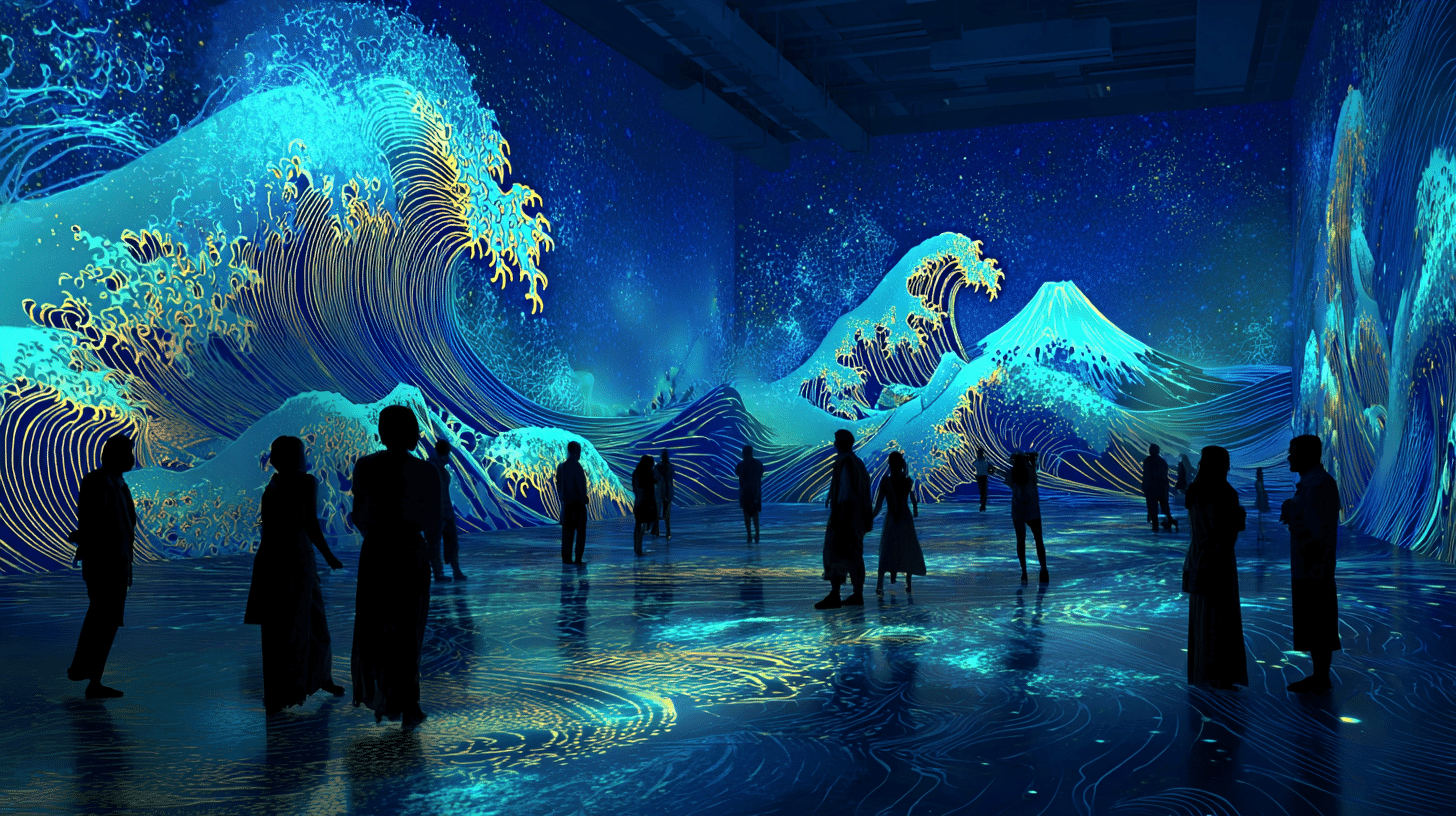
Imagine watching Hokusai's iconic Great Wave crash before your eyes, or seeing Sharaku's kabuki actors perform as if stepping off the stage. Edo-period woodblock prints, once frozen in time, are now coming alive through cutting-edge digital technology. The Osaka run of "Moving Ukiyo-e Exhibition OSAKA" closed on March 14, 2026. The tour has continued since.
What is "Moving Ukiyo-e Exhibition OSAKA"?
"Moving Ukiyo-e Exhibition OSAKA" ran from January 17 to March 14, 2026, at the Event Lab in Knowledge Capital, Grand Front Osaka North Building. The immersive digital art museum began in Nagoya in July 2023 and toured Kagoshima, Tokyo and Fukuoka domestically, with overseas stops in Milan in April 2024 and Taipei and Kaohsiung in 2025. By the time it reached Osaka it had drawn more than 350,000 visitors.
It also took the Excellence Award in the Project Category at the "CJPF Award 2025" hosted by the Cool Japan Public-Private Partnership Platform (Secretariat: Cabinet Office Intellectual Property Strategy Promotion Office).
Update: The tour continued after Osaka closed, reaching Paris in 2026. On July 18 the "Moving Ukiyo-e Exhibition HIROSHIMA" opened at NTT Cred Hall in Hiroshima (Motomachi Cred Pacela, 11F) and ran daily through September 6, the first staging in the Chugoku-Shikoku region. Organizers put cumulative worldwide attendance at 500,000 as of July, and the Hiroshima leg passed 10,000 visitors about ten days after opening. Admission is ¥2,200 general (¥2,000 advance), ¥1,500 student (¥1,300), ¥700 child (¥600), ¥1,900 senior (¥1,700), free for ages 3 and under.
Over 300 Masterpieces Come Alive with 3DCG
The Osaka venue showed over 300 works by world-renowned ukiyo-e masters including Katsushika Hokusai, Utagawa Kuniyoshi, Utagawa Hiroshige, Kitagawa Utamaro, Toshusai Sharaku, and Utagawa Kunisada. 3DCG animation and projection mapping set the static woodblock prints in motion.
Seven three-dimensional projection spaces each carried a different theme, with more than 40 projectors building the environments. Visitors moved through them as if they had stepped inside the prints.
Katsushika Hokusai: The "Old Man Mad About Painting"
One of the exhibition's highlights is the work of Katsushika Hokusai (1760-1849). Hokusai was a master artist of the Edo period who created over 30,000 works during his 88-year lifetime. In 1999, he was the only Japanese person included in Life magazine's list of "The 100 Most Important People of the Last Millennium."
Among his masterpieces, "The Great Wave off Kanagawa" from the "Thirty-six Views of Mount Fuji" series is one of the most recognized Japanese artworks worldwide. Van Gogh praised it enthusiastically in letters to his brother, and composer Debussy drew inspiration from it for his orchestral work "La Mer." In July 2024 the image was placed on the back of Japan's new 1,000 yen note.
In the exhibition the great wave breaks and sprays in front of you. The wave that Hokusai perfected past the age of 70 moves.
Toshusai Sharaku: Ukiyo-e's Greatest Mystery
Another must-see artist is Toshusai Sharaku. Sharaku burst onto the ukiyo-e scene in May 1794, produced approximately 145 works in just 10 months, and then vanished without a trace, becoming known as the "mysterious artist" of ukiyo-e history.
Sharaku's most distinctive feature was his "okubi-e" (large-head pictures) of kabuki actors, which boldly exaggerated their features, hooked noses, wrinkles, protruding jaws, to capture their individual personalities. This revolutionary style was controversial at the time. German art historian Julius Kurth published a study of Sharaku in 1910 that praised him highly, and from that reception Japan came to describe him as one of the world's three great portraitists alongside Rembrandt and Velázquez. The label itself took hold in Japan rather than in Kurth's own text.
Sharaku's true identity remained a mystery for centuries, but recent research suggests he may have been Saito Jurobei, a Noh actor employed by the Tokushima Domain. In the 2025 NHK Taiga drama "Berabou," which focuses on publisher Tsutaya Juzaburo who discovered and promoted Sharaku, this mysterious artist plays a key role in the storyline.
Osaka-Exclusive Exhibition Content
The Osaka venue features unique exhibition commentary not available at other locations. Visitors can learn about the history of ukiyo-e in Osaka and the relationship between Kamigata (Osaka-Kyoto) culture and woodblock prints, offering cultural depth beyond the digital art experience.
In addition to digital displays, the exhibition includes precious original ukiyo-e prints from the Edo period and reproductions, allowing visitors to compare the original works with their digital interpretations.
The Osaka Run, For the Record (Now Closed)
Exhibition Period: January 17 (Sat) - March 14 (Sat), 2026 Hours: 10:00-20:00 (Last entry 19:30) *Open daily during the exhibition period Venue: Grand Front Osaka North Building, Knowledge Capital Event Lab Address: 3-1 Ofuka-cho, Kita-ku, Osaka Access: 3-minute walk from JR Osaka Station, 3-minute walk from Osaka Metro Midosuji Line Umeda Station
Ticket Prices:
- Adult: ¥2,300 (day-of) / ¥2,000 (advance)
- Student (High school/University/Vocational): ¥1,600 (day-of) / ¥1,300 (advance)
- Child (Ages 4 to Junior High): ¥1,000 (day-of) / ¥800 (advance)
- Ages 3 and under: Free
Photography and video were permitted throughout the venue and social media posting encouraged, a policy the Hiroshima staging has kept.
Ukiyo-e was born as popular entertainment for Edo-period commoners, sold for just a few hundred yen per print. Today they sit in museums worldwide and individual impressions can command hundreds of millions of yen. The Osaka run is over, but the tour has not stopped.
Does your country have similar efforts to reinterpret traditional art through digital technology?
References
- https://www.ukiyoeimmersiveart.com/osaka
- https://osaka-info.jp/event/ukiyoe-immersive-art-osaka/
- https://www.grandfront-osaka.jp/event/5218/
- https://prtimes.jp/main/html/rd/p/000000396.000046440.html
- https://www.ukiyoeimmersiveart.com/hiroshima
- https://prtimes.jp/main/html/rd/p/000000472.000046440.html






Global Discussion
15 comments