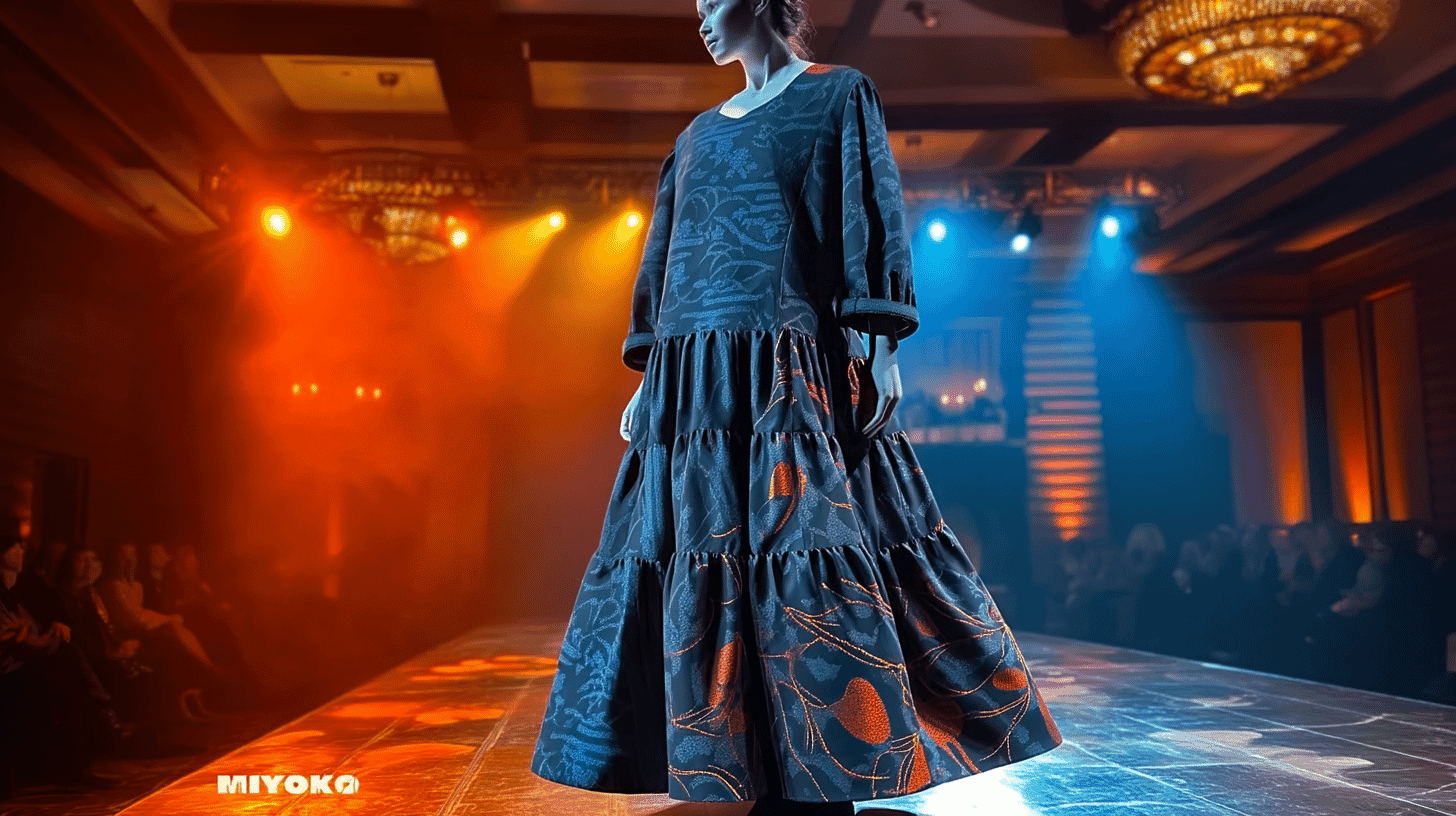
👘 What if a 14-inch-wide strip of silk—woven using techniques passed down for centuries—could become a modern dress or suit? A 76-year-old Japanese designer with nearly 50 years of experience is proving it can, presenting her collection on one of fashion's biggest stages: New York City.

When Kimono Fabric Becomes Modern Fashion

On February 14, 2026, fashion brand MIYOKO will present its latest collection at St. Bartholomew's Church on Park Avenue in Manhattan. Held as part of an independent showcase during New York Fashion Week, the event will feature 14 garments—all crafted from traditional Japanese kimono fabrics called tanmono (反物).

For those unfamiliar with the term, tanmono are bolts of fabric specifically woven for making kimono. They're remarkably narrow—only about 14 inches (36 cm) wide—far slimmer than the broad textiles used in Western fashion. Transforming these narrow strips into Western-style dresses, suits, and jackets requires a completely different approach to pattern-making. MIYOKO's designs embrace this constraint, using the fabric's unique textures and pattern placement as integral elements of the garment's aesthetic.

A Designer With Half a Century of Craft

The woman behind the brand is MIYOKO herself, born in 1949. After graduating from a dressmaking academy and studying professional pattern cutting, she worked in the planning department of VIVID Hanae Mori—the fashion house of Hanae Mori, one of the few Japanese designers to show at Paris Haute Couture and a pioneer in bringing Japanese aesthetics to the global fashion stage.

MIYOKO now serves as the okami (proprietress) of Oshimaya Gofukuten, a traditional kimono shop established in 1946 in Gosen City, Niigata Prefecture. The concept of okami is deeply rooted in Japanese culture—she is the woman who manages the business, maintains customer relationships, and serves as the face of the establishment.

For approximately 50 years, MIYOKO has been creating made-to-order Western-style garments from kimono fabrics as her life's work. She formally established the MIYOKO brand in 2022, and since then has presented her work in Paris (September 2024), New York (February 2025), and at the Niigata Fashion Runway (April 2025).

The Textiles: Japan's Living Heritage

What sets MIYOKO apart from other designers working with Japanese materials is that all fabrics used are brand-new tanmono—not repurposed vintage kimono or upcycled scraps. Each piece is freshly woven using traditional techniques, supporting the artisans and workshops that continue these crafts today.

The collection features textiles from across Japan, each with its own centuries-old story:

Habutae & Sha (from Gosen, Niigata)Habutae is a lustrous, smooth silk fabric woven without twisting the warp threads, historically one of Japan's key export goods. Sha is a delicate, semi-transparent gauze-like fabric traditionally used for summer kimono. Gosen City is one of Japan's premier silk-weaving regions.

Ojiya-tsumugi (from Ojiya, Niigata) — A designated Traditional Craft of Japan, this silk textile is woven from hand-spun silk floss threads, giving it a characteristically soft, warm, and lightweight feel. Born in the snowy Echigo region, where harsh winters and humid air created ideal conditions for textile production.

Hon-Shiozawa (from Minamiuonuma, Niigata) — This fabric gets its distinctive shibo (textured surface with tiny ripples) from an extraordinary process: silk threads are twisted 7 to 8 times more tightly than normal, then woven and kneaded in warm water to create a crisp, refreshing texture. Known by its beloved nickname "Shiozawa Omeshi."

Yuki-tsumugi (from Yuki, Ibaraki) — Inscribed on UNESCO's Intangible Cultural Heritage list in 2010, this is considered one of Japan's finest silk textiles. Each bolt is woven by hand on a traditional backstrap loom called izari-bata, a process that can take months to complete. The result is fabric with an unmatched softness that becomes more supple with each wearing.

Yuzen fabricsYuzen-zome is Japan's most celebrated dyeing technique, where artisans hand-paint intricate designs of flowers, birds, landscapes, and seasonal motifs onto silk using resist-paste outlines. The technique produces astonishingly detailed, painterly imagery that has been described as "wearable art."

"Not Preserving Tradition—Rebuilding It for Today"

MIYOKO's philosophy carries a deliberate message: traditional craft should not be treated as museum artifacts. The brand's stated theme is reconstructing tradition not as something to merely "preserve" but as "clothing for people living in the present."

This philosophy addresses a very real crisis in Japan. Kimono demand has been declining for decades, and textile-producing regions across the country are struggling with aging artisans, declining apprenticeships, and shrinking markets. By transforming tanmono into contemporary garments, MIYOKO creates new demand for these traditional fabrics while spotlighting the extraordinary skills of the weavers and dyers who produce them.

Notably, MIYOKO operates on a made-to-order basis with no standing inventory. Each garment is individually tailored to the wearer's body and preferences—a practice that stands in stark contrast to fast fashion and embodies the Japanese value of cherishing a single garment (ichigo ichie, or "one encounter, one chance," applied to clothing).

A Small-Town Shop on the World Stage

Perhaps the most compelling element of this story is the scale. Oshimaya Gofukuten is based in Gosen City, a town of roughly 45,000 people in Niigata Prefecture. The company has capital of just 5 million yen (approximately $32,000). This is not a luxury conglomerate or a venture-backed startup—it's a family-run traditional kimono shop that has been operating since 1946.

Yet from this modest base, MIYOKO has presented collections in both Paris and New York, two of the world's fashion capitals. Gosen City is itself a major silk-producing region, and there's something poetically fitting about a brand rooted in that local textile culture carrying those very fabrics onto an international stage.

The venue for this year's show, St. Bartholomew's Church, is a Byzantine-Romanesque landmark on Park Avenue dating to 1918—a space where East meets West in a very literal sense. The show is produced by EC Entertainment Media's MY RUNWAY PROJECT as part of an independent showcase during Fashion Week.

Why This Matters Beyond Fashion

MIYOKO's New York debut is more than a fashion event. It represents a model for how Japan's traditional craft industries might find new life: not by freezing techniques in time, but by channeling them into contemporary forms that speak to global audiences. When a 76-year-old designer from a small Niigata town can command attention on Park Avenue with garments made from handwoven silk, it suggests that the world's appetite for authenticity, craftsmanship, and cultural depth is far from exhausted.

In Japan, there's a growing movement to bring traditional textile techniques into modern fashion. Does your country have designers or brands that incorporate traditional weaving or dyeing methods into contemporary clothing? We'd love to hear about them.

References

Reactions in Japan

The idea of Gosen's habutae silk making it to a New York runway is incredibly moving. My grandmother used to weave in Gosen, so reading this brought me to tears. I can only imagine how thrilled the people in the production region must be...

I agree 0
I disagree 0

To be honest, an independent showcase 'during' Fashion Week and an official calendar runway show are completely different things. When media reports blur that distinction and say 'presenting at NY Fashion Week!' it's a bit frustrating from an industry perspective.

I agree 0
I disagree 0

Making Western clothes from 36cm-wide fabric—just drafting the pattern must be mind-boggling. I went to fashion school and I can tell you this is truly a specialized skill. It's work that absolutely requires 50 years of accumulated experience.

I agree 0
I disagree 0

As someone from Niigata, this is wonderful news. Gosen, Ojiya, Minamiuonuma—all the materials used are from our prefecture's proud traditions. Though whether activities like this actually help solve the succession problem in production regions remains to be seen.

I agree 0
I disagree 0

Presenting a collection in NY at age 76—the vitality is incredible. She's my parents' generation, but her drive to compete internationally might be more aggressive than today's young designers.

I agree 0
I disagree 0

So Yuzen fabrics are being used too. As a Yuzen artisan, a single bolt can take months to complete, so cutting it into Western clothes gives me mixed feelings. But maybe it's better to have someone wear it than let it sit unused in a drawer...

I agree 0
I disagree 0

A no-inventory, made-to-order model is the polar opposite of fast fashion. It's a low-environmental-impact approach from an SDGs perspective, and using new fabrics generates direct demand for production regions. But how do they address the scalability issue?

I agree 0
I disagree 0

Kimono remake is common, but what's interesting about MIYOKO is the use of brand-new fabric. It's a completely different concept from vintage upcycling. Not 'preserving tradition' but 'wearing fabric woven with today's skills in today's designs'—that feels fresh.

I agree 0
I disagree 0

Even a basic Yuki-tsumugi bolt costs at least $2,000, and Yuzen can be a whole different price bracket. What would the final garment price be? The target customer base must be extremely limited. Presenting in NY will boost brand value, though.

I agree 0
I disagree 0

As someone who wears kimono regularly, seeing fine fabric used for Western clothing is honestly a little sad. But given that the kimono-wearing population has drastically declined, 'being worn' might be the greatest tribute to the fabric. In the end, maybe what matters most is that the cloth lives on.

I agree 0
I disagree 0

The fact that she came from Hanae Mori's planning department really got me. Hanae Mori's butterfly designs are legendary in Japanese fashion, and someone from that lineage still pushing boundaries at 76 is genuinely cool.

I agree 0
I disagree 0

A company with $32K in capital doing a show in NY—I wonder if it's profitable or all out-of-pocket. It's wonderful as cultural outreach, but what about business sustainability?

I agree 0
I disagree 0

St. Bartholomew's Church is one of NY's architectural gems. Just imagining Japanese tsumugi and Yuzen fabrics in that space gives me goosebumps. The contrast between stone Western architecture and Japanese silk must be absolutely stunning.

I agree 0
I disagree 0

An era where a small local kimono shop can go global. I love that it's coming from Gosen City. I hope we see more of this direct 'production region to world' route, bypassing Tokyo entirely.

I agree 0
I disagree 0

She's been making Western clothes from kimono fabric for 50 years? That's incredibly ahead of her time. Back then people probably said 'what a waste,' but now it's being recognized globally. Persistence really does win in the end.

I agree 0
I disagree 0

Voices from Around the World

Charlotte Dubois

As someone in the Parisian haute couture world, constructing garments from 14-inch-wide fabric is an unbelievable technical feat. It upends every conventional rule of dressmaking. A perfect example of how constraints breed creativity.

David Chen

To be fair, it's an independent showcase rather than an official NYFW runway show—that's worth noting. But even so, the impact of showcasing these materials in that venue should be significant.

Priya Sharma

India has incredible handwoven traditions too—Banarasi silk, Kanjivaram silk—but very few brands transform them into Western garments and bring them to international fashion scenes. MIYOKO's approach could be a valuable reference for India's textile industry.

Thomas Bergström

From a Scandinavian design perspective, MIYOKO's no-inventory, made-to-order model makes perfect sense. We have active slow fashion discussions in Sweden, but Japan apparently has 50 years of actual practice behind it. That's impressive.

Amina Okafor

Nigerian Aso-oke cloth is also handwoven and often one-of-a-kind, but Japan is far superior at branding in the 'traditional fabric as modern fashion' narrative. African textiles have the same potential, but we haven't established routes to international stages. It's frustrating.

Marco Bellini

As an Italian, I have opinions about textile quality. I knew Yuki-tsumugi was a UNESCO Intangible Cultural Heritage, but I didn't know there was a brand actually making it into wearable clothing. I can feel the respect for the material in this approach.

Sarah Mitchell

A 76-year-old woman presenting a collection in NY is the ultimate counter to the ageism plaguing the fashion industry. Experience and skill transcend age. We need more stories like this.

김수현 (Kim Soo-hyun)

Brands using hanbok fabric in modern fashion are growing in Seoul, but few have taken it to NY yet. Japan's moves like this are inspiring. It would be exciting if Korea and Japan could jointly pioneer an 'Asian traditional textiles' category together.

Roberto Salazar

Oaxacan embroidery from Mexico is globally popular too, but the problem is big brands copying it and stripping away cultural context. The way MIYOKO clearly communicates which region and which technique produced each fabric is an answer to the cultural appropriation issue.

Lisa Nakamura-Thompson

As a third-generation Japanese-American, news like this makes me feel connected to my roots. My grandmother had Yuki-tsumugi in her tansu chest, but I never learned to wear kimono. If it becomes Western clothing, maybe I could wear it too.

Hans Müller

Bauhaus said 'form follows function,' but for MIYOKO it might be 'form follows material.' The 36cm-wide fabric dictates the form, and that constraint generates the design. There's something surprisingly resonant with German design thinking here.

Olivia Park

The Australian fashion industry honestly doesn't pay much attention to fabric history or backstory, but brands with this kind of narrative definitely resonate with a certain clientele. If it appeared in a Sydney boutique, I'd absolutely check it out.

Jean-Pierre Moreau

The fabric quality is surely excellent, but the real question is the design. 'Using great materials' alone won't compete in the global fashion market. Whether the cutting, silhouette, and styling reach Paris or Milan standards is the true benchmark.

Ana Costa

Brazil has indigenous weaving traditions, but virtually zero movement to bring them to international fashion. What Japan excels at is the ability to narrate tradition as a 'story.' By adding narrative alongside technique, the value of the fabric multiplies.

王美玲 (Wang Meiling)

China has world-class traditional textiles too—Suzhou embroidery, Hangzhou silk. But honestly, in branding 'contemporary fashion using traditional materials,' we're well behind Japan. I envy the Japanese ecosystem that allows small, regional brands like MIYOKO to reach the world stage.