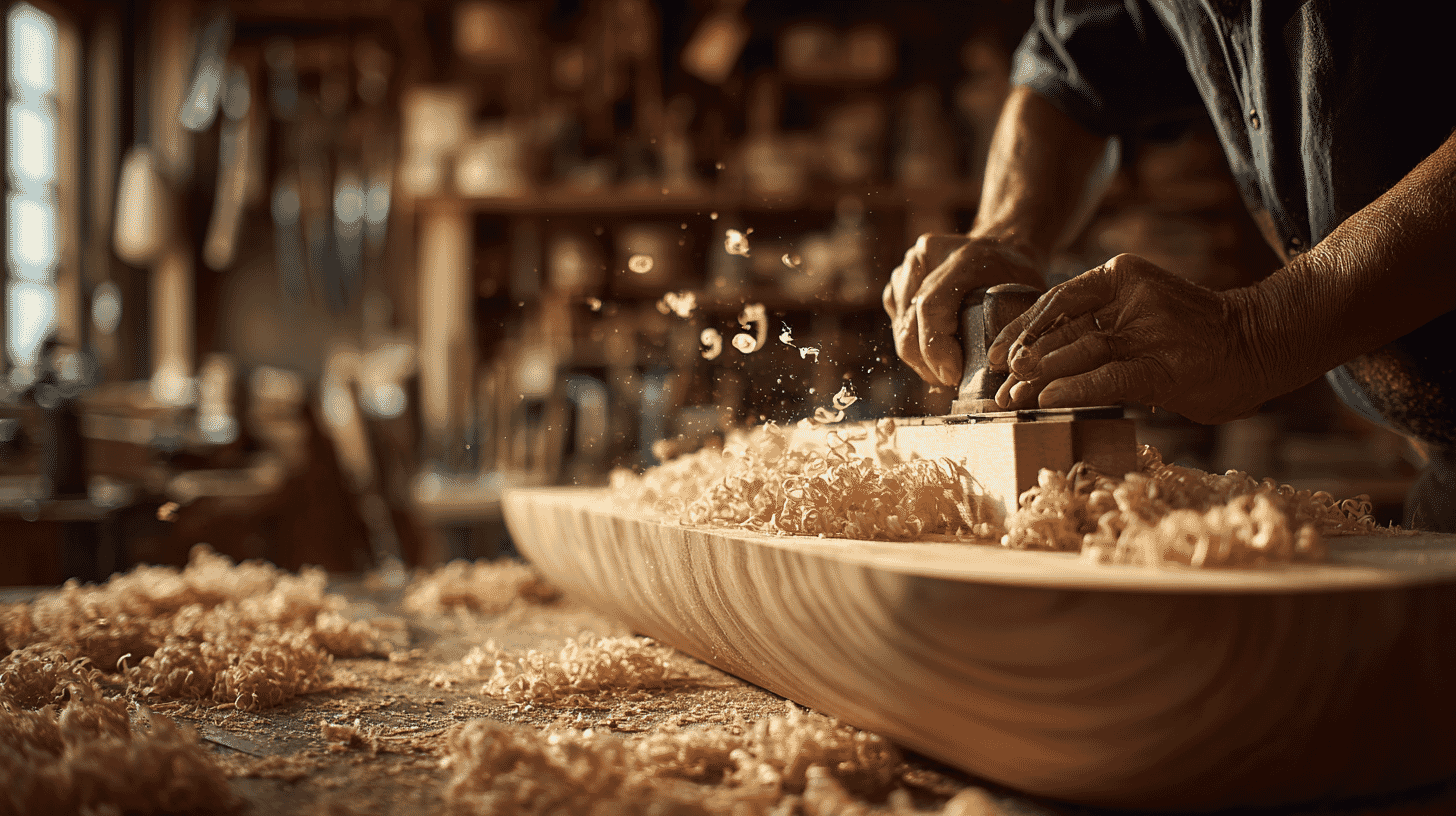
In a modest workshop on the outskirts of Tokyo, a furniture craftsman has won 50 international design awards across 8 countries, using nothing but hand planes and blades. In a world of disposable furniture, this man builds pieces meant to last 100 years. His philosophy shows that Japanese craftsmanship isn't a relic of the past but a blueprint for the future.
Meet Shigeki Matsuoka: Japan's "Contemporary Master Craftsman"
On the western edge of Tokyo, in the city of Musashimurayama, sits the workshop of KOMA, a furniture studio of roughly 20 artisans led by a man known simply as "Oyakata" (master). His real name is Shigeki Matsuoka, born in 1977, and he is one of the most decorated furniture makers alive today.
After graduating from art school, Matsuoka apprenticed at Hita Kogei, a furniture manufacturer in Saitama Prefecture. Within just two and a half years, he was entrusted with developing a new chair design, a rare distinction for such a young craftsman. In 2003, he struck out on his own and founded KOMA, building a brand around a deceptively simple idea: every piece of furniture should have the quality and beauty of a one-of-a-kind artwork, even when produced as a product line.
In 2020, Japan's Ministry of Health, Labour and Welfare named Matsuoka a "Gendai no Meiko" (Contemporary Master Craftsman), the youngest recipient that year. This is one of the highest honors the Japanese government bestows on skilled artisans, recognizing individuals whose technical mastery sets the standard for their entire profession. In 2024, the Tokyo Metropolitan Government added to his accolades by designating him a "Tokyo Meister."
Conquering the World's Top Three Design Awards, and 47 More
KOMA's furniture has earned recognition far beyond Japan. In March 2025, Matsuoka received Germany's prestigious "iF Design Award," completing a sweep of what the design world calls the "Big Three": the iF Award (Germany), the Red Dot Award (Germany), and the International Design Excellence Award (IDEA, United States).
But Matsuoka didn't stop there. At the DNA Paris Design Award 2024, his "tie sofa" won the Grand Prix in the Product Design category, the top honor, with only one Grand Prix awarded per category. The same sofa also earned recognition at London's International Creative Competition. Across all competitions, Matsuoka's personal tally reached 50 international design awards spanning 8 countries.
Among KOMA's most celebrated creations is the "cocoda chair," the brand's flagship model. Rather than designing storage furniture as a conventional box, the "cocoda" series borrows structural principles from chair design, using legs and frames to create three-dimensional forms that are strikingly unusual for cabinets and sideboards. The "tie sofa" reimagines the sofa not as a piece of seating but as a spatial element that shapes the relationships between the people who use it.
Matsuoka also designed the Symbol Furniture for the Tokyo 2020 Olympics, bringing Japanese woodworking to the world's largest sporting stage.
"Design Is About Fulfilling Purpose"
At the heart of Matsuoka's work is a conviction that might surprise those who expect Japanese craft to be about ornament: "Design means fulfilling a purpose." He doesn't start by sketching beautiful shapes. He starts by asking what the furniture is for. Is this chair for dining? For relaxing? For working at a desk? The answer determines everything.
This process-driven approach leads to an unexpected outcome: when function is pursued to its absolute limit, beautiful form emerges naturally. The aesthetic appeal of KOMA furniture isn't applied decoration, it's the inevitable result of deeply considered ergonomics and material understanding.
The crafting process itself relies on traditional Japanese hand tools, planes ("kanna") and blades that Matsuoka calls his "treasures." Each surface is shaved by hand, stroke by stroke, producing a smoothness and tactile warmth that machine sanding simply cannot replicate. Visitors to the Musashimurayama workshop often remark on the sheer volume of wood shavings produced, enormous bags, three or four at a time, a testament to how much material is removed by hand in pursuit of the perfect curve.
KOMA chairs start at around $1,300, with sofas exceeding $12,700, prices that reflect the reality that each piece is individually handcrafted. The brand operates flagship stores in Ogikubo (Suginami) and Aoyama (Minato) in Tokyo, and ships worldwide.
"Keinen-Bika": The Philosophy That Turned Heads in America
One of the most compelling voices championing KOMA and Japanese craftsmanship abroad is Ryuun Tsukahara, a Gen-Z entrepreneur born in 2000. After enrolling at an American university, Tsukahara had a revelation during a class presentation about consumer culture. He introduced a Japanese concept called "keinen-bika", literally, "beauty through aging."
While Western consumer culture often frames aging as deterioration ("keinen-rekka" in Japanese), Japanese traditional crafts embody the opposite: objects become more beautiful, more characterful, and more beloved the longer they are used. When Tsukahara presented this idea to his American classmates and professors, the response was immediate and enthusiastic. "That's such an advanced way of thinking," they said. "That's sustainability at its most beautiful." In that moment, Japanese craft was no longer seen as a quaint cultural tradition, it was recognized as a forward-looking philosophy for a world drowning in disposable goods.
Tsukahara went on to found KASASAGI in 2020, a company that bridges traditional Japanese craft and modern business. He was selected for Forbes JAPAN's "CULTURE-PRENEURS 30" list, appeared on major Japanese television programs, and in 2025 established KASASAGI STUDIO, an architecture firm that integrates traditional craft techniques into contemporary building design, a field he calls "Kogei Architecture." KASASAGI's own office furniture is entirely custom-made by KOMA, including a table crafted from "jindai keyaki", zelkova wood that spent over 1,000 years buried underground, a material of extraordinary rarity and beauty.
Building a Future Where Craftspeople Can Thrive
KOMA draws visitors from across Japan not just for its furniture, but for its management philosophy. In the traditional craft world, artisans often work in isolation, and many struggle financially. Matsuoka has built something different: a team-based workshop where roughly 20 craftspeople collaborate under the motto "A company is made of its people."
What sets KOMA apart is its emphasis on each artisan's "producing power", not just the ability to make excellent things, but the ability to communicate that excellence to the market. Founding member Toshihiro Kamei launched "Bespoke Case," a luxury watch case brand using rare woods. A staff member trained at Tokyo University of the Arts brings contemporary art sensibilities to furniture design. Each individual's strengths become part of KOMA's collective identity.
Collaborations extend beyond the workshop. KOMA works with "carpenter artists" like Shohei Hishida, whose buildings fuse Japanese and European traditional construction methods. These cross-disciplinary partnerships open new markets and new forms of expression for traditional woodworking.
This model addresses one of the most persistent challenges in Japanese craft: the difficulty of making a sustainable living. When artisans can't earn enough, skills disappear within a generation. KOMA offers a counter-narrative, proof that world-class handcraft can also be a viable business.
Furniture That Outlives Its Maker
Matsuoka has said in multiple interviews: "I want to create furniture that people recognize as excellent no matter how the times change, no matter who is looking at it. Furniture whose value is still acknowledged 100 years after I'm gone."
This ambition speaks to a broader reality facing Japanese traditional craft. Artisans are aging, successors are scarce, and cheap industrial alternatives are everywhere. KOMA's answer is to compete not on price but on an entirely different axis: irreplaceable quality rooted in human skill and natural materials.
In an era of mass production, hand-finished furniture carries something factory-made pieces cannot, the dimension of time. Wood grain shifts and deepens with years of use. The surface develops a patina unique to its owner's touch. The piece doesn't just age; it grows alongside the person who lives with it. This is "keinen-bika" in its purest form, and it may be the most compelling argument Japanese woodworking offers to the world.
In Japan, the idea of "growing" an object rather than "consuming" it is deeply embedded in craft culture. Does your country have a tradition of craftsmanship where objects become more beautiful with use?







Global Discussion
15 comments