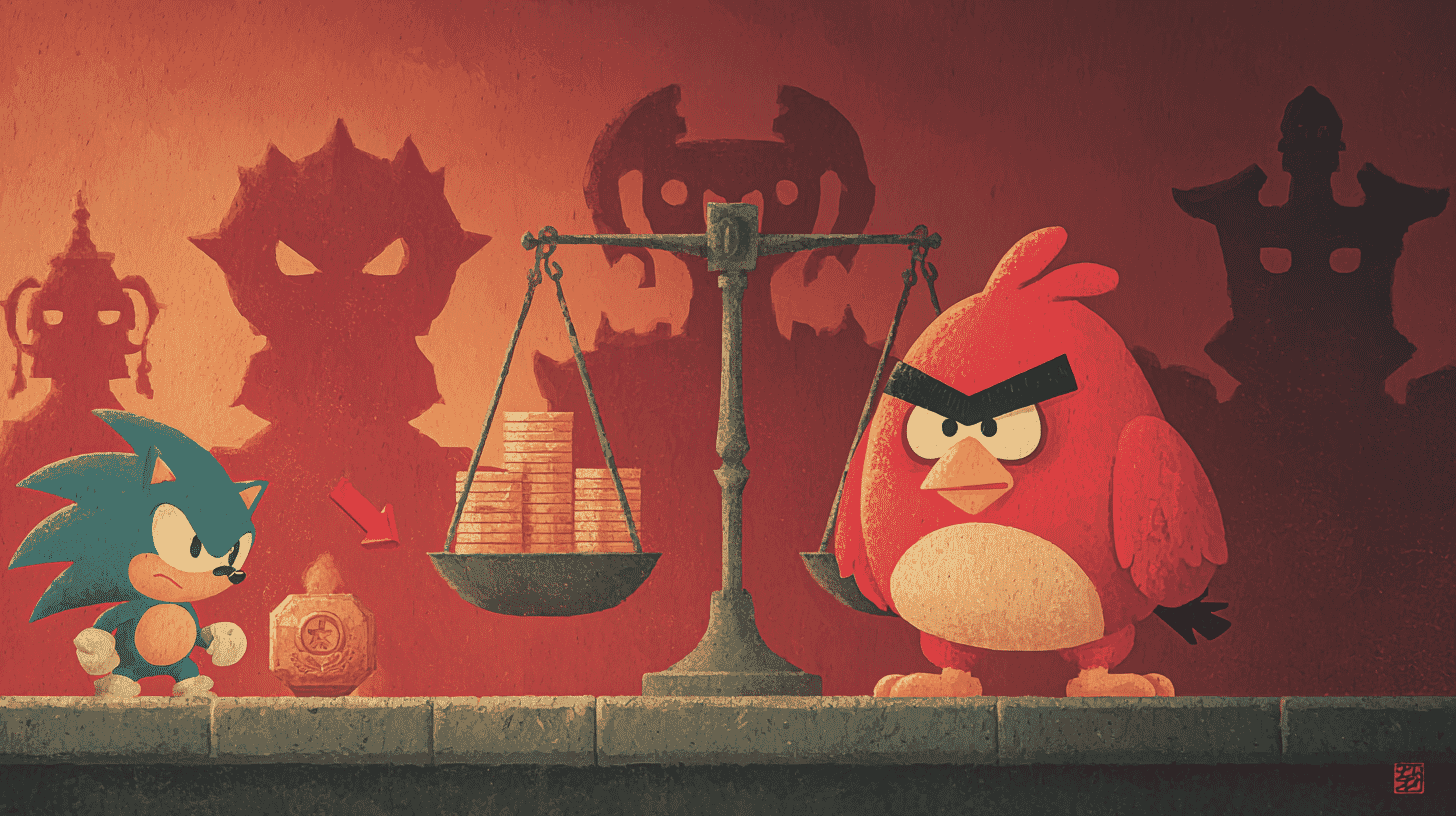
📉 Record revenue, first net loss in 11 years. On May 12, 2026, SEGA Sammy Holdings closed the books on a fiscal year that looked great at the top of the income statement and brutal at the bottom. Revenue hit a record 487.5 billion yen (about $3.1 billion). Net income? A loss of 5.76 billion yen (about $36.6 million), the first time the company has ended a year in the red in 11 years. The culprit, by name: Rovio Entertainment, the Finnish studio behind Angry Birds that SEGA acquired in 2023. This is what a "kitchen-sinking" year looks like, and what comes next is a sharp pivot away from the live-service mega-game dream and back toward the franchises that built SEGA in the first place.
The headline numbers
For the fiscal year ending March 2026:
- Revenue: 487.5 billion yen (~$3.1B), +13.7% YoY (a record)
- Operating income: 47.1 billion yen (~$299M), -2.1% YoY
- Ordinary income: 54.2 billion yen (~$344M), +2.1% YoY
- Net income attributable to shareholders: -5.76 billion yen (~-$36.6M). First net loss since FY2015
- Special losses: 58.8 billion yen (~$373M). The line item that flipped the year
So the operating business actually performed reasonably well, and the pachislot/pachinko (gaming-machine) segment had a strong year. The collapse happened below the operating line.
What broke: Rovio and Stakelogic
The 58.8 billion yen in special losses comes mostly from two acquisitions that didn't pan out:
- Rovio Entertainment: impairment of approximately 31.3 billion yen (~$199M) on goodwill and other intangible assets, booked in Q3
- Stakelogic B.V. (online casino software, Netherlands): impairment of approximately 18.7 billion yen (~$119M), booked at year-end and above the ~15.0 billion yen originally estimated, as regulatory tightening in the Dutch market shrank the addressable market faster than expected
SEGA acquired Rovio in August 2023 for roughly $776 million. Less than three years later, it has written down more than a quarter of that price. The company's own explanation: after Rovio joined the group, the global mobile market saw multiple new mega-titles and user-acquisition costs (ROAS, return on ad spend) deteriorated sharply, leaving Rovio unable to execute the growth plan SEGA had paid for.
The collaborative mobile title Sonic Rumble, jointly developed with Rovio and launched in November 2025, also missed key performance indicators on active users.
The argument international gamers keep making
In the comments on NeoGAF, ResetEra and r/gaming, the same line keeps showing up in slightly different wording: Rovio's owners sold at the top, and SEGA got left holding the bag.
The 2023 acquisition closed at a moment when Angry Birds, the franchise that defined casual mobile gaming in the early 2010s, was no longer the cultural force it had been in 2012-2016. Privacy changes on iOS made paid user acquisition vastly more expensive industry-wide. Mobile gaming's growth had slowed. Buying a mature mobile-IP holder for nearly a billion dollars in that environment is, in hindsight, a hard sell.
SEGA Sammy has been clearer in tone than usual. The Q3 FAQ initially acknowledged the company had "relied too much on local management" at Rovio (a phrase it later softened). Daniel Svärd, formerly head of live game studios at King (the Candy Crush maker), is being brought in as Rovio COO. The strategy now: focus Rovio narrowly on the Angry Birds IP itself, raise the share of payments made outside the app stores to improve margins, and stop trying to be a broad mobile publisher.
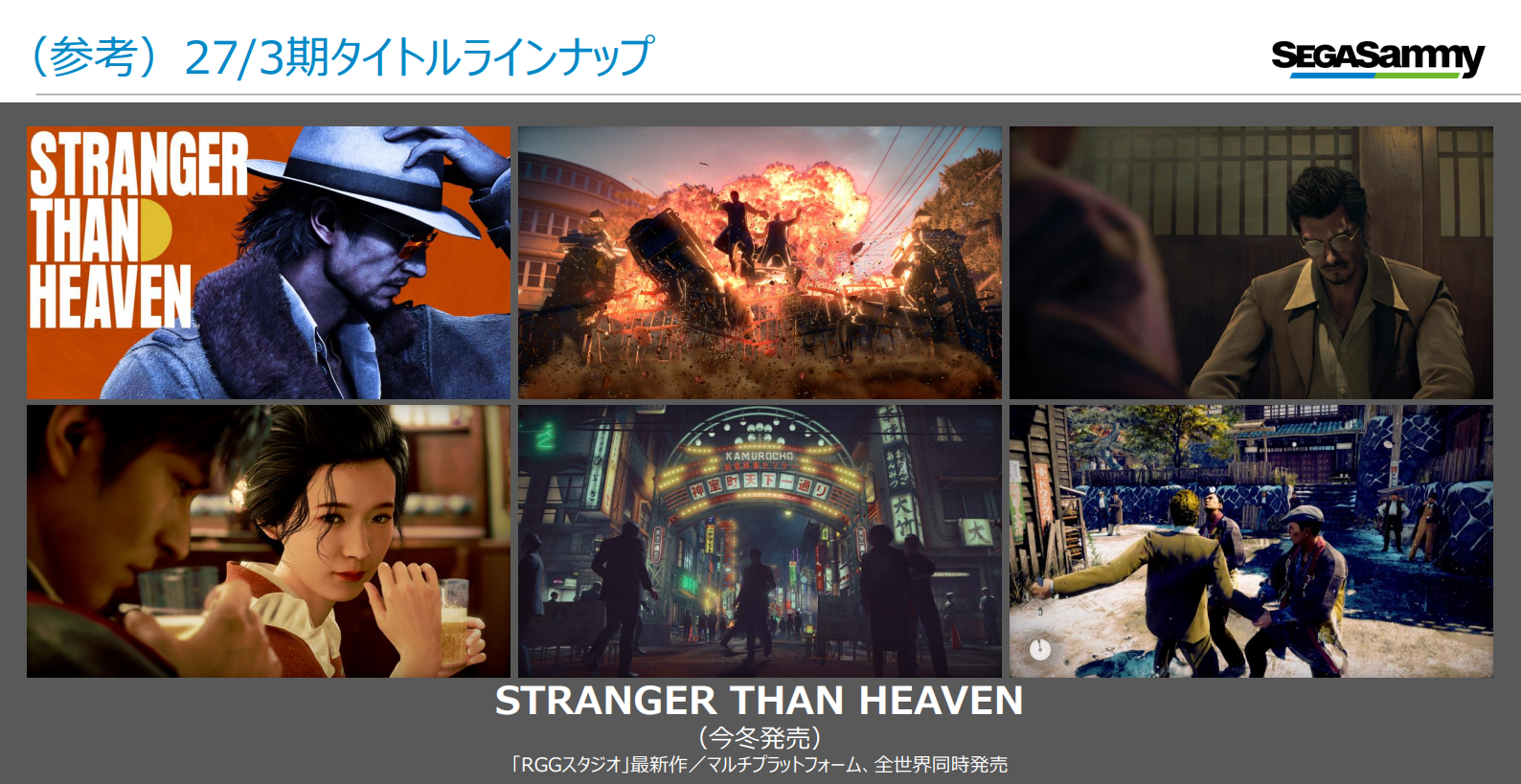
SEGA Sammy Holdings via 4Gamer.net
The harder problem: full-game new releases also missed
It would be convenient to blame everything on Rovio. The data doesn't quite let SEGA off the hook.
Entertainment Contents segment revenue was 326.6 billion yen (~$2.1B), up just 1.6% YoY, while operating profit fell 20.6%. The company explicitly said new full-game releases and repeat sales of older titles both came in below plan. The full-game lineup for the year included RAIDOU Remastered, SHINOBI: Art of Vengeance, Sonic Racing CrossWorlds, Football Manager 26, Like a Dragon: Kiwami 3 / Dark Ties, and Persona 3 Reload on Switch 2.
The structural problem SEGA has named publicly is real and applies to a lot of mid-budget Japanese publishers right now: the market is bifurcating into AAA and indie, while the "AA / single-A" middle, where many SEGA titles sit on budget, is increasingly squeezed. SEGA's CEO Haruki Satomi acknowledged in earnings remarks that the company's titles score well on quality but haven't yet converted that into the kind of must-buy unit sales that move financial needles.
The Super Game is dead. Long live the four mainstay titles.
This is the part that matters most for the next few years.
SEGA confirmed in this earnings cycle what had been rumored since February: the "Super Game" initiative is officially cancelled. Super Game was SEGA's five-year plan, announced around 2021, to build a global live-service mega-title aimed at 100 billion yen in lifetime revenue. With the global GaaS market littered with corpses (Concord, Suicide Squad: Kill the Justice League, multiple Sony cancellations) and SEGA's own Sonic Rumble underperforming, the project no longer made sense.
Instead, here's the FY2027 plan in plain language:
- Deprioritize F2P. Over 100 developers are being shifted from F2P projects onto full-game development for mainstay IPs.
- Ship four major new titles on mainstay IPs between April 2026 and March 2027.
- Suspend large M&A. No more 776-million-dollar acquisitions for the foreseeable future.
- Buy back 20 billion yen (~$127M) of shares by July 31, 2026, and cancel them.
- Push transmedia harder. The Angry Birds Movie 3 drops in December 2026, Sonic the Hedgehog 4 (live action) in March 2027.
The four mainstay-IP titles aren't officially named, but the consensus reading among gaming press is some combination of: a new mainline Sonic (it's the franchise's 35th anniversary in 2026), Persona 4 Revival, Stranger Than Heaven (the next from Ryu Ga Gotoku Studio, due winter 2026), and Total War: Warhammer 40,000. That's a genuinely promising lineup, and it's the most concentrated mainstay-IP push SEGA has telegraphed in years.
Why this matters now
Three reasons this earnings cycle is more interesting than the usual "Japanese publisher misses guidance" story:
1. It's an honest write-down. Plenty of companies in SEGA's position would have stretched the goodwill carrying value out for another year or two. Taking the full hit now, including the year-end Stakelogic impairment, clears the balance sheet and lets the next CEO conversation be about growth instead of legacy mistakes.
2. It's a clear refutation of "buy your way into mobile." SEGA, Embracer, Take-Two (Zynga), Microsoft (Activision-King): publishers have spent the 2020s acquiring mobile firms at premium valuations. SEGA's experience is the cleanest cautionary tale yet. Expect this to come up in the next dozen boardroom conversations about mobile M&A.
3. It's a real strategy pivot, not just spin. Moving 100+ developers off F2P and onto full games is an operational decision with consequences: Rovio loses bench depth, Sonic Team gains it. Combined with the death of Super Game and the four mainstay-IP commitment, the trajectory is clear: SEGA is betting that the path back to growth runs through Sonic, Like a Dragon, Persona, and Total War, not through a global live-service breakout hit.
What overseas fans are watching for
For the Sonic, Yakuza/Like a Dragon, Persona and Total War communities, this is, paradoxically, a more reassuring earnings cycle than the previous few. The signal: SEGA's resources are coming back to the franchises that earned the publisher its international goodwill in the first place. A "major new Sonic title" lining up with the 35th anniversary and Sonic 4 movie is the kind of synergy SEGA hasn't had since the Sonic film series first took off. The Ryu Ga Gotoku Studio direct schedule alone has fans asking whether Stranger Than Heaven and Like a Dragon 9 could both arrive in the next 18 months.
For investors, the questions are tighter: will the four new mainstay titles each clear two million units? Can Rovio actually stabilize Angry Birds 2 under the new King-trained COO? Is the Stakelogic situation contained, or does the Dutch market keep getting worse?
For SEGA itself, the message from this earnings call is that the company is willing to take pain to reset. That's a good sign, but the next 12 months are when the four mainstay-IP titles either prove the bet or don't.
In your country?
If you grew up on Sonic, Yakuza or Persona, you've watched SEGA make some genuinely odd corporate decisions over the past decade. Does the pivot back to full games and away from F2P feel like the right call where you live, where mobile gaming still dominates revenue charts? Or do you think SEGA is retreating from a market it should have figured out? Let us know in the comments.
References
- SEGA Sammy Holdings: FY2026 results presentation (Japanese PDF): https://www.segasammy.co.jp/cms/wp-content/uploads/pdf/ja/ir/20260512_q4_presentation_jp.pdf
- 4Gamer.net: SEGA Sammy reports FY2026 results, Super Game cancelled, Rovio impairment drives net loss: https://www.4gamer.net/games/999/G999905/20260512022/
- Nintendo Life: SEGA Records $200 Million Impairment Loss as Angry Bird Dev's Performance Is "Sluggish": https://www.nintendolife.com/news/2026/02/sega-records-usd200-million-impairment-loss-as-angry-bird-devs-performance-is-sluggish
- Video Games Chronicle: Sega plans to release "four major new titles for mainstay IPs" by the end of March 2027: https://www.videogameschronicle.com/news/sega-plans-to-release-four-major-new-titles-for-mainstay-ips-by-the-end-of-march-2027/
- Insider Gaming: Sega Reports Over $200M Rovio Impairment in Q3 Earnings: https://insider-gaming.com/sega-reports-over-200m-rovio-impairment-in-q3-earnings/
- gamebiz: セガサミー決算レポ: https://gamebiz.jp/news/421247







Global Discussion
14 comments