🚁 Picture a drone hovering over the ocean, laying down concrete one layer at a time. No scaffolding, no crane, nobody standing underneath.
A company in Hokkaido plans to have exactly that working on a real job site by 2028. The "Flying 3D Printer" is what Japan's construction industry looks like when it runs out of people.
What the F3DP Actually Is
Aizawa Concrete, headquartered in Tomakomai, Hokkaido, is building a machine called the F3DP (Flying 3D Printer): a large gasoline-powered drone with a robotic arm, a pump, and a nozzle slung underneath. It extrudes specialized concrete as it flies, layer by layer, with nothing on the ground to hold it up.
The drone half comes from Arase-Aizawa Aérospatiale (AAA), a venture co-led by engine designer Kunio Arase and Aizawa Concrete CEO Yoshihiro Aizawa. The base airframe, the AZ-1000, runs on a custom 1,000cc engine derived from big-bore motorcycle technology, carries a maximum payload of 150 kg, and stays airborne over six hours when empty. According to industry outlet MIRU, once fuel weight is subtracted, the concrete payload works out to somewhere around 85 kg.
Arase is a former Suzuki motorcycle engineer who worked on the Hayabusa's engine. So: a bike engine guy and a concrete company, building flying construction equipment together.
The Arm Cancels Out the Wind
Wind is the whole problem. A 3D printer bolted to the ground barely vibrates. A drone in flight does not have that luxury, and a nozzle that drifts a few centimeters ruins the layer.
So the F3DP carries an AI-controlled robotic arm. When the airframe sways, the arm corrects the nozzle position in real time and keeps depositing material where it belongs. Aizawa calls this construction's version of "physical AI."
Shota Abe, the company's executive officer overseeing 3D concrete printing, told Nikkei xTECH that the team wants to have the F3DP flying and extruding material in verification tests by 2027.
First Job: Formwork for Floating Wind
The debut application is offshore wind. The drone flies above a platform on the water and layers concrete to build the formwork for semi-submersible floating structures, the ones that hold turbines upright in deep water. Aizawa is targeting deployment on an actual offshore wind project by the end of 2028.
Work at sea is at the mercy of weather, worker safety is hard to guarantee, and hauling heavy equipment and scaffolding out to open water is expensive. Replace all of that with one aircraft and the economics change.
Where Else This Could Go
Offshore wind is just the opening.
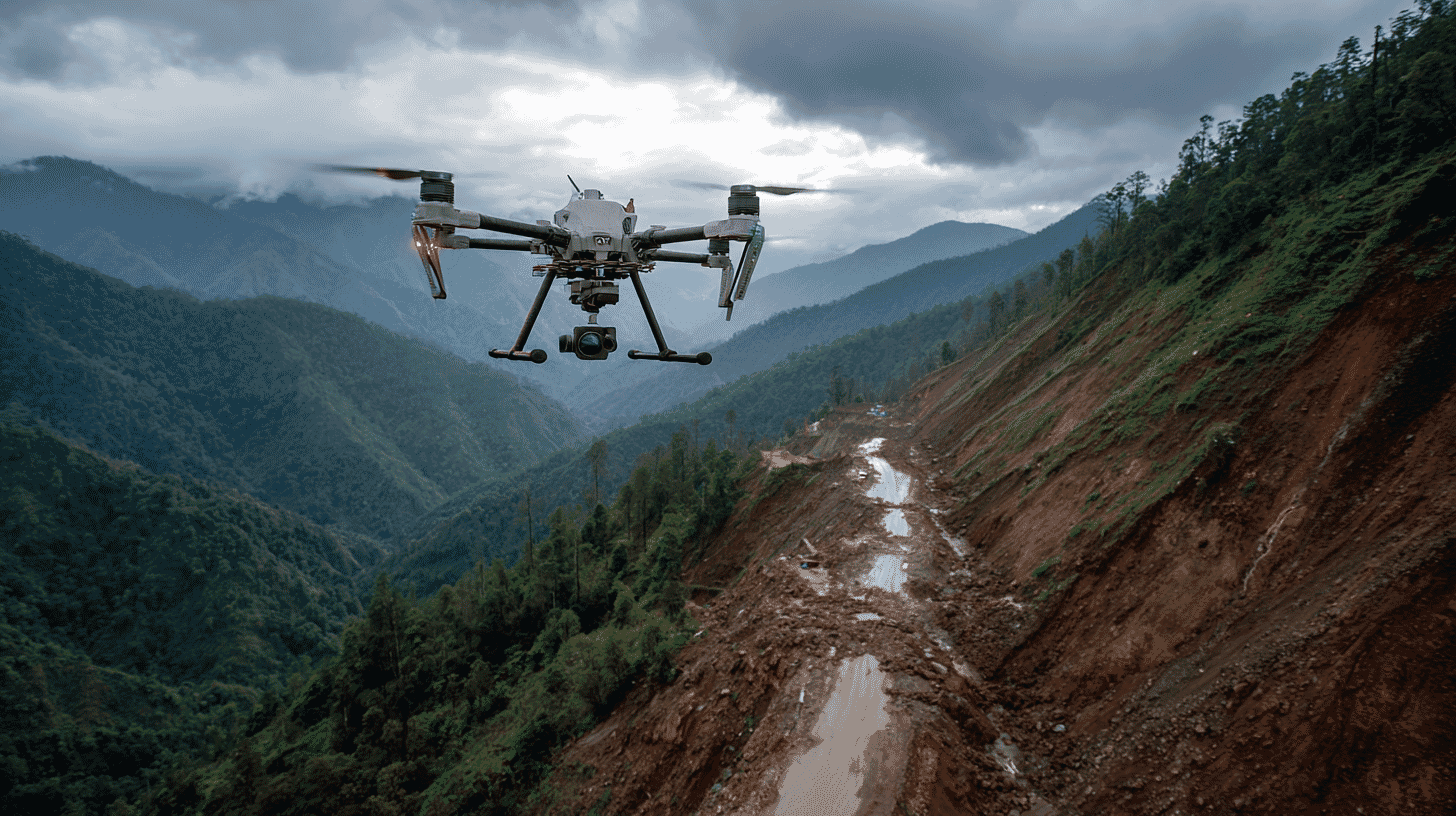
After an earthquake or a landslide cuts road access, a drone could reach sites no person or excavator can and build emergency structures from above.
Mountain infrastructure is another fit. About 70% of Japan's land is mountainous, and the aging bridges and retaining walls up there need constant attention. On sites where just erecting scaffolding costs a fortune, flying the repair material in changes the math. Same for remote islands, where shipping materials is the bottleneck: get the mix there and you can print on the spot.
In London, a Swarm Tried the Same Thing
Japan is not alone here. On September 21, 2022, a team centered on Imperial College London (ICL) and Empa, the Swiss Federal Laboratories for Materials Science and Technology, published Aerial-AM (Aerial Additive Manufacturing) in Nature: a fleet of 3D-printing drones inspired by how bees build nests. University College London and the University of Bath took part as well.
The system pairs BuilDrones, which deposit material in flight, with ScanDrones, which measure the result and inform the next move, all of them working from a single blueprint. Proof-of-concept prints included a 2.05-meter, 72-layer cylinder in polyurethane-based foam and an 18-centimeter, 28-layer cylinder in a custom structural cement-like material, at a manufacturing accuracy of five millimeters.
Mirko Kovac, the professor who led the work, has talked about repairing tall buildings, rebuilding after disasters, and eventually construction on the Moon or Mars.
How the F3DP Differs
| F3DP (Aizawa Concrete) | Aerial-AM (ICL / Empa) | |
|---|---|---|
| Stage | In development, targeting 2028 | Lab proof of concept |
| Power | Gasoline engine (long endurance) | Electric (lab conditions) |
| Material | Construction-grade concrete | Cement-like mixes / polyurethane foam |
| Setup | One large drone + AI robotic arm | Swarm of small cooperating drones |
| Target use | Offshore wind, infrastructure | Tall-building repair, disaster relief (conceptual) |
| Status | Still in development as of March 2026 | 2022 (published in Nature) |
ICL is chasing autonomous coordination among small drones. Aizawa is trying to make one big machine do real construction work. Different bets, and they may well meet somewhere.
The Work Exists. The Workers Don't.
Why push this hard? Look at the numbers.
Japan's construction workforce peaked at 6.85 million in 1997 and averaged 4.77 million in 2024, down roughly 30% from that peak. The age curve is worse: 36.6% of those workers are 55 or older, while 11.9% are under 30 (Ministry of Land, Infrastructure, Transport and Tourism, based on the government's Labour Force Survey). In Teikoku Databank's January 2026 survey, 69.6% of construction firms reported a shortage of full-time staff, the highest of all 51 industries tracked. Bankruptcies attributed to labor shortages hit a record 441 in fiscal 2025, and construction accounted for 112 of them, over a quarter of the total.
Then came the overtime cap. Since April 2024, construction has been subject to the same limits as other industries, 45 hours a month and 360 hours a year in principle. Japan calls it the "2024 problem." Fewer people, and now legally fewer hours from each of them.
Meanwhile the infrastructure built during the postwar boom keeps aging on schedule. Road bridges, tunnels, sewers, ports. Construction investment for fiscal 2025 is projected at roughly ¥75.6 trillion (about $470 billion at ¥162 to the dollar).
More work than ever, fewer hands to do it. That's the whole argument for automation, right there.
Why a 90-Year-Old Concrete Maker Is Doing This
You would expect this from a Tokyo startup. It's coming from a company founded in Hokkaido in 1935.
Yoshihiro Aizawa went from Nikkei reporter to New York correspondent before joining the family business, and became its third-generation president in 2008. Under him, the company has built research ties with MIT and TU Delft, and became the first in the world to commercially mass-produce self-healing concrete, marketed as Basilisk, in which bacteria seal their own cracks. Its c3dp division printed a glamping facility attached to an art museum in Niikappu, Hokkaido, the first 3D-printed lodging in Japan. With Sekisui House, it printed a public bench and donated it to the town of Minamifurano.
In June 2023 it opened the Fukushima RDM Center in Namie, Fukushima Prefecture, at a total cost of about ¥3 billion (roughly $19 million), two-thirds of it covered by a national subsidy. Alongside research and production buildings, the site has an endurance test hangar for engine drones and an outdoor proving field. That's where the F3DP work happens.
The company's stated goal is to turn itself from a traditional materials business into an "innovation marketing group built on smart materials." The F3DP is the poster child.
What Has to Be Solved by 2028
None of this is easy. You need a concrete mix that sets fast enough mid-air and still performs as a structure. You need a heavy machine carrying building material to fly reliably for hours. You need it to cope with wind, rain, and temperature swings at sea and in the mountains. And you need aviation rules that were never written with construction-weight aircraft hovering over a job site in mind.
But Japan isn't the only country stuck with a labor shortage, aging infrastructure, and a renewables buildout all at once. If building from the sky ever works, the market for it won't stop at the water's edge.
Japan is inventing machines out of the plain fact that nobody is left to swing the hammer. What's straining construction where you live? Are drones and robots on site yet, or still in the brochure?
References
- https://xtech.nikkei.com/atcl/nxt/column/18/03526/030200005/
- https://www.iru-miru.com/article_detail.php?id=59308
- https://www.aizawa-group.co.jp/news2021082401/
- https://www.aizawa-c3dp.com/
- https://www.imperial.ac.uk/news/239973/3d-printing-drones-work-like-bees/
- https://www.nature.com/articles/s41586-022-04988-4
- https://www.mlit.go.jp/tochi_fudousan_kensetsugyo/const/content/001994097.pdf
- https://www.tdb.co.jp/report/economic/20260409-laborshortage-br25fy/







Global Discussion
15 comments