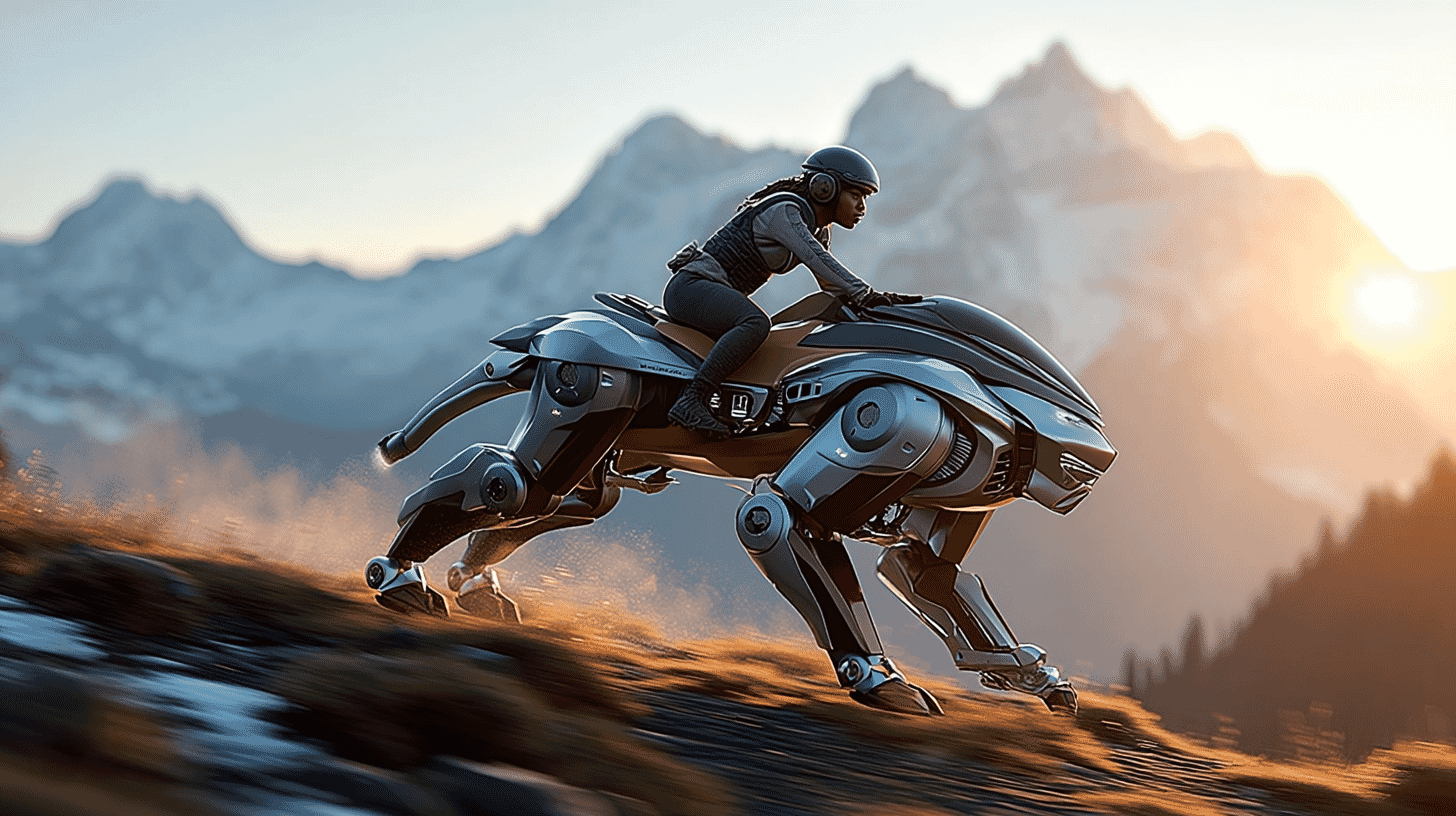
Imagine riding a robotic horse through snowy mountains and rocky terrain. What seemed like a 2050 dream is now racing toward reality, with a working prototype expected in just four years. Meet CORLEO, Kawasaki's hydrogen-powered four-legged mobility vehicle that's turning science fiction into science fact.
What Is CORLEO? The Heart of a Lion
CORLEO is a four-legged off-road personal mobility vehicle developed by Kawasaki Heavy Industries. The name derives from "Cor Leonis," the Latin name for Regulus, the brightest star in the Leo constellation, meaning "heart of the lion."
This robotic horse represents an entirely new category of transportation. Unlike traditional motorcycles or ATVs, riders straddle the machine and control it through weight shifting, just like riding a real horse. With four mechanical legs instead of wheels, CORLEO can traverse mountain terrain, snow-covered landscapes, and rocky areas that would be impossible for conventional vehicles.
Kawasaki's unique advantage lies in combining decades of motorcycle expertise with advanced robotics. The rear legs feature a swing-arm mechanism borrowed from motorcycle technology, moving independently to absorb shock. This allows riders to maintain a stable, forward-facing posture even on steep inclines.
Powered by Hydrogen for Environmental Responsibility
CORLEO runs on a 150cc hydrogen engine. Hydrogen canisters mounted in the rear legs supply fuel to the engine, which generates electricity to power drive units in each leg.
By choosing hydrogen propulsion, Kawasaki achieves low-emission, near-silent operation, crucial for exploring natural environments without disturbing wildlife or contributing to pollution. This aligns with Kawasaki's broader involvement in hydrogen infrastructure development.
The design targets a top speed of approximately 62 mph (100 km/h). Engineers studied the movements of cheetahs and leopards to optimize the machine's form and locomotion patterns.
Osaka Expo 2025: 1.2 Billion Social Media Impressions
CORLEO made its public debut at the "Future City" pavilion during the Osaka-Kansai Expo in April 2025. Initially presented as a "2050 concept model," the full-scale prototype couldn't walk but demonstrated various poses by flexing its legs.
The CGI promotional video showing CORLEO galloping through snowy mountains and leaping over obstacles went viral, generating approximately 1.2 billion cumulative social media impressions worldwide.
Overwhelmed by this response, Kawasaki formally announced in December 2025 that it was accelerating development toward commercialization, decades ahead of the original schedule.
Targeting Riyadh Expo 2030 for Real-World Debut
Kawasaki has established a dedicated "SAFE ADVENTURE Business Development Team" reporting directly to the company president. The revised timeline is ambitious:
Development Roadmap
| Timeline | Milestone |
|---|---|
| 2027 | Riding simulator completed |
| 2030 | Deployment as venue mobility at Riyadh Expo, Saudi Arabia |
| 2035 | Commercial product launch |
| 2040 | Target ¥300 billion (~$2 billion) in related business revenue |
At the Riyadh Expo, Kawasaki aims to have visitors actually riding CORLEOs around the venue, a dramatic demonstration of the technology's real-world capability.
The SAFE ADVENTURE Vision: Zero Mountain Accidents
CORLEO is the centerpiece of Kawasaki's broader "SAFE ADVENTURE" concept, which aims to make mountainous regions safely accessible to everyone while working toward zero mountain accidents.
The company is developing an integrated navigation system that detects weather conditions, temperature, road conditions, and wildlife presence. This information is relayed to smartphones or other devices to guide riders along safe routes. For night riding, the system can project path markers onto the ground.
Interestingly, Kawasaki collaborated with the Kobe University equestrian team during development. When motorcycle test riders straddled the prototype, their instincts led them to "ride it like a bike." Input from students with actual horseback riding experience helped optimize handlebar shapes and stirrup positions for more intuitive, horse-like control.
Gaming and eSports Expansion
The riding simulator scheduled for completion in 2027 will let users experience CORLEO in virtual reality. Kawasaki plans to license the 3D models and motion data developed during the project to the gaming and eSports industries.
This strategy allows potential customers to experience the CORLEO universe before the actual product hits the market, building anticipation and familiarity simultaneously.
Challenges and Outlook: The Road Ahead
Significant engineering challenges remain. Achieving the agility shown in promotional videos requires cutting-edge suspension and stability systems. Whether a near-production prototype can reach the demonstrated performance levels in just four years remains uncertain.
However, Boston Dynamics' four-legged robot "Spot" has already demonstrated remarkable capabilities, including herding sheep and navigating complex terrain. Scaling up such technology to carry a human rider isn't far-fetched.
Competition is also intensifying. Chinese companies like Unitree Robotics are rapidly advancing in the four-legged robot space. How CORLEO positions itself in this global landscape will be crucial.
Your Turn: What's Happening in Your Country?
This fusion of robotics and hydrogen energy could reshape how we think about personal mobility. What innovative transportation technologies are being developed in your country? Are there similar projects combining robots and sustainable energy?
References
- https://www.khi.co.jp/pressrelease/detail/20251203_1.html
- https://www.khi.co.jp/expo2025/concept01/index.html
- https://global.kawasaki.com/en/corp/newsroom/news/detail/?f=20251211_7502
- https://newatlas.com/motorcycles/kawasaki-robot-horse-corleo/
- https://futurism.com/robots-and-machines/kawasaki-robot-horse-production
- https://hypebeast.com/2026/1/kawasaki-moves-toward-production-for-the-corleo-hydrogen-powered-robotic-horse






Global Discussion
16 comments