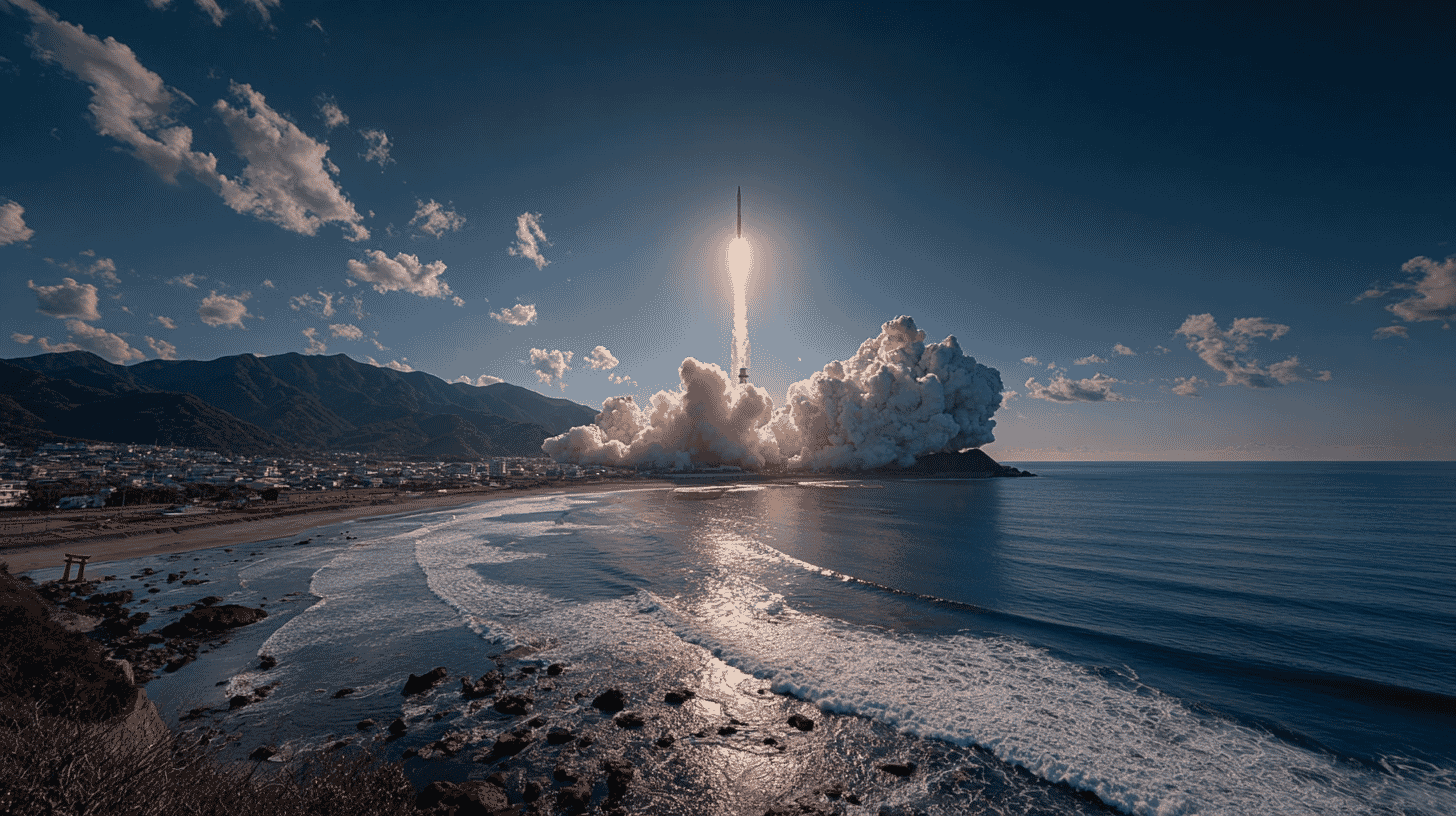
Japan's dream of a privately-developed satellite orbital insertion fell short once again. After two failed attempts in 2024, Japanese space startup SpaceOne took its third shot with the small rocket "KAIROS," but the March 5, 2026 launch also ended in a flight abort, a third straight loss. Redesigned sensors, reinforced heat and vibration shielding, a crowdfunding campaign backed by local schoolchildren, here's how Japan's private space industry is turning failure into fuel for the future.
What Is KAIROS? Japan's Homegrown Small Rocket
KAIROS is a small solid-fuel rocket developed by SpaceOne, a Japanese space venture company. Standing roughly 18 meters (59 feet) tall and weighing about 23 metric tons, it is compact compared to major launch vehicles, but purpose-built to deliver small satellites into orbit.
The name comes from the Greek god of "opportune timing." SpaceOne's vision is to become a "space delivery service" (Uchu Takuhaibin in Japanese), capable of launching a satellite within just four days of receiving it, aiming to be the world's fastest turnaround launch provider.
Founded in 2018, SpaceOne is backed by some of Japan's most recognized corporations: Canon Electronics, IHI Aerospace, Shimizu Corporation, and the Development Bank of Japan. The company operates its own dedicated launch facility called "Spaceport Kii" in Kushimoto, Wakayama Prefecture, on the southern tip of Japan's Kii Peninsula. The site faces the Pacific Ocean to the south and east, providing an ideal geography for flexible launch trajectories while avoiding populated areas.
Two Failures: What Happened
Flight 1 (March 13, 2024)
KAIROS's first attempt ended just five seconds after liftoff. The rocket's autonomous flight safety system determined that the vehicle had strayed outside its predetermined safe flight corridor and triggered a self-destruct sequence. The rocket exploded directly above the launch pad in footage that was broadcast nationwide.
The root cause was an overestimation of the solid fuel's burn rate. The actual thrust fell slightly short of predictions, causing the rocket to drift outside the safety parameters. Post-analysis also revealed that the safety margins had been set conservatively, perhaps too conservatively. Engineers later concluded the rocket would likely have flown normally if the self-destruct had not been triggered. A frustrating outcome that underscored both the promise and the peril of autonomous safety systems.
Flight 2 (December 18, 2024)
For the second attempt, SpaceOne had recalibrated its fuel burn rate predictions and widened the safety system's acceptable flight envelope. This time, the rocket lifted off cleanly and rose steadily, crossing the 100 km Kármán line (the internationally recognized boundary of space) and reaching a maximum altitude of approximately 110.7 km. Stage separation and fairing jettison were both achieved, significant milestones.
But about 80 seconds into the flight, a new problem emerged. A sensor responsible for detecting the angle of the first-stage engine nozzle began sending erroneous signals. In rocket engineering, the nozzle is the steering wheel: by tilting it slightly, the rocket adjusts its direction. With faulty sensor data, the guidance system lost accurate knowledge of where the nozzle was pointing, and the rocket entered an uncontrolled spin. The second stage couldn't correct the deviation inherited from the first stage, and at 3 minutes 7 seconds, the autonomous safety system again terminated the flight.
What Changed for Flight 3
In August 2025, SpaceOne formally announced the results of its failure investigation. Through extensive reproduction testing, the company confirmed that erroneous signals from the nozzle angle sensor were the root cause of the second flight's failure.
The key improvements for Flight 3 include:
Sensor Redesign. The nozzle angle detection sensor has been fundamentally redesigned with a new architecture to improve reliability.
Signal Path Overhaul. The cable routing that carries sensor signals has been rerouted to minimize exposure to vibration and thermal stress during flight.
Enhanced Heat and Vibration Protection. Overall durability against the extreme conditions of rocket flight (intense vibration, high temperatures) has been strengthened across the vehicle.
Comprehensive Vehicle Audit. Beyond the specific sensor fix, SpaceOne conducted a full review of development and manufacturing data, assembly procedures, and inspection processes.
One notable engineering decision: Flight 3 targeted the same orbit as Flight 2, a sun-synchronous orbit at roughly 500 km. Keeping the conditions identical meant that a success could be attributed to the fixes rather than to a changed flight profile. It's a mark of engineering integrity.
Flight 3: A Third Failure
KAIROS Flight 3 was originally scheduled for February 25, 2026, at 11:00 AM Japan Standard Time, from Spaceport Kii in Kushimoto, Wakayama Prefecture. Weather and high-altitude wind conditions forced repeated postponements to March 1 and then March 4 (halted just before launch), and the rocket finally lifted off on March 5 at 11:10 AM.
Once again, orbital insertion was not achieved. About 68.8 seconds after liftoff, during first-stage burn at an altitude of roughly 29 km, the autonomous flight safety system judged the mission unachievable and triggered a flight abort, destroying the vehicle. All five onboard satellites are believed lost. Following Flights 1 and 2, it was a third straight failure, and Japan's first privately-conducted satellite orbital insertion was postponed yet again.
At the post-launch press conference, SpaceOne said no major anomaly was found in the vehicle or flight path, and that the autonomous flight safety system itself most likely malfunctioned, a cause distinct from the first two flights. An investigation is underway.
The rocket had carried five small satellites: Terraspace's "TATARA-1R" (approximately 70 kg), Space Cubics' "SC-Sat1a" (a space-grade computer demonstration), Hiroo Gakuen Junior and Senior High School's "HErO" (an educational satellite), Arc Edge Space's "AETS-1," and Taiwan's TASA (Taiwan Space Agency) "NutSat-3." The fact that a Tokyo-based junior and senior high school had a satellite aboard is itself a sign of how accessible space is becoming.
The mission was named "Rising Hope Star," chosen through an internal employee vote, reflecting the company's aspiration to become a "rising star of hope" for Japan's space industry.
Crowdfunding and Community Support
SpaceOne launched a crowdfunding campaign on the READYFOR platform for Flight 3, with an initial goal of ¥80 million (approximately $530,000) and a stretch goal of ¥100 million ($670,000). The funds will help cover a portion of launch costs.
What's remarkable is the unwavering community support despite two failures. Local children sent messages like "KAIROS is our future" to the company. Official viewing areas in Kushimoto and Nachikatsuura quickly sold out, and JR West has arranged special trains for launch day.
The rocket launch has become an economic catalyst for the region. With hotels, local food vendors, and tourism packages all tied to the event, Kushimoto is evolving into something of a Japanese Cape Canaveral, a space tourism destination in its own right.
Japan's Private Space Industry: Where Things Stand
Japan's space program has historically been led by JAXA (Japan Aerospace Exploration Agency) and large institutional rockets like the H-IIA and H3. Private companies developing their own orbital-class launch vehicles is a relatively new phenomenon in Japan, one that the country has been slower to embrace compared to the United States.
But that landscape is shifting. Beyond SpaceOne, Interstellar Technologies in Hokkaido is developing the "ZERO" small liquid-fuel rocket. AstroX, which recently raised $15 million in Series A funding, is pursuing a "Rockoon" approach, launching rockets from high-altitude balloons. The Japanese government has also begun actively supporting these ventures through SBIR (Small Business Innovation Research) programs and defense contracts.
Globally, SpaceX dominates with over 150 launches per year, while Rocket Lab's Electron has established a solid track record in the small satellite market. Meanwhile, Virgin Orbit's 2023 bankruptcy demonstrated the harsh realities of the small launch vehicle business.
Had KAIROS succeeded, it would have been the first time a Japanese private company independently delivered a satellite to orbit. That milestone remains out of reach for now, but SpaceOne has already secured contracts for Flights 4 and 5, including a defense ministry demonstration satellite mission. The company is also developing an "Enhanced KAIROS" that would replace the solid third stage with a methane engine to improve orbital insertion capability to 250 kg for sun-synchronous orbit.
SpaceOne aims for 20 launches per year by the late 2020s and 30 per year by the 2030s, and says it will not abandon that vision despite three straight losses. The investigation into Flight 3 and the road to Flight 4 will be a make-or-break moment, not just for SpaceOne but for Japan's entire private space industry.
How is private space development progressing in your country? How does your society react when a rocket launch fails? We'd love to hear about your country's space ambitions in the comments below.
[Update, July 2026]** The investigation into Flight 3 is still running. SpaceOne says the autonomous flight safety system now under suspicion was carried over from Flight 2 with no change to its design or parts, and that pre-flight hardware and software checks found nothing wrong. KAIROS is the first Japanese rocket to fly an autonomous flight safety system in operational use; larger vehicles such as the H-IIA rely on destruct commands sent from the ground. Work on Flight 4 is nonetheless under way: when Spaceport Kii was opened to reporters on July 14, 2026, components for the next vehicle had arrived and were being inspected. No launch date or payload had been announced as of that point.



Global Discussion
15 comments