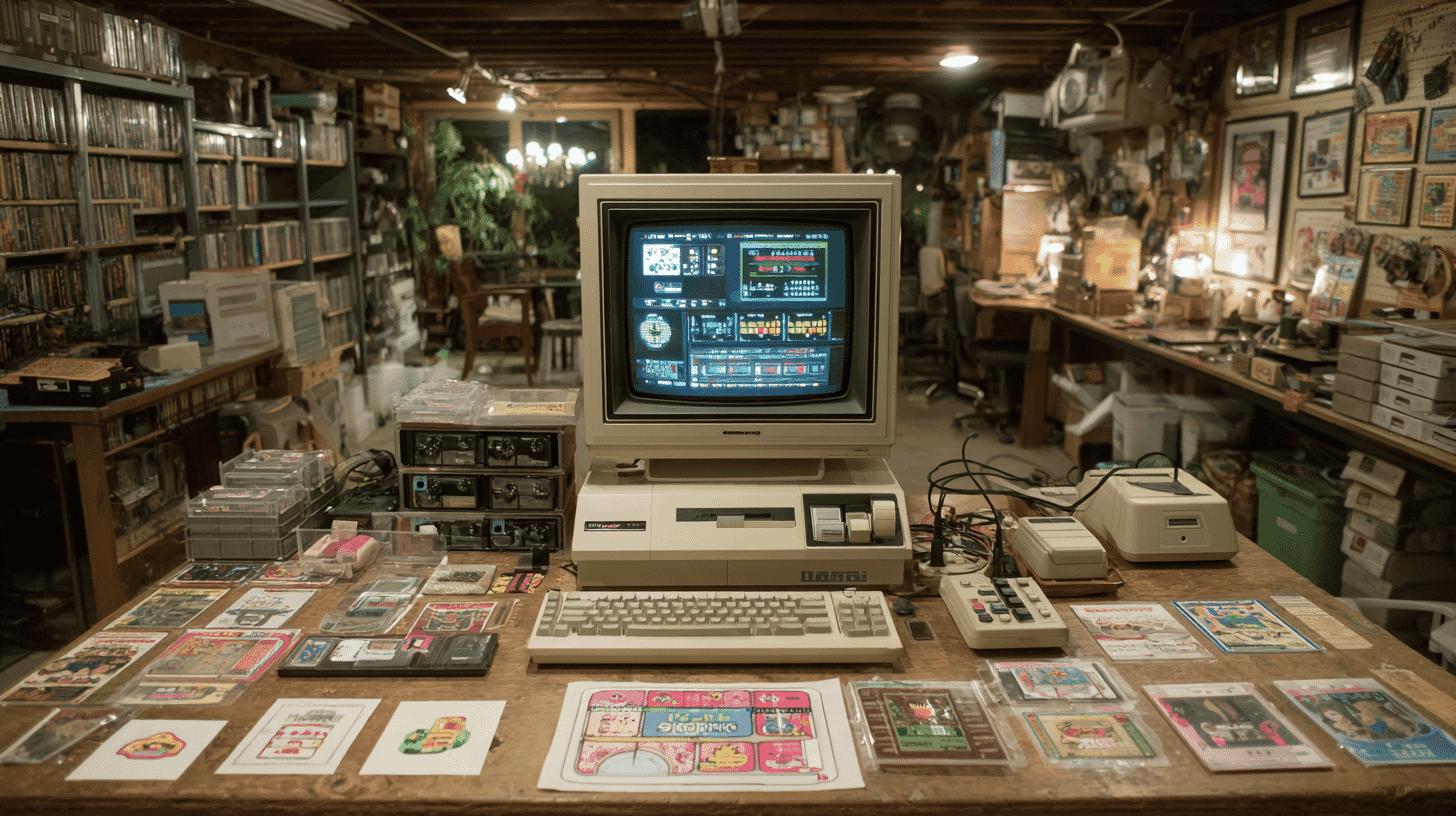
Can you still play the games from your childhood? Thousands of 1980s PC games stored on floppy disks are being lost to mold and magnetic decay. For 15 years, a small Japanese NPO has been racing time to save 18,000 retro game titles, one disk at a time. What follows draws on an interview with Game Preservation Society president Joseph Redon, conducted at the organization's headquarters by Game*Spark in March 2026.
A French Gamer's Mission in Tokyo
The Game Preservation Society (GPS) is a Japanese NPO founded in September 2011 in Tokyo, though its preservation efforts trace back to the 1990s. At the helm is Joseph Redon, a Frenchman who fell for Japanese games as a child, taught himself Japanese, and moved to Japan in 2000. The organization operates from its Setagaya headquarters with 37 full members and roughly 1,100 supporter members worldwide.
The GPS's mission is both physical and digital archiving of games distributed in Japan. Their current focus is Japan's domestic microcomputer and hobby PC platforms from the 1970s and 80s, machines such as the PC-8801, FM-7 and X1, which carry thousands of titles that never reached the outside world.
Redon frames the work not as a nationalistic effort but as a universal one. Just as Mozart's music transcends Austria, he argues, gaming culture transcends borders. These games belong to world heritage, and losing them means losing a piece of everyone's cultural history.
Inside the Archive: 18,000 Titles and Counting
The GPS headquarters is a three-story building that looks ordinary from the outside but houses professional-grade archival facilities within. The location was chosen 12 years ago for its high elevation (minimizing flood risk), concrete construction, and sufficient space within the organization's modest budget.
The second floor stores approximately 18,000 game titles in a climate-controlled, lightless environment. Inside, 3-inch, 5-inch, and 8-inch floppy disks and cassette tapes are preserved under constant temperature and humidity control. According to Redon, once media enters this space, "time essentially stops."
What sets the GPS apart from other game archives worldwide is its "separated storage" method. Rather than keeping a game's packaging, media, manual, and cover art together as a set, the GPS stores each component separately based on material type. Paper, magnetic media, and plastics all have different optimal preservation conditions, and storing them together accelerates deterioration. Storage containers use acid-free neutral paper, and metal components are treated with anti-corrosion materials. The archival-grade file folders are manufactured by a Japanese company but so rarely used domestically that the GPS imports them from the United States.
About half of the 18,000 titles are duplicates, but Redon emphasizes these are invaluable. Identical packaging can conceal different software versions or manual revisions, and backup copies serve as insurance when migration work reveals a damaged disk.
The ground floor houses a reading room with roughly 3,000 gaming publications, open to outside researchers by appointment. It includes materials not found even in Japan's National Diet Library. The GPS holds approximately 50,000 volumes total and aims to digitize them, though Japan's current legal framework presents significant obstacles. Their research indicates that about 60,000 game-related books have been published in Japan, of which fewer than 20,000 are in the National Diet Library's collection.
Racing Against Decay
Migration, the process of digitally preserving the contents of physical media, has reached roughly the halfway point across the GPS's holdings, a process that has already taken seven to eight years. The remaining media will require even more time, as the easier formats were prioritized first.
The greatest enemy is mold. Japan's humid climate, especially during the rainy season (tsuyu), is devastating for magnetic media. A floppy disk stored in an average Japanese household closet will develop mold within a year. Nearly 100% of the used PC game software that arrives at the GPS shows some degree of mold contamination, visible mold in about 70% of cases, with microscopic contamination in much of the remainder. Reading a moldy floppy without treatment can destroy both the disk and the drive, so each disk must be individually cleaned using techniques the GPS developed in-house.
There's an ironic twist: older media tends to be more durable. Cassette tapes have a protective shell that shields the magnetic tape inside, and they can often be salvaged even with some damage. CD-ROMs, however, become unrecoverable once degradation begins. As storage technology has advanced toward higher density and lower cost, physical resilience has decreased. The same principle applies to hardware, a Famicom (NES) is relatively easy to repair, while a modern console hits repair limits quickly due to compact, tightly integrated components.
The GPS operates entirely on volunteer labor. Redon and all members hold regular jobs and contribute their free time to preservation work. But by his own calculation, the team cannot complete the work within their lifetimes at the current pace. Degradation is ongoing and irreversible, and the only way to accelerate is funding. As a purely non-profit organization that does not engage in any commercial activity, the GPS relies 100% on supporter membership fees. Increasing the supporter base is their most pressing need.
The organization does receive grants from Japan's Agency for Cultural Affairs, which temporarily boost their pace during six-month project periods. But sustainable, long-term funding remains elusive.
The Legal Limbo of Mobile Game Preservation
The GPS has been thinking about preserving games from Japan's feature phones (known as garakei, literally "Galápagos phones" for their uniquely Japanese evolution) since the organization's founding. Between 2013 and 2014, staff rented trucks and traveled to secondhand electronics stores (Hard Off chains) across Japan, buying used phones in bulk, often from bargain bins priced at roughly $0.70 each. However, after Tokyo Olympics–related discussion of "urban mining" raised awareness of rare metals in old electronics, used phones largely disappeared from the market or became collector's items.
Technically, data can be extracted from feature phones using built-in maintenance modes, the same interfaces that carrier shops once used for data transfers. This avoids the need for hacking. The GPS successfully demonstrated this approach in collaboration with an overseas development team.
The problem is legal. Game data on feature phones is copy-protected, and extracting it may constitute circumvention under Japanese law. While the Agency for Cultural Affairs has approved floppy disk migration under certain conditions, no one has been able to provide a clear legal answer for mobile phone data. In the United States, fair use provisions allow overseas groups to extract data and upload it to the Internet Archive. Japan's copyright law has no equivalent provision.
The GPS has taken a pragmatic first step: publicly urging Japanese consumers not to discard their old feature phones. Meanwhile, they seek pro bono legal support to navigate the regulatory landscape, a resource that has proven difficult to find.
How Migration Actually Works
The GPS's approach to digital preservation differs fundamentally from simply copying data. Redon explains it through an analogy with book digitization: you don't just extract the text. First you photograph each page at high resolution, then analyze the images to produce searchable text.
For floppy disks, the GPS samples the magnetic signal itself at the analog level, essentially "recording" the disk the way you'd record a cassette tape. This raw analog capture preserves enough information to reconstruct the original data even if the physical medium is completely destroyed. The resulting "raw data" files are enormous, a single book page scanned at 1200 DPI produces roughly 1 GB, though the OCR text output is just a few kilobytes. Game media follows a similar pattern.
The GPS calls the final verified digital output a "remaster." This creates a foundation for potential future game re-releases: if a rights holder wants to republish a title but no longer possesses the original media, the GPS can provide a verified digital copy.
However, preserving digital data long-term poses its own challenges. The GPS currently stores approximately 200 TB of data on servers at its headquarters, with no offsite backup. Establishing a mirror server would cost roughly $13,000, beyond the current budget. If a fire struck the building, 15 years of digitized archives would be lost. Cloud storage is cost-prohibitive at this scale, though Redon notes that what seemed impossible 15 years ago (storing 100 TB) is now routine, suggesting the economics will eventually improve.
Global Interest Is Surging
One of the most striking recent developments is the dramatic shift in the GPS's supporter demographics. Approximately 60% of their 1,100 supporters are now from English-speaking countries, a change that surprised even Redon.
Historically, the most dedicated collectors of Japanese retro games were Europeans, particularly from France, the United Kingdom, and Italy, where museum culture runs deep. But in recent years, American gamers have developed intense interest in Japan-exclusive titles. They're exploring differences between the Japanese Famicom Disk System and Western releases, scrutinizing audio variations, and seeking out titles that never left Japan.
The academic world is also paying attention. Game studies students and researchers increasingly visit the GPS because reliable primary sources about Japanese retro gaming simply don't exist online. With AI-powered translation removing the language barrier, the scarcity of information, not language, has become the main obstacle for international researchers. The GPS is gradually being recognized as an essential scholarly resource.
Outreach: Short Videos and a Living Database
Starting in March 2026, the GPS launched a content series across its website, YouTube, X, and Instagram. Each week, a short video and article profile one archived title, with a monthly reveal showing how the selections connect to a common theme.
This initiative serves dual purposes: attracting new supporters who may not know the GPS exists, and fulfilling the organization's statutory mission of public information sharing. Preservation alone isn't enough, making the results accessible to the world is built into the GPS's founding charter.
In February 2026, the GPS hosted the sixth installment of its "Legendary Game Creators" talk series, featuring Koichi Nakamura, former chairman of Spike Chunsoft and a key figure behind Dragon Quest and the Mystery Dungeon series. The event filled a 180-seat hall and was, like all GPS events, completely free. The organization has also produced two documentary films in its "geimu" (芸夢, a play on the Japanese word for "game" and "dream") series, focusing on the people and events that shaped Japanese gaming history.
How Does the GPS Compare Internationally?
The most prominent game preservation organization in the West is the Video Game History Foundation (VGHF), a 501(c)(3) non-profit founded in 2017 by former games journalist Frank Cifaldi. On January 30, 2025, the VGHF launched its digital library in early access, with more than 1,500 out-of-print gaming magazines among over 30,000 files. Their scope covers North American releases broadly, including source code, design documents, press kits, and promotional materials.
The GPS and VGHF occupy complementary niches. While the VGHF takes a broad approach to Western gaming history, the GPS goes deep into Japan-specific platforms and employs analog-level magnetic preservation techniques that few organizations worldwide attempt. Both organizations share the structural vulnerability of depending on volunteers and donations, and both face the same existential urgency: the media they seek to preserve is degrading with every passing day.
Cifaldi and VGHF library director Phil Salvador have both used GDC panels to talk about the state of game history as a field, and the funding question keeps coming back. The global game preservation community remains small, underfunded, and racing against physics.
Japan's Responsibility, and the World's Opportunity
Perhaps the most striking insight from Redon's interview is the GPS's philosophy of total preservation: "We try to save everything without judgment." If a magazine needs to be cut apart for scanning, they'll cut the only known copy. It's a commercial product, another one can potentially be found. When priorities waver, preservation always wins.
Japan created a disproportionate share of the world's gaming heritage, yet lacks systematic institutions to preserve it. Gaps in the National Diet Library's collection, the absence of fair use in copyright law, and slow progress on digital archiving legislation all compound the problem. But these materials exist only in Japan. If Japan doesn't act, no one else can.
How does your country preserve its gaming history and digital cultural heritage? Are there government-backed museums or archives dedicated to games? Or does preservation depend on volunteer communities and passionate individuals? We'd love to hear your perspective.









Global Discussion
13 comments