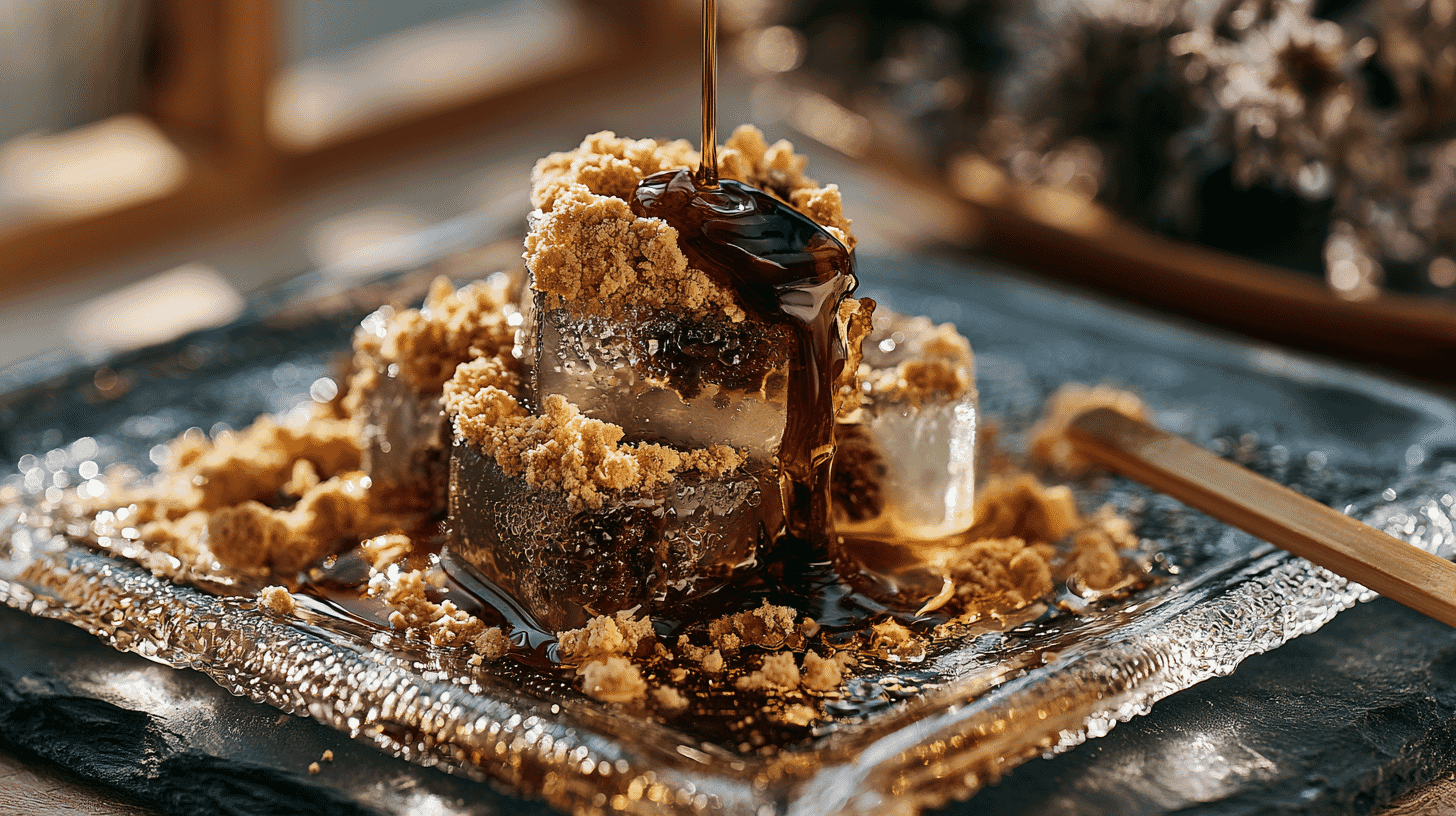
🍮 You scoop it warm from the pot, and it wobbles like it has a pulse. Dust it with toasted soybean powder, pour over a thread of dark sugar syrup, and the first bite barely counts as chewing, it just dissolves. This is warabi mochi, a Japanese sweet that has been quietly close to perfect for a thousand years, and it is currently having a very loud moment on the other side of the planet.
It is made from a fern. Yes, really.
Let us start with the fact that catches almost everyone off guard, plenty of Japanese people included: warabi mochi is not made from rice. The "mochi" in the name is a bit of a friendly lie. The real thing comes from warabiko, starch pulled from the underground stem of bracken, a scruffy wild fern that grows on hillsides all over Japan.
And "pulled from" is carrying a heavy load in that sentence. You dig up the roots, wash them, crush them, and rinse the starch out in cold water again and again. Only a few percent of the root's weight ends up as powder. Ohtanido, the Kawasaki specialist shop discussed below, harvests roughly two tons of bracken root a year and gets about 40 kilograms of starch from it. That kind of yield turns an ordinary ingredient into something closer to a luxury, which is exactly what happened. For centuries, real bracken starch was treated almost the way we treat truffles today: rare, expensive, a little mythical.
That scarcity explains a small mystery. If you have eaten warabi mochi in Japan, you probably picture a clear, glassy cube. But warabi mochi made from 100% bracken starch, hon-warabiko, is not transparent at all. It comes out a deep, smoky brown, with a denser, springier pull. The pretty see-through version most shops sell is usually made from sweet potato or tapioca starch instead. Both are delicious. Only one of them ever met a fern.
The texture is the entire point
Here is the part that throws first-timers: warabi mochi has almost no flavor of its own. Bite into a plain piece and you taste... not much. That is not a flaw. It is the design.
Warabi mochi is a texture food. The whole experience lives in the mouthfeel, that soft, trembling, slightly bouncy give, followed by a slow melt that feels less like eating and more like a dessert quietly giving up. The Japanese words for it, purupuru and mocchiri, are basically onomatopoeia for "wobble" and "chew," and they describe it better than any English phrase manages to.
The flavor comes from its two lifelong companions. Kinako, a nutty powder of roasted soybeans, gets dusted over the top and adds a warm, toasty edge. Kuromitsu, a dark syrup made from Japanese brown sugar, gets drizzled on for deep, almost molasses-like sweetness. The mochi itself is the cool, neutral stage; kinako and kuromitsu are the performance. It is also why warabi mochi reads as a summer sweet in Japan, clear, cold, and jiggling on the plate, it practically lowers the room temperature.
A sweet with a thousand-year head start
Warabi mochi did not arrive yesterday. Records suggest it was being enjoyed well over a thousand years ago, and one often-repeated story claims Emperor Daigo, who reigned from 897 to 930, was so fond of it that he granted the humble sweet an honorary court title. Treat that tale as charming rather than certified, but the age is real.
Its history also has a harder chapter. Because bracken starch was so scarce, warabi mochi went through repeated supply crises. By the Edo period, makers were already stretching the precious starch by blending in kuzu (arrowroot) and other powders, an improvisation that, almost by accident, opened the door to every sweet-potato and tapioca version on shelves today. In leaner times, bracken starch even served as famine food, a survival ingredient rather than a treat. A sweet that now signals indulgence once helped people get through the year.
Kinako, kuromitsu, and the matcha takeover
The classic serving is timeless: chilled cubes, a generous snowfall of kinako, a slow pour of kuromitsu, maybe a few sweet red beans on the side. But warabi mochi turns out to be unusually easy to reinvent, and that flexibility is a big reason it travels well.
The breakout star is matcha warabi mochi, either dusted with the bright green tea powder or kneaded right into the starch so the whole thing glows jade. It hits a sweet spot for overseas fans who already love matcha lattes and matcha ice cream: same flavor, brand-new texture. Roasted hojicha tea and black sesame have their own followings, and shops keep going further, folding in mango, pineapple, and chocolate. There is even a warabi mochi drink, soft little pieces dropped into tea or milk and sipped through a fat straw, tapioca-pearl style. Whether that counts as evolution or heresy depends entirely on who you ask.
Built for a phone screen
If someone set out to design a dessert for short-form video, they might land on something a lot like warabi mochi. It jiggles. It stretches. It glistens. Watch a kama-age warabi mochi, the freshly cooked kind scooped steaming straight from the pot, and it pours and folds in a way that is almost hypnotic.
That is catnip for TikTok and Instagram. Search "warabi mochi" and you will find a steady stream of close-up wobble shots, ASMR scooping, matcha pour-overs, and home cooks triumphantly tracking down a bag of warabiko at an Asian grocery. It is photogenic, a little mysterious to non-Japanese viewers, and rewards the slow-motion button. For a sweet whose appeal is mostly texture, the one thing a still photo cannot capture, video turned out to be the perfect translator.
From a temple street to a queue in Melbourne
The momentum is not just online. Specialist warabi mochi shops have been popping up well beyond Japan, fresh-made counters and pop-ups drawing genuine lines in Melbourne, Kuala Lumpur, Singapore, Sydney, and Los Angeles, often with matcha and kinako as the headline flavors.
Japan's confectionery makers have noticed. According to a 2025 report from JETRO, the Japan External Trade Organization, the country's overall sweets exports hit a record in 2024, and warabi mochi is increasingly pitched abroad not as an obscure traditional snack but simply as a modern dessert. The report profiles Ohtanido, a warabi mochi specialist that opened in 2006 on the bustling approach to Kawasaki Daishi temple near Tokyo. Worried that Japan's traditional bracken-starch craft was fading as older producers retired, the shop went all the way upstream. In 2016 it secured roughly a hectare of bracken field in Kobuchizawa, Hokuto City, Yamanashi Prefecture, and its president traveled to a village in the Hida area of Gifu that had stopped producing real bracken starch some fifty years earlier, learning the old methods directly from elderly residents. The same shop also develops mango and pineapple flavors for overseas buyers and helped spawn that sippable warabi mochi drink. Guard the tradition, bend the format: that combination is the whole strategy.
It is a fitting next chapter for a sweet that has always quietly adapted. Warabi mochi survived famines, swapped its core ingredient, and slipped from imperial courts to temple-gate stalls to convenience-store fridges. Going viral on a phone in another hemisphere is, honestly, one of the gentler things that has happened to it.
In Japan, warabi mochi is comfort and nostalgia, a cool, wobbling square that means summer. What is the dessert that wobbles its way into your own childhood memories?
References
- JETRO, "Cultivating overseas markets with warabi mochi as a sweet" (2025-10-06): https://www.jetro.go.jp/biz/areareports/2025/d9b2f17fd0d668ef.html
- Ohtanido official site: https://ohtanido.com/







Global Discussion
4 comments