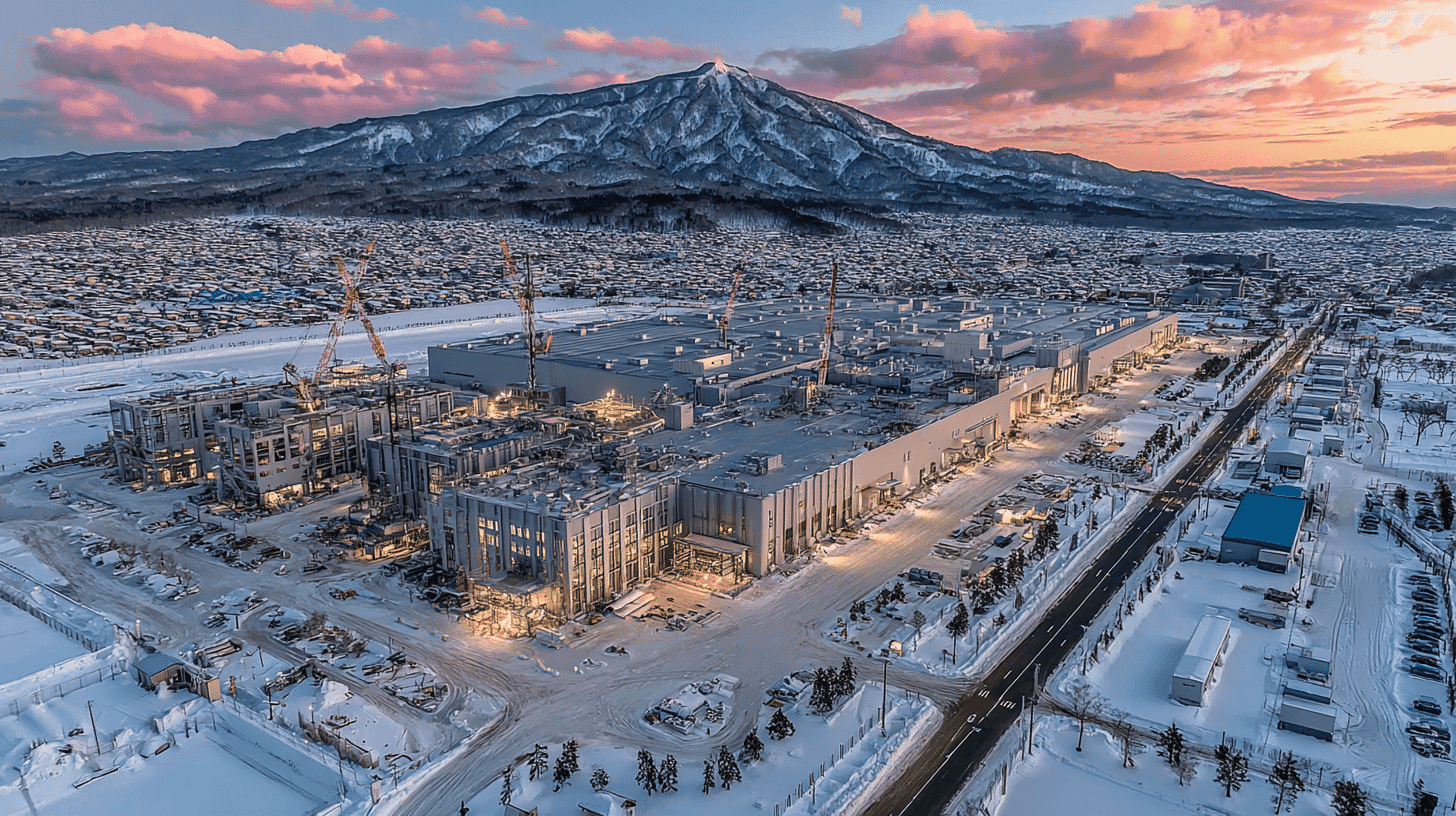
In today's world, whether a country can manufacture its own semiconductors has become a matter of national security. Japan just doubled down on that bet. The government announced another $4 billion for Rapidus, a startup chip company tasked with producing the world's most advanced semiconductors by 2027. Total public investment now stands at $15 billion, but the hardest part isn't building the factory. It's finding customers.
What the $4 Billion Covers
On April 11, 2026, Japan's Ministry of Economy, Trade and Industry (METI) officially approved ¥631.5 billion (approximately $4 billion) in additional funding for Rapidus for fiscal year 2026. The breakdown: ¥514.1 billion for front-end manufacturing processes (creating circuits on silicon wafers) and ¥117.4 billion for back-end processes (chip assembly and packaging).
The announcement came at the opening ceremony of a new Analysis Center and back-end R&D facility at Rapidus's factory site in Chitose, Hokkaido. Economy Minister Ryosei Akazawa attended, stating that the government would "spare no support necessary for the success of the Rapidus project."
Including all previous rounds, cumulative government support has reached ¥2.354 trillion (about $15 billion). An additional ¥300 billion is expected in fiscal 2027. Separately, the government plans ¥250 billion in direct equity investment across 2025-2026, bringing the total national commitment toward ¥3 trillion ($19 billion) by the end of fiscal 2027.
What Is Rapidus?
Rapidus was founded in 2022 by eight major Japanese companies including Toyota, NTT, Sony Group, and Canon. It operates as a "foundry", a company that manufactures chips designed by other companies, the same business model that made Taiwan's TSMC the world's most valuable semiconductor company.
The target is mass production of 2-nanometer chips, a scale so small that the circuit width is about 1/50,000th the thickness of a human hair. Currently, only TSMC and Samsung have the capability to produce at this cutting-edge level. If Rapidus succeeds, it would become the world's third player at this technology node.
Rapidus is developing its technology in collaboration with the Albany NanoTech Complex in New York State and Belgium's Imec, building on IBM-derived manufacturing processes.
The Biggest Challenge: Finding Customers
Building a factory and mastering the technology is only half the battle. For a foundry, the critical question is: who will place orders?
METI recognizes this gap. On the same day, it announced subsidies of up to ¥90 billion ($570 million) for two AI chip design projects, one by Fujitsu developing computing platforms for AI agents, and another by IBM Japan creating accelerators for physical AI applications. A METI official noted the hope that these projects would eventually lead to manufacturing orders for Rapidus. In effect, the government is subsidizing the creation of Rapidus's future customers.
Currently, Canon and US AI chip startup Tenstorrent are mentioned as potential clients, but stable factory utilization will require many more.
The Global Subsidy War
Japan's investment in Rapidus is part of a worldwide race among governments to secure domestic chip production.
United States: CHIPS Act ($52.7 billion). Signed in 2022, this law provides up to $8.5 billion to Intel, $6.6 billion to TSMC, and $6.4 billion to Samsung for US-based manufacturing. However, President Trump has publicly criticized the law, creating uncertainty about its future.
European Union: EU Chips Act (~€43 billion target). A combined public-private investment goal supporting projects like Infineon's €5 billion Dresden fab and a TSMC joint venture in Germany worth €10 billion. The EU's approach has drawn criticism for redirecting funds from existing research programs.
South Korea and Taiwan. South Korea supports Samsung and SK Hynix primarily through tax incentives. Taiwan maintains its dominant semiconductor ecosystem while TSMC expands globally.
Japan's $15 billion is modest compared to the US CHIPS Act's $52.7 billion total, but the concentration on a single company is remarkable. It's a high-risk, high-reward strategy that essentially bets the country's semiconductor future on one player.
TSMC in Japan: Complement or Competitor?
Japan's semiconductor strategy has a second pillar: TSMC's Kumamoto operations.
TSMC began mass production at its first Kumamoto factory (JASM) in late 2024, making 12-28nm chips for Sony and Denso. In February 2026, TSMC upgraded its plans for a second Kumamoto factory, switching from 6-7nm to 3nm AI chips, with total investment growing to $17 billion.
Rapidus's 2nm and TSMC Kumamoto's 3nm are technologically adjacent. Rapidus represents Japan's push for indigenous manufacturing capability, while TSMC's presence provides proven, world-class production. The two are more complementary than competitive, though they do clash directly in the battle for engineering talent.
What the Analysis Center Means
The newly opened Analysis Center evaluates prototype chips and feeds results back to the production line to improve yield rates (the percentage of chips that work correctly). Located right next to the factory, it enables rapid improvement cycles, a critical factor for reaching the quality levels needed for commercial production.
The back-end R&D facility focuses on chip assembly and packaging technologies, an area where Japanese companies are considered strong and where significant innovation opportunities remain.
Prime Minister Takaichi's Semiconductor Vision
Prime Minister Sanae Takaichi has positioned semiconductors as a pillar of national strategy. The government aims to grow domestic semiconductor manufacturing revenue from ¥6 trillion ($38 billion) in 2022 to ¥40 trillion ($250 billion) by 2040. Rapidus's successful mass production is central to this plan.
Minister Akazawa stated that the government is "prepared to continue support even after mass production begins," signaling a long-term commitment rather than a one-time investment.
Open Questions
The investment of over ¥2 trillion in public funds has sparked ongoing debate in Japan. Skeptics ask whether this level of government involvement is necessary and whether it risks becoming a waste of taxpayer money. Supporters counter that given the risk of a Taiwan contingency, domestic semiconductor production is essential, and that failing to invest now means falling behind permanently.
Whether Rapidus can truly begin mass production in the second half of fiscal 2027, and whether it can secure enough customers to sustain operations, remain the defining questions. The world is watching Japan's semiconductor comeback story unfold.
What does your country think about government subsidies for the semiconductor industry? We'd love to hear your perspective.








Global Discussion
15 comments