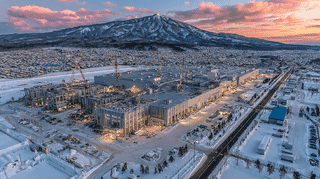
A fresh 150-billion-yen government injection pushes the state's share of Rapidus's capital to roughly 60%. Yet Tokyo capped its voting rights at 11.5%, keeping the firm out of state-enterprise territory by design. We unpack subsidies versus equity, the fate of the 2nm skeptics, and the question of who will actually buy the chips.
TSMC's Japanese subsidiary JASM posted a quarterly profit of NT$951 million (about $30 million / ¥4.78 billion) in Q1 2026, the first time the Kumamoto fab has been in the black since mass production began in December 2024. We unpack what the 14-month turnaround means against the backdrop of Japan's ¥1.23 trillion in subsidies, the Sony-Denso-Toyota partnership, TSMC's Arizona and Dresden expansions, and Rapidus's high-stakes 2nm bet.
Kioxia forecast a 48-fold jump in Q1 net profit to 869 billion yen ($5.5 billion), making the Japanese NAND maker Japan's single-largest AI beneficiary on a quarterly basis after Toyota. We unpack the US ADS listing plan, the supercycle reshaping NAND prices, the HBM gap with Samsung and SK Hynix, and what it all means for Japan's broader semiconductor revival.
Nikon posted a record net loss of 86 billion yen (about $548 million) for the year ended March 2026, dragged down by a 90.6 billion yen writedown on its German SLM Solutions metal 3D printer acquisition. As Canon attacks the lithography market and TSMC Kumamoto ramps up 3nm production, Japan's optics giant is missing its own country's semiconductor boom. We unpack the ASML technology gap, the diversification bets that went wrong, the EssilorLuxottica stake, and the new mid-term plan built around "near-leading-edge" ArF immersion tools.
Fujitsu is doubling down on its sovereign AI strategy with the FUJITSU-MONAKA CPU series, choosing Rapidus as a manufacturing partner and 'coexisting' with NVIDIA's GPUs rather than competing. We compare Japan's hybrid approach to China's fully autonomous Loongson (LoongArch) and Europe's Arm-based SiPearl, revealing how Japan's pragmatic balance defines a third path in global chip sovereignty.
Kumamoto Prefecture, Koshi City and Mitsui Fudosan signed a partnership agreement on April 27 to launch a 31-hectare 'Kumamoto Science Park' core hub — modeled on Taiwan's Hsinchu — to anchor Japan's semiconductor revival around TSMC's 3nm Kumamoto fab by 2030. We compare it with the US CHIPS Act and EU Chips Act, and unpack the land-price spikes and labor crunch already reshaping the region.
Japan's METI officially approved an additional $4 billion for Rapidus, bringing total government support to $15 billion. We analyze Japan's 2nm chip ambitions alongside the US CHIPS Act, EU Chips Act, TSMC's Kumamoto expansion, and the critical challenge of finding customers.
Global chip sales hit $88.8B in Feb 2026, up 61.8% YoY. Yet Japan is the only region with 9 consecutive months of decline. We analyze the structural reasons behind Japan's stagnation amid the AI-driven global boom.
Japan's AIST has established ASiST, a new consortium bridging chip design, front-end, mid-process, back-end, and packaging. Learn how it fits into Japan's semiconductor revival alongside Rapidus and competes with U.S. and EU chip strategies.
Fujitsu will develop a fully domestic AI semiconductor (NPU) using 1.4nm process technology, with manufacturing outsourced to Japan's national chipmaker Rapidus. Backed by Japan's Ministry of Economy, the move leverages supercomputer Fugaku's energy-efficient technology. We analyze Japan's semiconductor revival strategy vs. the US CHIPS Act, EU Chips Act, and Korea's K-Chips initiative.
Rapidus CTO Kazunari Ishimaru says Japan's startup chipmaker aims to close the technology gap with TSMC to just six months at the 1nm generation. We analyze Rapidus' 2nm mass production timeline, IBM partnership, Hokkaido fab progress, $19B in government backing, and Japan's chances of rejoining the cutting-edge semiconductor race.
Japan is seeing new momentum in chip design. Fabless startups like TRIPLE-1 and Socionext challenge Chinese giant Bitmain's dominance in mining ASICs. We explore Japan's emerging role in chip design, Rapidus's 2nm mass production plans, TSMC partnerships, and positioning amid the US-China semiconductor rivalry.
Rapidus's AI design agent 'Raads' is already in use by 3 companies — 2 domestic, 1 overseas. This LLM-based EDA suite enables natural language chip design, cutting design time by 50% and costs by 30%. We compare it with TSMC and Intel's AI tools and examine Rapidus's path to 2nm mass production.
Japan's government has set an ambitious target of ¥40 trillion ($260B) in domestic semiconductor sales by 2040, announcing plans for cutting-edge AI research hubs. From Rapidus's 2nm chips in Hokkaido to TSMC's $17B 3nm fab in Kumamoto and JDI's $13B US display plant, we break down Japan's full semiconductor strategy—and compare it with the US CHIPS Act, EU Chips Act, and South Korea's and Taiwan's chip policies.
On February 27, 2026, Dai Nippon Printing announced an investment in Rapidus aimed at developing and scaling EUV photomasks for the 2nm generation. Here is DNP's role in the NEDO programme, its three multi-beam mask writers, the roadmap toward mass production in fiscal 2027, its High-NA EUV work for 1.4nm, and how the Japanese supply chain splits between DNP, Tecsend and HOYA.
Japan reveals the full picture of its Rapidus investment scheme: becoming top shareholder with just 10% voting rights, holding golden shares with veto power, and a mechanism to seize majority control if finances deteriorate. We compare Japan's $19B commitment with the US CHIPS Act and EU Chips Act, and examine whether Rapidus can realistically mass-produce 2nm chips by 2027.
Rapidus CEO Atsuyoshi Koike unveiled the world's first 600mm square glass substrate RDL interposer at SEMICON Japan 2025, yielding roughly ten times as many interposers as a 300mm wafer. How it compares with TSMC's CoWoS and Intel's Foveros, and what Japan's packaging strategy is betting on ahead of 2028 mass production.
Japan is running its largest postwar industrial policy: over 10 trillion yen for semiconductors and AI through fiscal 2030, defense at 2% of GDP two years early, and 20 trillion yen in GX transition bonds. Rapidus at 2nm, TSMC Kumamoto's shift to 3nm, 14 niche global leaders, and where it stood in mid-2026.
Japan's Rapidus targets full-scale 2nm chip production by FY2028 in Hokkaido. From prototype success to mass production roadmap, TSMC & Samsung competition, $19 billion in government support, and Japan's semiconductor revival strategy: a comprehensive report.
Even TSMC's record 9 trillion yen investment can't meet AI chip demand. Amid supply shortages, Japan's Rapidus challenges 2nm mass production. We analyze Japan's semiconductor comeback potential through short TAT strategy and economic security perspectives.