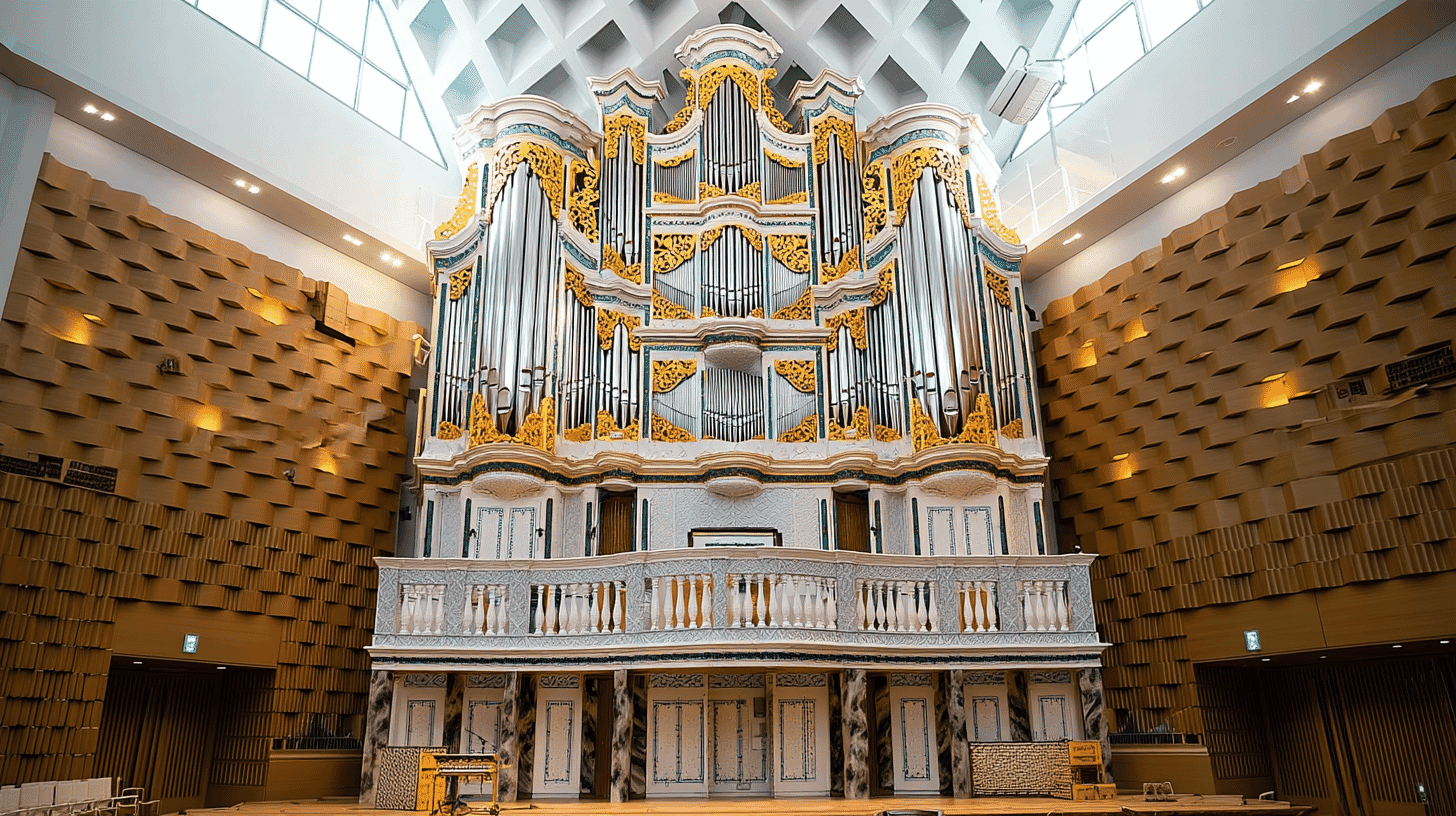
A new pipe organ has been finished in Ichikawa, a commuter city on the Chiba side of the river from Tokyo. Three manuals and a pedalboard, 50 stops, eight bellows. There is a motor for the wind, but the sound the instrument was built for comes from people pumping. According to the organisers that takes at least five of them: the organist, someone working the stops, and bodies on the bellows.
It stands in the Iijima Tojuro Memorial LLC Hall, inside the Comprehensive Creation Center of Yamazaki Baking, the company whose bread fills the shelves of Japanese convenience stores. Building it took eight years. Japan has plenty of concert-hall organs far larger than this one, so the size is not what stands out. What does is that someone in 2026 commissioned an instrument that runs on human effort.
An instrument that runs on people
The model is the organ Adam Gottlob Casparini built in 1776 in Vilnius, Lithuania, reported as an instrument of 30 stops. The Ichikawa version expands it to three manuals and 50. Japanese coverage describes keys cut from light shina lime, windchests made from oak that a timber dealer had air-dried and set aside 40 years earlier, and stop hardware cast by metalworkers in Kanazawa. The methods, those reports say, are those of roughly 300 years ago, worked by hand, and were the brief from the start rather than a flourish.
The wind system is where the choice bites. A motor delivers air at a constant pressure. The eight bellows, pumped by people, do not. The pressure shifts a little as the instrument is played, and the notes shift with it. Japanese reports compare the effect to breathing, and to speech.
The cost of that is people. A recital on this organ is not a single musician alone at a console. It is a small crew, half of them out of sight, doing physical work for the length of the programme. Instruments like this were ordinary in the 18th century partly because labour was the cheapest thing in the building. Reproducing the sound means reproducing the labour.
What "the largest in Japan" measures
The organ was announced as the largest in Japan in its historical style, and the qualifier carries most of the weight. The body of that same coverage is more careful, saying only that an instrument on this scale has few precedents in the country. By raw count, the biggest instrument in Japan is at the Tokyo Metropolitan Theatre in Ikebukuro: 126 stops and around 9,000 pipes in a rotating case that presents three different organs, tuned three different ways, to the same hall. The Rieger at Suntory Hall has 74 stops and 5,898 pipes. Fifty stops is nowhere near either figure.
The claim is about historical style, not volume. The big Japanese hall organs are engineering answers to a modern question: how do you fill two thousand seats, in equal temperament, with one player and a console full of electrical assistance. Building in an 18th-century style means giving up every one of those answers deliberately. Fifty stops assembled that way sits in a different category of difficulty from 126 stops assembled the modern way.
From Vilnius, 1776, to a commuter suburb
The Casparini organ still stands in the Church of the Holy Ghost in Vilnius, and it survives in unusually complete condition for a late Baroque instrument, which is why researchers keep going back to it. Ichikawa is not the first place it has been rebuilt.
In October 2008 the Craighead-Saunders Organ was dedicated at Christ Church in Rochester, New York, after an international research group had spent about six years documenting how 18th-century organs were actually made. Two manuals, 33 stops, about 2,000 pipes, and a bill of $2.8 million. The Eastman School of Music, which ran the project, credits the voicing of that instrument to a Japanese builder named Munetaka Yokota.
Yokota built the Ichikawa organ. Before Rochester he worked at the Göteborg Organ Art Center at the University of Gothenburg, where he led the work on the pipes for the North German Baroque Organ dedicated at Örgryte Nya Kyrka in August 2000. That instrument has four manuals and pedal, 12 bellows and quarter-comma meantone tuning, and was built as a research project rather than a commission. His workshop is now in the old Fujino district of Sagamihara, west of Tokyo, and its recent catalogue runs to an 18-stop organ for a Lutheran church in Miyazaki in 2019 and a 33-stop instrument in Amsterdam in 2018. Fifty stops is a considerable step up.
Japan's hall organs are running out of rooms
Japanese public halls started buying organs in 1978, when Narashino, a short train ride from Ichikawa, put an instrument by Beckerath of what was then West Germany into its cultural hall: 49 stops, 3,512 pipes. The city describes it as the first large pipe organ installed in a public facility in Japan. Older instruments do exist. The former Tokyo Music School concert hall in Ueno still holds an organ of 1,379 pipes, bought from Britain in 1920 and given to the school by Yorisada Tokugawa in 1928, which Taito Ward calls the oldest pipe organ in the country still used for concerts. But that one went into a school auditorium. The idea of putting a large organ in a hall for the general public starts in 1978. Other cities followed through the 1980s and 1990s, and an organ became a normal fixture of a municipal concert hall.
That hall closed at the end of March 2023, and the organ had nowhere to be. In October 2024 the city put the question to a crowdfunding campaign, on the condition that a shortfall would mean refunding every donor and leaving the instrument where it was. It took in 86.98 million yen, about $560,000, across 5,647 contributions, well past the 60 million yen it had asked for. Relocation, according to the local paper Narashino Keizai Shimbun, had been quoted at roughly 150 million yen, about $960,000. The instrument is to be reassembled in a rebuilt hall at the south exit of JR Tsudanuma Station, due in 2031. Installing it in 1978 had cost about 100 million yen, in money that no longer means what it meant then.
Narashino is not a special case. The organ in Matsue's Prava Hall, installed in 1985, went more than 35 years without the overhaul such instruments normally receive every 20 to 25 years. The city held workshops and ran surveys before deciding to overhaul it during a renovation of the building and to build school programmes around it. A hall organ is not furniture that can be carried out when a lease ends. It is fitted to the room, and when the room goes, the future of the instrument lands on a budget committee.
Why the answer was a bakery
Yamazaki Baking opened its Comprehensive Creation Center on December 1, 2016, in Ichikawa, the city where the company began. The site holds a research laboratory, a training centre, lodging, and the LLC Hall, which seats between 350 and 500 and is open to local residents as well as staff. The company presents the whole thing as its stated principle of contributing to culture, put into practice. Trade coverage of the organ credits the decision to build it to Nobuhiro Iijima, the company's president. What it cost has not been disclosed.
A private hall has no capital plan, no council to convince every few years, no line item that has to survive the next round of cuts. An instrument needing five people in the room to sound right is a hard thing to get past a public hall that is judged on how often its rooms are booked, or so it looks from outside. For a company that already decided its hall is not supposed to pay for itself, it is much easier. The Vilnius original was built for a church, not a two-thousand-seat auditorium, and 350 to 500 seats is roughly the room it was designed to fill.
Two recitals open the instrument to the public in November 2026: Wolfgang Zerer, professor at the Hochschule für Musik und Theater Hamburg, on the 6th, and Krzysztof Urbaniak, professor at the Academy of Music in Kraków, on the 21st, each with masterclasses attached. The programmes run from Bach and Buxtehude through Mendelssohn and Brahms to Jehan Alain, and bookings already reach into January and February 2027. Wanting an organ in a historical style in Japan usually means having one built. Imported old instruments are here, as Ueno shows, but centuries-old European churches to inherit one from are not. Where you live, is the old instrument already down the road, or would somebody have to pay to build it?
References
- https://ebravo.jp/archives/213405
- https://musicnews.lflc.jp/articles/64e72dad71e8b880
- https://www.yamazakipan.co.jp/company/creationcenter/index.html
- https://munetakayokota.com/works/
- https://www.esm.rochester.edu/organ/instruments/craighead-saunders/
- https://www.newswise.com/articles/unique-new-pipe-organ-is-first-precise-replica-of-best-preserved-late-baroque-organ-in-europe
- https://www.goart.gu.se/research/instruments/north-german-baroque-organ
- https://www.geigeki.jp/facilities/concerthall/organ/
- https://www.suntory.co.jp/suntoryhall/facility/organ/
- https://www.city.narashino.lg.jp/soshiki/sogoseisaku/oshirase/pipeorgancfor.html
- https://narashino.keizai.biz/headline/551/
- https://www.city.matsue.lg.jp/soshikikarasagasu/kyoikuiinkai_shogaigakushuka/shogaigakushu_kominkan/1561.html
- https://www.culture.city.taito.lg.jp/bunkatanbou/topics/sogakudo/index.html
- https://www.hfmt-hamburg.de/en/hochschule/organisation/personen/wolfgang-zerer
- https://www.amuz.krakow.pl/en/wydzialy/wydzial-ii-instrumentalny/katedra-organow/pracownicy-katedry/dr-hab-krzysztof-urbaniak/
- https://www.murc-kawasesouba.jp/fx/index.php








Global Discussion
2 comments