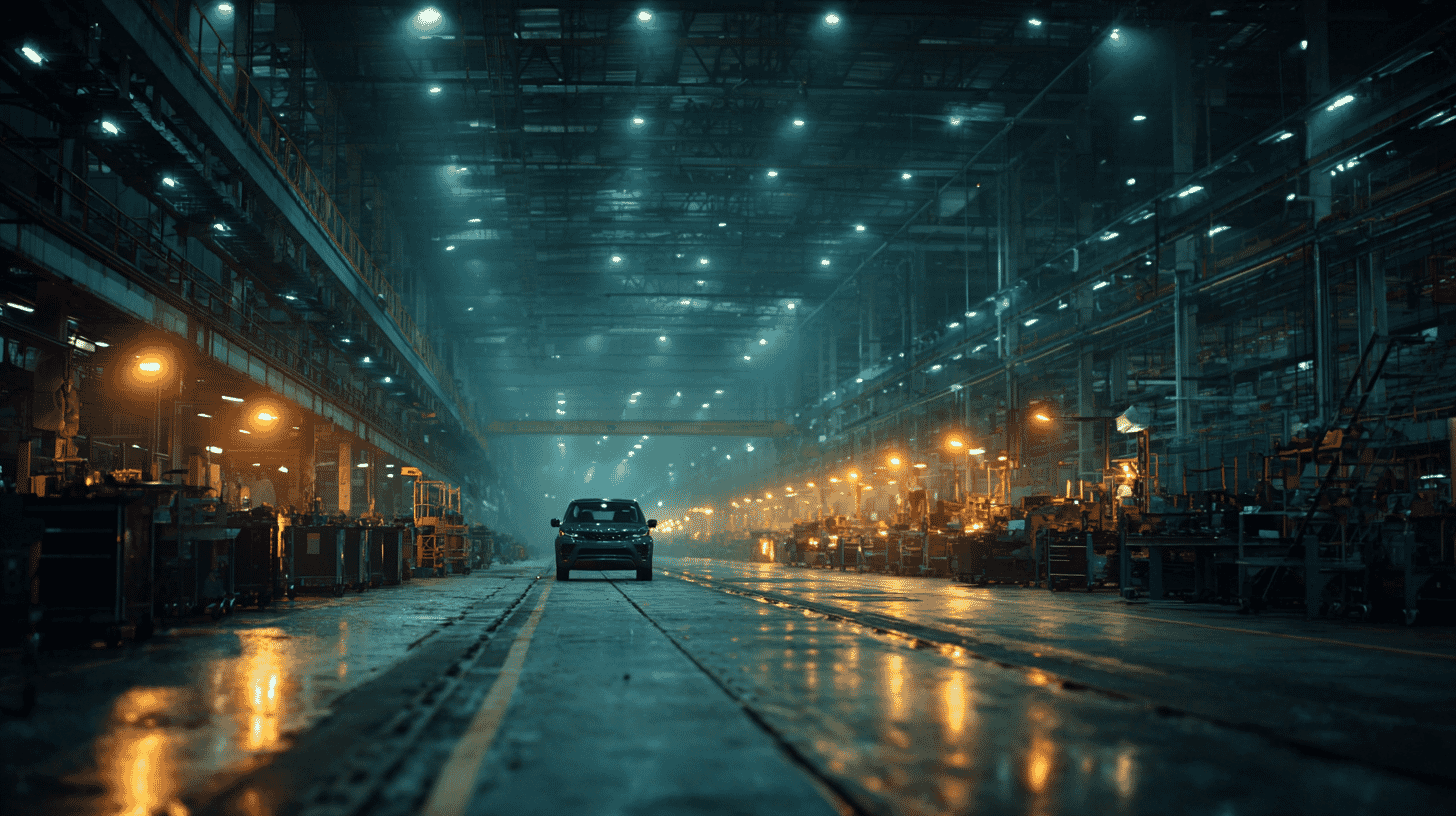
The European footprint of one of Japan's most iconic automakers is shrinking fast.
On May 5, 2026, Nissan Motor Co. confirmed it would cut about 900 jobs across Europe, roughly 10% of its regional workforce, and consolidate two assembly lines into one at its Sunderland plant in northeast England, the company's only complete-vehicle factory in Europe. A month later, on June 3, Nissan and Chery International UK signed a memorandum of understanding covering the line that gets freed up.
Coming after Nissan's failed merger talks with Honda last year and as part of CEO Ivan Espinosa's "Re:Nissan" recovery plan, this announcement isn't just a routine restructuring. It's a snapshot of an industry-wide squeeze: Chinese EV makers are storming Europe, Japanese brands are losing share, and the post-Renault era is forcing Nissan to compete in Europe largely on its own.
What Nissan Actually Announced
Three concrete measures came out of the May 5 (UK time) statement.
First, around 900 European job cuts, about 10% of the regional headcount. Nissan hasn't disclosed which sites or functions will be affected, only that it has "started discussions with European employees" to simplify structures.
Second, line consolidation at Sunderland. The plant currently runs two assembly lines that together build the Qashqai compact SUV, the Juke crossover, and the brand-new electric Leaf. From the second half of 2026, all three models will run down a single line, with Line 2 moving from two shifts to three shifts to compensate. Nissan stresses no Sunderland jobs will be lost as a direct result of this change, though some UK roles may be among the 900 European cuts elsewhere in the business.
Third, partial closure of the Barcelona parts warehouse and a switch to an importer model in the Nordic countries. In the Nordics, Nissan will stop running its own sales operation and let local dealers import and sell its cars instead.
The Sunderland Reality: A Plant Running at 50%
UK media reporting from the BBC, Autocar, Auto Express, and the Financial Times paints a stark picture of Sunderland.
Capacity: over 500,000 vehicles per year. Actual 2025 output: roughly 273,000 cars, barely half of capacity. Utilization rate: roughly 50%, dropping below 30% during the recent transition to the new Leaf.
Sunderland opened in 1986 and currently employs about 6,000 people, making it one of the largest single-site employers in UK manufacturing. With Line 1 going dark, Nissan is openly looking for another carmaker to take over the empty building, a dramatic concession for a plant that once embodied Japanese manufacturing pride in Britain.
Andy Palmer, the former Nissan executive who began his career at Sunderland, told Autocar: "Any reduction in capacity is bad news for Nissan and bad news for Sunderland."
Enter Chery: The Chinese Tenant Scenario
The leading candidate to occupy Sunderland's vacant line is China's Chery Automobile.
Chery entered the UK market in August 2024 with its Jaecoo and Omoda brands. By the first four months of 2026 its share of new-car registrations had reached about 6%, according to the Society of Motor Manufacturers and Traders. The Jaecoo 7 is the third best-selling new car in the UK year-to-date, with more than 20,000 registrations, and Chery's retail network had grown to 126 dealerships by May.
Chery has form when it comes to inheriting Nissan facilities. It is already building cars with Spain's Ebro at a former Nissan plant near Barcelona, and in January 2026 it agreed to acquire Nissan's Rosslyn factory in South Africa.
Sunderland now has its answer too. On June 3, 2026, Nissan and Chery International UK signed a non-binding memorandum of understanding to study contract manufacturing of Chery vehicles on Line 1 from fiscal 2027. Nissan would remain the sole owner of the plant, and the workforce would stay on Nissan's payroll. Massimiliano Messina, who runs Nissan's European business, called it "an important step forward for our operations" and said the two sides were still working toward terms that suit both. Which models would be built has not been decided.
Under that structure Nissan shares fixed costs and preserves Sunderland jobs, while Chery sidesteps UK tariff exposure and EU local-content rules through local manufacturing. It's a logical commercial pairing, but one that drops a Chinese carmaker into the heart of British auto manufacturing, with all the political optics that come with it.
Why Nissan Got Squeezed: Three Structural Forces
1. Japanese brands are losing Europe to the Chinese
Nissan's UK market share dropped to 3.7% in the first four months of 2026, down from 5.6% in 2016, a roughly 30% relative decline. Chery, which was not selling in Britain two years ago, is already near 6%. SAIC's MG brand sits at 4%, BYD at 3.45%. The Chinese have leapfrogged the Japanese in the UK market, and the broader European trend is the same: in January 2026, BYD's EV sales in Europe nearly tripled year-on-year, and Leap Motor was up 357%.
The International Council on Clean Transportation's latest report flags Nissan as 28 g CO2/km above its EU compliance target, the largest gap of any major brand. Without remedial action, fines loom in 2027 when the 2025–2027 averaging period closes.
2. The unwinding of the Renault alliance
The 20-year Renault-Nissan alliance has been steadily dismantled since 2023:
- 2023: Renault cut its Nissan stake from 43% to 15%, with voting rights capped equally at 15% on both sides.
- March 2025: Both companies agreed to lower the minimum cross-shareholding floor from 15% to 10%, freeing up capital. Nissan also sold its 51% stake in their Indian joint venture to Renault.
- June 2025: Reports emerged that Nissan plans to sell roughly 5% of its Renault stake to fund product development.
Greater independence was something Nissan management had wanted for years, but it comes with a cost: the joint procurement and platform-sharing scale benefits are smaller, and Nissan now competes in Europe largely as a standalone player against well-resourced rivals.
3. The Re:Nissan plan: profitability over volume
In May 2025, new CEO Ivan Espinosa unveiled "Re:Nissan," a plan to cut 20,000 jobs globally (about 15% of the workforce), consolidate seven of the seventeen complete-vehicle factories worldwide, and slash 500 billion yen (about $3.1 billion at the July 2026 rate of ¥163/USD) in fixed and variable costs.
Domestically in Japan, Nissan's Oppama plant in Kanagawa Prefecture will end vehicle production by the end of fiscal 2027. Overseas, the Civac plant in Mexico's Morelos State winds down by March 2026. The European 900-cut and Sunderland line merger are the European chapter of that same global story.
Volkswagen, Stellantis: Europe Is Hurting Together
This isn't a Nissan-only problem. It's an industry-wide squeeze.
Volkswagen announced in autumn 2024 that it could close domestic German plants for the first time in its 87-year history, with thousands of layoffs, a 10% wage cut for VW-brand workers, and a pay freeze in 2025–2026. The VW brand's half-year operating profit dropped about 40% year-on-year, and shares are down 44% over five years.
Stellantis (parent of Jeep, Fiat, Peugeot, Citroën, Vauxhall, Opel, and others) announced in November 2024 that it would close its Vauxhall van factory in Luton, England, putting more than 1,000 jobs at risk. Its Mirafiori plant in Italy has repeatedly halted Fiat 500 EV production. Stellantis also took roughly €14.5 billion in charges in 2025 for "the cost of overestimating the pace of the energy transition": write-offs on cancelled EV products, battery capacity rationalization, and platform impairments.
Ford is cutting 4,000 European jobs, mostly in Germany and the UK. Bosch plans to cut 5,500 jobs by 2032. Michelin is closing two French sites.
The picture is consistent: cheap, well-built Chinese EVs, weak European demand, and a slower-than-expected EV transition are forcing nearly every legacy automaker into defensive cost-cutting. Nissan is dealing with the same pressures, just as a Japanese player.
Japanese vs European Labor Practices
To readers from outside Europe, "900 layoffs at a Japanese company" might sound out of character. Within Japan itself, Nissan's December 2024 cuts were structured around voluntary early retirement, since Japanese corporate culture has historically leaned heavily on lifetime employment.
In Europe, the rules are different.
In Germany, the Mitbestimmung (co-determination) system gives worker representatives half the seats on the supervisory boards of large companies. Plant closures and mass layoffs require lengthy bargaining, and unions can legally call strikes. VW's union reps have repeatedly used that leverage during 2024–2025 negotiations.
In France, companies must consult their Comité Social et Économique (works council) before any major restructuring, and the government routinely intervenes to defend jobs at strategic sites.
In the UK, the labor market is more flexible, but collective consultation is still required: 30 days for layoffs of 20+ workers, 45 days for 100+. Nissan's wording, "we have started discussions with our European employees," signals the start of that statutory clock, not the conclusion.
So the European cuts will play out gradually over months of consultations, country by country, rather than as a single Japanese-style "voluntary retirement window." It's slower and more expensive for the company, but more protective for workers.
Sunderland and the Future of UK Auto Manufacturing
Sunderland has been a totem of UK auto since 1986. UK vehicle output peaked above 1.7 million units a year; in 2024 it slumped to about 780,000, less than half. Jaguar Land Rover is also reportedly in early talks with Chery about manufacturing partnerships. The notion that British mass-market cars might increasingly be built by Chinese brands in former Japanese factories is moving from speculative op-ed to live commercial discussion.
"We need Nissan to stay here and build sensibly priced vehicles," wrote Auto Express columnist Mike Rutherford. "But thousands more of them, please, with or without Nissan badges." That's the real bet behind the Chery deal: keep British production lines running, even if the brand on the hood changes.
For Nissan, that's both a pragmatic solution and a quiet humiliation: a factory that once symbolized Japanese manufacturing strength in Europe could end up as a shared workshop with one of the rivals beating Nissan in its own market.
The Bottom Line
Behind numbers as small as 900 jobs and one production line sits the dismantling of the Renault alliance, the failed Honda merger, the Chinese EV onslaught in Europe, the structural rebalancing of an entire continent's auto industry, and a clash between Japanese and European employment cultures.
Espinosa's pitch, a "leaner, more resilient business that adapts quickly to market changes," is rational. Whether it's enough to defend Nissan's place in Europe is the open question. The day a Chery logo goes up over a Sunderland production line, if it comes, will be remembered as a milestone in the global rebalancing of the auto industry.
What's happening to the auto industry in your country right now? Plant closures, layoffs, foreign brands moving in: drop a comment below and tell us what you're seeing.
References
- https://www.bbc.com/news/articles/cm2x4j5vyglo
- https://www.itv.com/news/tyne-tees/2026-05-05/nissan-to-merge-uk-production-lines-and-cut-european-workforce
- https://www.autocar.co.uk/car-news/new-cars/nissan-shut-production-line-sunderland-cost-saving-move
- https://www.autoexpress.co.uk/nissan/369516/nissan-shuts-one-sunderland-production-line-qashqai-juke-and-leaf-output-be
- https://www.electrive.com/2026/04/17/nissan-eyes-chery-deal-to-sublease-sunderland-plant/
- https://global.nissannews.com/en/releases/250331-01-e
- https://theicct.org/publication/european-car-market-monitor-mar-2026/
- https://www.best-selling-cars.com/europe/2026-january-europe-car-sales-and-market-analysis/
- https://news.web.nhk/newsweb/na/na-k10015115201000








Global Discussion
14 comments