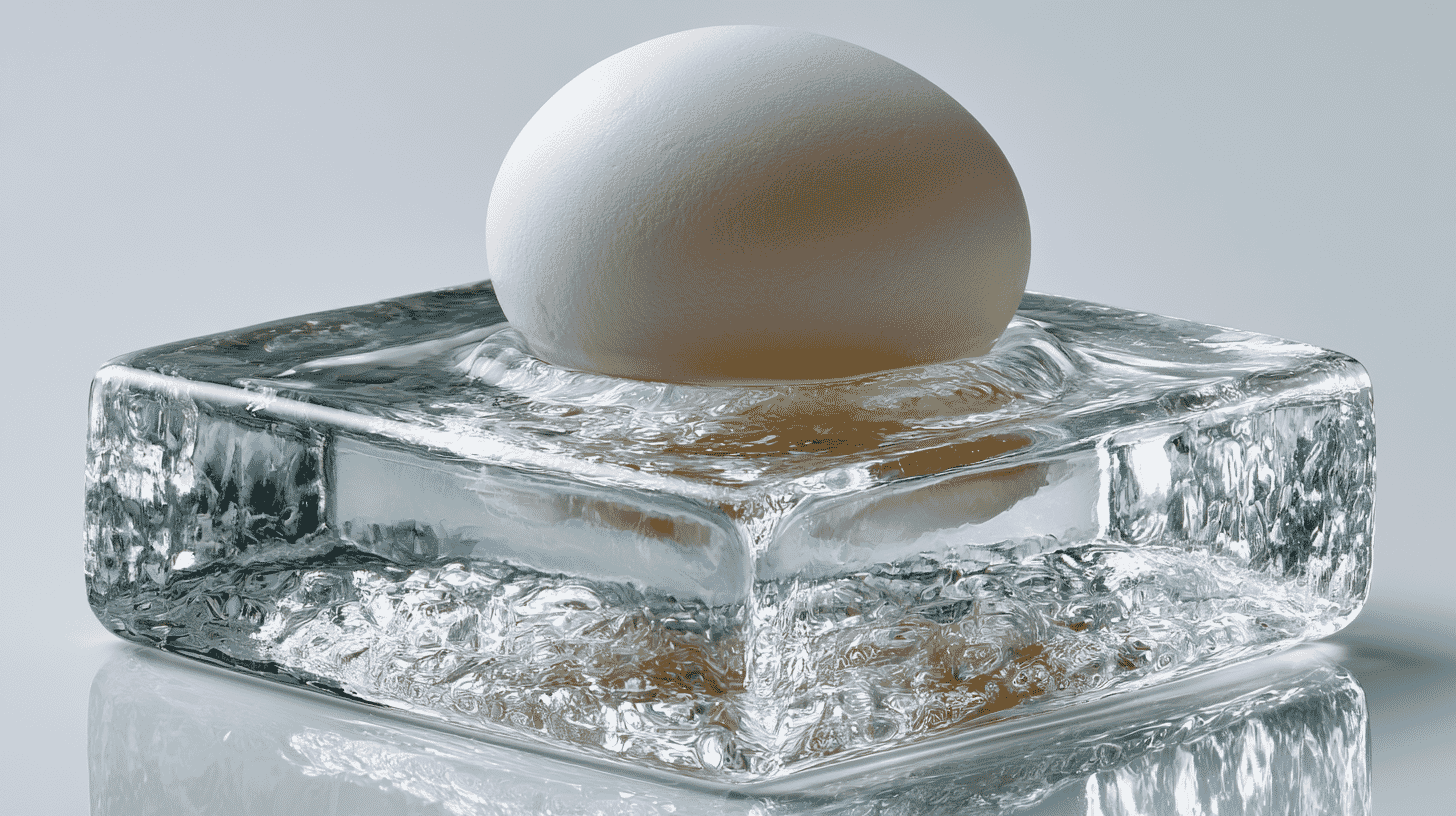
🥚 Drop a raw egg from a sixth-floor window and it should end up as breakfast on the pavement. Drop it onto a 2cm slab of a certain Japanese gel and it just sits there, intact. That gel is called αGEL, and there's a good chance you've already squeezed it, written with it, or worn it without ever knowing.
The material that started with a falling pillow
αGEL (written "Alpha GEL" in English) is a silicone-based gel that Taica, a chemical maker based in the Kyobashi district of central Tokyo, developed in 1984. Calling it "soft" undersells it. It wobbles, almost liquid to the touch, yet it springs back and shrugs off impacts that would shatter glass or crack a phone screen.
Taica tells the origin story happily. In the early 1980s, a developer worn out from chasing a new shock-absorbing material got hit on the head by a melted cooling pillow, the gel-filled kind you press to a fever. That gooey blob became the clue. He started gathering every gel-like substance he could find, picking apart their molecular structures one by one, until trial and error finally produced something new.
The party trick that made αGEL famous is the egg. Taica drops a raw egg from 18 meters onto a sheet of αGEL just 2cm thick, and the egg survives. The stunt got written up in newspapers, and the image of the unbroken falling egg is now so tied to the brand that Taica registered it as a trademark.
You've probably touched it already
Here's the fun part for anyone outside Japan: αGEL has been hiding in everyday objects for decades.
That newspaper egg trick caught the eye of ASICS. The two companies developed a shoe cushioning material together, and in 1986 αGEL went into ASICS running shoes, the domestic "Freaks α" and the overseas "GT-II." By Taica's account it's been used in ASICS footwear ever since, more than thirty years.
If you went to school in Japan, you almost certainly know it from somewhere else: the uni α-gel mechanical pencil. Mitsubishi Pencil launched it in 2003 with a squishy gel grip, and it became a runaway hit with students, with shops repeatedly selling out. The softness has a downside the packaging openly warns about, though: poke the grip with a fingernail and it can tear.
Casio's G-SHOCK watches use it too. αGEL is packed inside the case to soak up vibration, part of a system Casio calls Triple G Resist, built to shrug off shocks, vibration, and centrifugal force all at once. Taica engineers compare the trick to seismic isolation: the system that keeps Japanese houses standing through earthquakes, shrunk to fit inside a wristwatch. You'll also find the gel in PORTER bags, smartphone cases, and plenty of cameras and laptops.
Soft, springy, and built to eat impacts
So why does a blob this floppy stop an egg from breaking?
The short version: αGEL turns a sharp hit into a slow squish. When something slams into concrete, the collision is over in an instant, and cramming all that force into a tiny sliver of time is exactly what produces a bone-rattling, or shell-cracking, peak. αGEL does the opposite. It deforms, stretching the impact out over a longer moment so the peak force never spikes. In Taica's own framing, it swallows the impact by converting that energy into deformation. Squish instead of smash.
Vibration is a related problem, and it's where the material earns its keep inside machines. Tuning the gel's softness and its "damping," how quickly it settles after being disturbed, lets it absorb a wide band of frequencies, from heavy low-frequency rumble to fine high-frequency buzz, including the faint microvibrations ordinary rubber struggles with. The same family of gel can also be tuned to pull heat away from electronics. One squishy material, several jobs.
Killing a drone's invisible enemy before it's built
Which brings us to the newest place αGEL is turning up. At Japan Drone 2026, Taica showed off its αGEL anti-vibration materials alongside a "vibration design support service," as the trade outlet BUILT reported in June.
The problem it tackles is unglamorous but real. A modern drone is a flying bundle of sensitive gear, cameras, sensors, communication units, control boards, and all of it shakes in flight. A jittery camera ruins footage; a rattled sensor feeds back bad data. The old fix was to bolt damping material onto a finished drone, test it, adjust, then test again. Slow and expensive.
Taica's pitch is to move that work to the design stage. The company hears out a client's vibration headaches and operating conditions, then runs simulations to work out the right damping structure before anything is physically built, covering not just which material and shape to use but the vibration testing and performance checks too. A booth representative told BUILT that the approach trims development time and cost. The service isn't drone-only; it targets any product fighting vibration, with drones as the showcase this time around.
From a student's pencil to machines that fly, the same gel keeps turning up in a new guise. Taica says αGEL has even reached AI hardware, IoT devices, and space development.
Japan has a habit of producing these unsung materials, the kind that do crucial work while hiding inside something else. What's the under-the-radar material in your country that everyone uses and almost nobody can name?





Global Discussion
0 comments