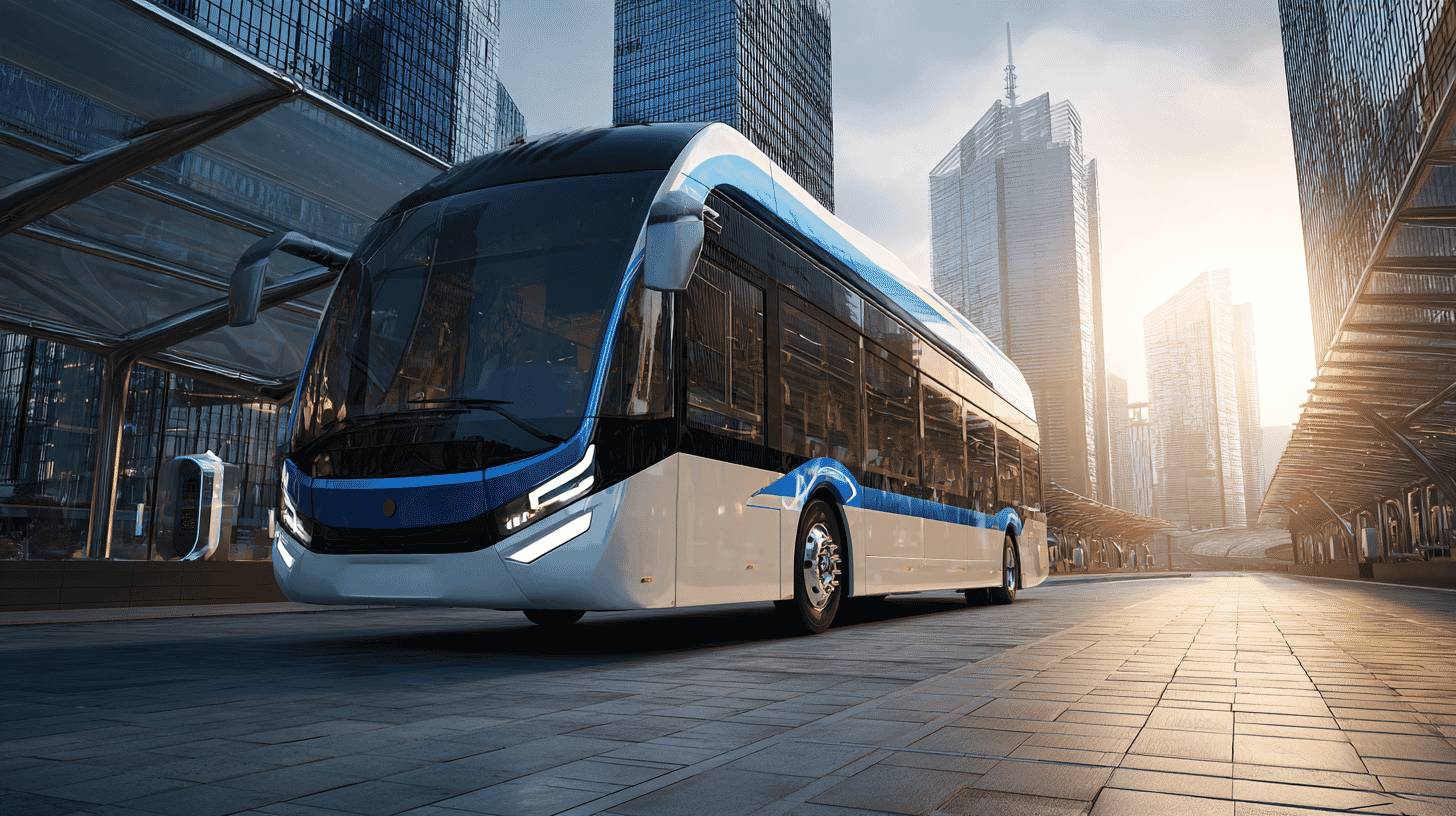
Mitsubishi Fuso Truck and Bus Corporation and Taiwan's Hon Hai Precision Industry (Foxconn) have formally agreed to establish a new company to run an EV bus business in Japan.
It is the first time Foxconn, known worldwide for making the iPhone, has teamed up with a Japanese commercial-vehicle maker. A Japan-Taiwan partnership is taking shape to challenge a domestic EV bus market where BYD holds about a 60% share.
The New Company: A 50-50 Equal Stake, Launching in Late 2026
On January 22, 2026, Mitsubishi Fuso Truck and Bus and Hon Hai Precision Industry held a press conference in Kawasaki, announcing they had reached a final agreement to set up a new company handling the development, production, and sale of EV buses. The two had already reached a basic agreement in August 2025 on strategic collaboration in ZEV (zero-emission vehicle) buses, and this is a major step forward from that.
The new company is to be established in the second half of 2026, subject to regulatory approvals, as an equal joint venture in which Mitsubishi Fuso and Hon Hai each hold 50%. It will be headquartered in Kawasaki, alongside Mitsubishi Fuso. Katsuhito Takara, head of Mitsubishi Fuso's bus business division, is to become CEO, and Jun Seki, the Hon Hai CSO (chief strategy officer) who oversees its EV business, is expected to be deeply involved in running the new company as well.
At the press conference, then Mitsubishi Fuso president Karl Deppen said that "by joining forces, we will launch a technically strong bus company."
Production Plan: Manufacturing at the Toyama Plant Based on Hon Hai Models
The new company will use the plant of Mitsubishi Fuso Bus Manufacturing (Toyama City), a Mitsubishi Fuso subsidiary, to manufacture EV buses. The vehicles will be developed and made under the "FUSO" brand.
The vehicles will be based on the large EV bus "Model T" and the small EV bus "Model U" developed by the Hon Hai group. It will start with the "Model T2," a large route bus based on the "Model T" that Hon Hai has mass-produced in Taiwan since 2022. Specifications will differ from the Taiwanese version, and a vehicle based on the smaller Model U is left for later consideration.
It aims to start taking orders for large route buses during 2027, prioritizing sales in the domestic market first. It also has an eye on overseas expansion in the future.
Why Team Up with Hon Hai? A Strategy to Clear the Development-Cost Wall
Electrifying a bus costs far more to develop than a passenger car. A large EV bus that carries many passengers over long distances demands high energy efficiency and safety. As battery capacity grows, higher vehicle weight and price are unavoidable.
For example, the large EV bus "ERGA EV" that Isuzu Motors launched in 2024 costs about ¥70 million per unit, roughly twice the price of a diesel model.
With the bus market as a whole shrinking, development investment by Mitsubishi Fuso alone was not realistic. A Mitsubishi Fuso source said the company "is in no position to develop and invest on its own," and so it chose to tap Hon Hai's EV technology and ample financial resources.
Hon Hai's EV Strategy: A Contract-Manufacturing Model Devoted to B2B
Hon Hai declared its entry into the EV business in 2019 and has expanded through a business model of taking on the design and manufacture of vehicles.
Jun Seki, who leads Hon Hai's EV business (a former Nissan Motor deputy COO and former Nidec president), has made the company's business model clear: "We have no intention whatsoever of doing B2C; we stick strictly to B2B." It does not sell under its own brand but brings products to market under partner companies' brands.
In Taiwan, it has been putting EV buses on the market since 2022 through Foxtron, a joint venture with Yulon Motor. The Hon Hai-led EV development consortium "MIH" has more than 2,700 participating companies, including Japanese firms.
This tie-up with Mitsubishi Fuso is a collaboration with a Japanese player following Mitsubishi Motors, and for Hon Hai it carries the meaning of securing its first EV manufacturing base in Japan.
Market Background: Japan's EV Bus Market, Where BYD Holds a 60% Share
In Japan's EV bus market, China's BYD shows an overwhelming presence. Having entered the Japanese market in 2015, BYD has delivered about 500 units cumulatively and captured about a 60% share of the domestic EV bus market.
In addition to the large "K8" and small "J6," BYD introduced the mid-size "J7" in 2025, completing a full route-bus lineup. Its price competitiveness is also high, with the J7's suggested retail price set at ¥36.5 million.
Japan's electric-bus market was worth about $1 billion in 2024, and one forecast has it reaching about $4 billion by 2033 at an average annual growth rate of 14.7%. Under a government policy aiming for carbon neutrality by 2050, demand for electrifying public transit is expected to keep rising.
The Significance of Japan-Taiwan Cooperation: Geopolitical Risk and Supply-Chain Diversification
The Mitsubishi Fuso and Hon Hai partnership also has strategic significance beyond market competition.
In recent years, concern over the risk of dependence on Chinese-made EVs has grown in many countries. Collaboration with Hon Hai, a Taiwanese company, is also drawing attention from the standpoint of supply-chain diversification.
Mitsubishi Fuso is also in the midst of a business integration with Hino Motors, and this tie-up with Hon Hai relates to that move. The two companies' holding company, ARCHION, launched on April 1, 2026 and listed on the Tokyo Stock Exchange Prime Market the same day. Deppen became ARCHION's president and CEO, and Franziska Cusumano took over as president of Mitsubishi Fuso. Hino Motors jointly operates "J-Bus" with Isuzu Motors, but antitrust considerations make direct collaboration between Mitsubishi Fuso and J-Bus difficult. The tie-up with Hon Hai became an option to accelerate EV development while avoiding that constraint.
The Outlook Ahead: Toward the Start of Orders in 2027
The new company aims to develop next-generation buses capable not only of electrification but also of autonomous driving. Business expansion targeting global markets is also planned.
For Hon Hai, its track record in commercial vehicles could be a foothold for expanding collaboration with Japanese passenger-car makers. It has also announced an EV supply arrangement with Mitsubishi Motors, steadily raising its presence in the Japanese market.
Japan's bus industry faces many challenges, such as a shortage of drivers and difficulty maintaining routes. Spreading EV buses could contribute not only to environmental measures but also to realizing sustainable public transit through lower operating costs.
Japan's bus production is concentrated in the single Toyama plant, and the line running through it will gradually shift to a Taiwanese-designed EV. What this venture really tests is whether a partnership built on production and sales networks, rather than on shared engineering heritage, can hold.
How far has the electrification of public transit progressed in your country? What efforts are there around EV buses?









Global Discussion
15 comments