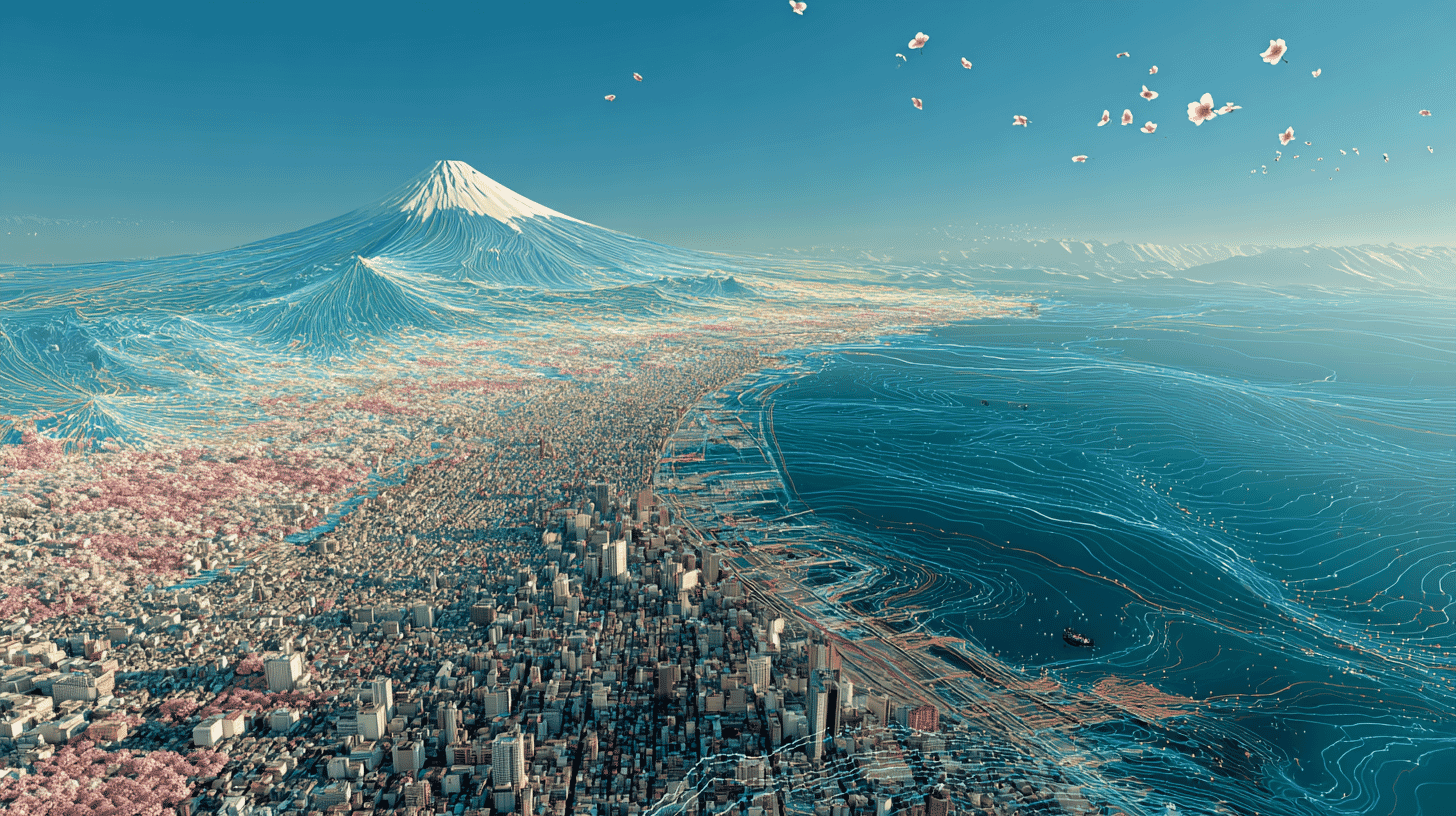
In April 2026, Japan got hit by FIVE earthquakes of seismic intensity 5 or higher in a single month. A magnitude 7.7 offshore Sanriku quake. A magnitude 6.2 Hokkaido quake. Twin magnitude 5 quakes in Nagano. A magnitude 5 in Ibaraki. In most countries, any one of these would dominate the news cycle for weeks and trigger international aid. In Japan? Five in 30 days, zero deaths, zero collapsed buildings, and most people just kept commuting. This isn't normal. This is what happens when a country has spent 47 years re-engineering itself to laugh in the face of tectonic plates. Here's a humorous-but-serious look at why Japan has essentially "solved" earthquakes, and the one rule you need to know if you're visiting.
The April Five-Pack: A Quick Recap
Let's just lay out what happened, because it's almost comical when you list them in a row:
April 1, Wednesday, Southern Ibaraki, M5.0, max intensity 5-lower (Moka, Tochigi) New fiscal year, new earthquake. Depth around 50km. A weak 5 on the Japanese intensity scale (which goes 1, 2, 3, 4, 5-lower, 5-upper, 6-lower, 6-upper, 7). Damage: essentially none.
April 18, Saturday 13:20, Northern Nagano, M5.0, max intensity 5-upper (Omachi) Originated near the Itoigawa-Shizuoka Tectonic Line. In Omachi City, 85 spots had roof tiles fall, gravestones toppled, and the ground subsided about 15cm in places. Injuries: zero.
April 18, Saturday 14:54, Northern Nagano, M5.1, max intensity 5-lower (Omachi & Nagano City) Same area, 90 minutes later. Active-fault aftershock pattern.
April 20, Monday 16:53, Off Sanriku, M7.7 (Mw 7.4), max intensity 5-upper (Hashikami, Aomori) The big one. Depth 19km, a thrust earthquake on the Pacific Plate boundary. Tsunami warnings issued for Hokkaido, Aomori, and Iwate. An 80cm tsunami was observed at Kuji Port in Iwate. The Japan Meteorological Agency issued the "Hokkaido-Sanriku-oki Subsequent Earthquake Advisory", only the second time it's been issued since the system started in December 2022. Some injuries were reported (a panel fell about 20 meters in a Hachinohe facility) but zero deaths and zero buildings collapsed.
April 27, Monday 05:24, Southern Tokachi, Hokkaido, M6.2, max intensity 5-upper (Urahoro) On the very last day of the post-Sanriku alert period, a deep quake (83km) struck. At Urahoro Town Museum, pottery shifted in display cases and a metal pole fell over, breaking glass. In Hakodate, a 91-year-old woman fell and injured her knee. JR canceled 85 trains, including the Rapid Airport service between New Chitose and Sapporo, affecting around 24,000 passengers.
Five quakes. Zero deaths. Zero structural collapses. By global standards, this is statistically absurd.
Why Japan's Buildings Refuse to Fall: The 1981 Code
The single biggest reason is a piece of legislation called the New Earthquake-Resistance Standard (新耐震基準), enacted on June 1, 1981.
The trigger wasn't, as is sometimes assumed, the famous 1995 Kobe earthquake, it was the 1978 Miyagi-oki earthquake (M7.4), which killed 28 people and destroyed 7,400 homes around Sendai. Japan looked at the damage and rewrote the rulebook.
The old standard required buildings to withstand "intensity 5" without collapsing. The new standard demanded that buildings "withstand intensity 6-upper to 7 without collapsing." That's a massive jump, equivalent to going from "designed for a strong shake" to "designed for the worst quake a person is statistically likely to ever experience."
Then came 1995 Kobe (M7.3, intensity 7). The result was a brutal, real-world test: over 70% of buildings constructed under the new 1981 standard came through with only minor or no damage, while pre-1981 structures collapsed catastrophically. Of the 6,434 deaths in Kobe, roughly 90% were caused by collapsing buildings and falling furniture.
Kobe drove a second wave of reforms: the 2000 Standard, focused specifically on wooden houses. It mandated soil surveys, tightened foundation rules, and required specific metal connectors at structural joints, closing the loopholes Kobe had exposed.
So today, Japan has a two-layered defensive line: any building built after 1981, and any wooden house built after 2000. If you're in a building under 25 years old, structural collapse is essentially off the table. The zero-death April wasn't a miracle. It was the payoff on 47 years of legislative compounding.
The Counterintuitive Rule: Don't Run Outside
If you remember nothing else from this article, remember this: when an earthquake starts, don't run outside.
This goes against every Hollywood-trained instinct. The reflex is "the building will crush me, I should get out." In modern Japan, the math runs the opposite way. A reinforced-concrete building built to post-1981 code is statistically very unlikely to collapse on you. Running outside, on the other hand, exposes you to a zone where shattering window glass, falling signs, exterior tiles, and chunks of concrete the size of a copy machine are raining down.
The Tokyo Metropolitan Government, every major Japanese insurance company, and every disaster-response manual say the same thing: stay where you are, get low, protect your head. If you absolutely must move, head for the center of a wide hallway or duck into a bathroom. If you're outside in a city, the safe move is to duck into a newer reinforced-concrete building, not flee from one.
Tokyo even has a labeling system called the "Tokyo Earthquake-Resistance Mark", buildings that have passed seismic certification get a sticker. If you see one, that building is your friend.
The hierarchy of safety:
- Inside a post-1981 reinforced-concrete building (best)
- In a wide-open space like a park
- Inside an older building with structural unknowns (workable)
- Running through a downtown street while the shaking is happening (worst)
The Fortress: Shizuoka Prefectural Government Annex
If you want to see the apex of Japanese earthquake engineering, look at the Shizuoka Prefectural Government Annex Building.
Shizuoka sits directly over the projected rupture zone of the long-overdue Nankai Trough megaquake. So when the prefecture built its new annex in 1996, the design brief was: "must keep functioning as a disaster command center even during a magnitude-8 earthquake directly below the building."
The specs are, frankly, ridiculous:
- 21 floors above ground, 2 below, 110 meters tall
- Designed to survive a magnitude-8 quake directly underneath
- Withstands ground motion of 70 kine (most buildings are designed for ~30 kine)
- Built with high-strength steel, 1.1× normal strength
- Steel members up to 55mm thick (roughly double an ordinary office tower)
- Anti-tipping wall extends 42.5 meters underground
- Roof bristles with police, fire, and disaster-response antennas
It houses the prefecture's Crisis Management Department, Crisis Management Center, Shizuoka Police HQ, and the new emergency dispatch center. During a Tokai-region earthquake, this building becomes the central node coordinating the national government, the Self-Defense Forces, police, fire departments, and every municipality. It's also linked to the offsite center for the Hamaoka Nuclear Power Plant in case of a radiological emergency.
Locals reportedly nicknamed the construction project the "Shizuoka Government Fortress Plan" because the building, mid-construction, looked like an actual military fortification. The fact that the 21st floor is an open-to-the-public Mt. Fuji observation lounge, no reservation needed, only adds to the surrealism. You can casually visit a fortress.
This isn't an outlier, either. Tokyo Metropolitan Government Building uses massive base-isolation and damping systems. Most of the Shinjuku skyscrapers were built post-1981 and are, counterintuitively, safer to be inside during a quake than the streets below them.
"Oh, an Earthquake": The Other Half of the Equation
The other reason Japan handles quakes well is cultural. The reaction speed is wild.
A magnitude-4 hits, and most Japanese people glance at their phones, mutter "ah, jishin da" ("oh, earthquake"), and go back to their coffee. The Earthquake Early Warning system pings before the shaking arrives, and people respond to it like a fire drill they've rehearsed since age six. Because they have.
This isn't insensitivity. It's the result of:
- The Earthquake Early Warning system only triggers above intensity 3, so when the alarm sounds, you know it's serious, and people genuinely brace for it
- Schools and workplaces run regular evacuation drills (in some prefectures, multiple times per year)
- Smartphones come with quake alerts on by default
- "Get under the desk, turn off the gas, prop the door open" is muscle memory by elementary school
If you're a tourist and feel a moderate shake, look at the locals first. If they're calm, you're fine. If somebody dives under a desk, copy them immediately. No questions, no pride.
Survival Kit for Golden Week Travelers
If you're visiting during Golden Week (April 29 – May 6), here's the minimum:
1. Install an early-warning app "Safety tips" (the official Japan Tourism Agency app, free, multilingual including Spanish), "NHK World," or "Yurekuru Call." They push alerts to your phone seconds before shaking arrives.
2. Don't run outside Said it three times now because it matters. Hotel room? Get away from windows, duck near an interior wall. Restaurant? Get under the table. Subway? Hold on, listen to staff.
3. If a tsunami warning is issued, head uphill immediately Particularly if you're traveling along the Pacific coasts of Hokkaido, Tohoku, Shikoku, or Kyushu. Strong shake near the sea = run uphill without waiting for the official warning. The shake itself is the warning.
4. Read your hotel's evacuation map Every hotel room has one on the back of the door. Glance at it once when you check in. Sixty seconds, possibly life-saving.
5. Calm is contagious If the locals aren't panicking, there's almost certainly no need for you to.
The Bigger Picture
April 2026 made it concrete: Japan has, in a real sense, solved the problem of "buildings falling on people during shaking."
What did it take? Forty-seven years of compounding building codes. The world's most aggressive early-warning system. Government buildings designed like military bunkers. School curricula that teach children to drop-cover-hold like it's brushing teeth. And a national temperament that responds to a magnitude-5 with "ah, jishin da."
Don't take this as a victory dance, though. The April 20 M7.7 may not be the main event, it could be the foreshock to something much larger, which is exactly why the post-quake Subsequent Earthquake Advisory existed. The Nankai Trough megaquake and the Tokyo direct-hit earthquake are both classified as "will happen, just not sure when." Japan still loses to fire, tsunami, and landslides in ways the building code can't fix.
But the ground shake itself? Largely beaten. The April five-pack should have killed dozens. It killed nobody. That's a result worth pausing on.
How does your country react when the ground shakes? What's the building code like where you live? Are people taught to run outside, or stay in? We'd love to hear from you in the comments.
References
- https://news.yahoo.co.jp/articles/679555ca27f71f68e327ae06877dcb4c01bf0163
- https://earthquake.tenki.jp/bousai/earthquake/entries/level-5-minus/
- https://www.jma.go.jp/jma/press/2604/21a/kaisetsu202604211600.pdf
- https://en.wikipedia.org/wiki/Japanese_seismic_intensity_scale
- https://www.bousai.metro.tokyo.lg.jp/kitaku_portal/1000047/1000541.html






Global Discussion
15 comments