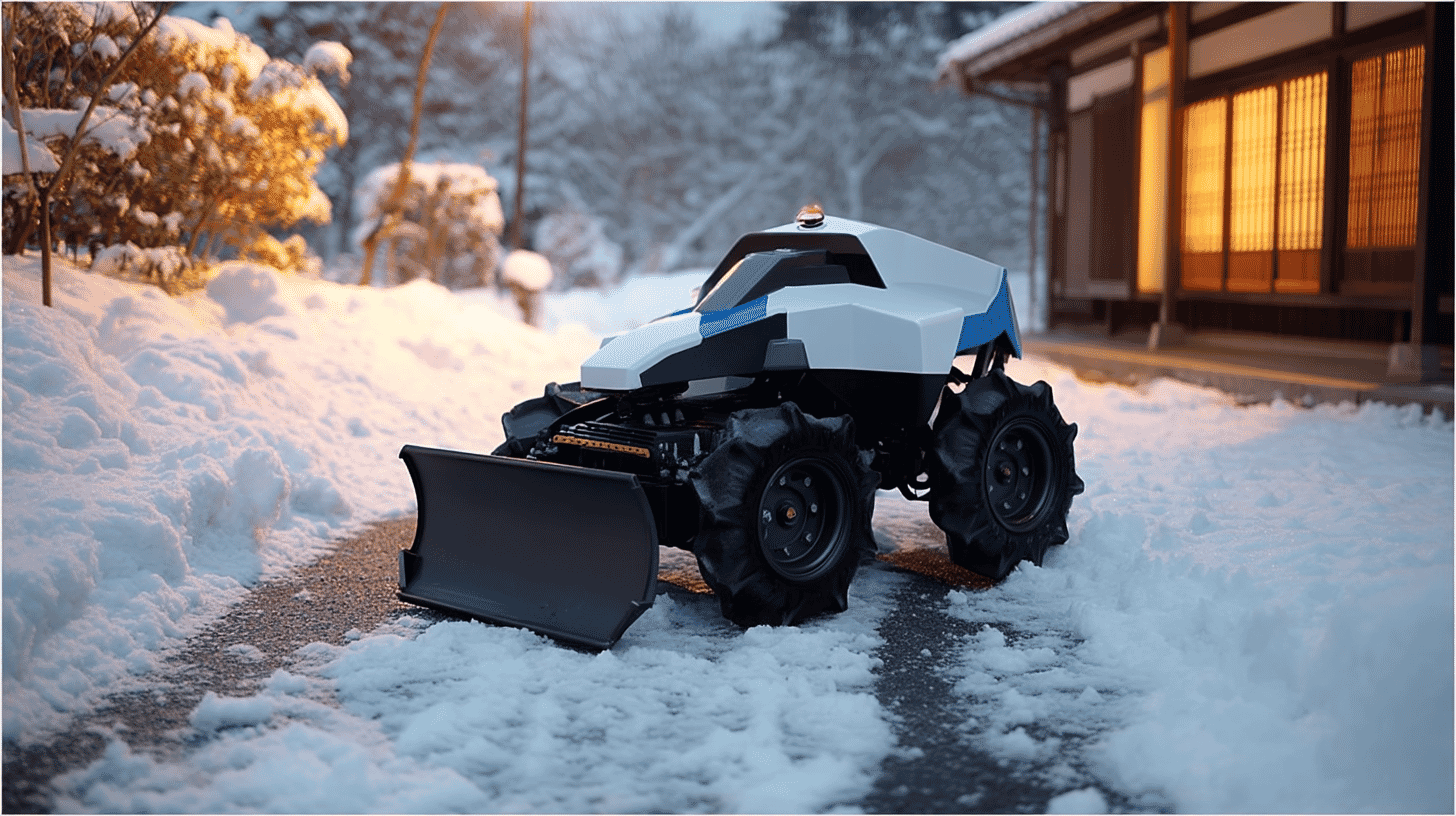
🌨️ What if you could clear snow before it even piles up? A tiny unmanned snow plow developed in Hokkaido just went viral— racking up 240,000 views on Japanese social media during Tokyo's February 2026 snowstorm. The twist? It was built by a startup that spent six years perfecting water drones. "If it can navigate water autonomously, it can handle snow too." That leap of logic might just transform winter in Japan.
From 200 Followers to 240,000 Views: A Snowstorm Spark
In February 2026, a heavy snowfall blanketed Tokyo—unusual for a city that rarely sees significant accumulation. Amid the chaos of disrupted trains and icy sidewalks, a video caught fire on social media. It showed a small, unmanned machine diligently pushing snow aside, working its way through a snowy path like a determined little worker.
The video was posted by an account with just around 200 followers. Within days, it had surpassed 240,000 views and attracted nearly 4,000 likes. Comments poured in: "So cute!" "Look at it working so hard!" "I need one of these!"
The machine in question is the "Snow Removal Drone" (Josetsu Drone), developed by everblue technologies, a startup headquartered in Chofu, Tokyo.
Born on Water, Reborn on Land
What makes this story truly fascinating is the technology's origin. Everblue technologies was founded in 2018 with a mission far removed from snow removal: developing sail-powered water drones that could navigate autonomously using wind energy, producing nearly zero carbon emissions.
By 2020, the company had successfully tested autonomous navigation in Zushi Bay, Kanagawa Prefecture. In 2022, they achieved a nine-hour continuous unmanned sailing test as part of a government-backed "Smart Island" project, transporting cargo between mainland Yamagata Prefecture and the remote island of Tobishima.
The intellectual leap came when CEO Tsunetake Noma realized the autonomous navigation, GPS control, and remote operation technologies developed for water could be applied to land vehicles. "If we can drive autonomously on water, we can do it on land," he reasoned. In 2022, the company pivoted to developing unmanned snow removal machines—and the Snow Removal Drone was born.
The "Roomba for Snow" Concept
Traditional snow removal in Japan follows a reactive pattern: wait for heavy snow to accumulate, then bring out heavy machinery or manual labor to clear it. This approach is physically demanding, time-consuming, and dangerous—especially for elderly residents in snow-heavy regions.
The Snow Removal Drone flips this logic entirely. Instead of waiting for snow to pile up, you activate the drone from the comfort of your home as soon as snow begins to fall. It clears small amounts continuously, preventing accumulation altogether.
The company has described its long-term vision as creating "a Roomba-like experience where regular use maintains a snow-free state." Think of it as a robot vacuum cleaner for your driveway—except instead of dust, it's handling fresh powder.
The 2026 Model: SRD-F11RC2
The latest model, announced in November 2025, packs serious capability into a compact frame:
Drivetrain: Four-motor, four-wheel drive with 1,000 watts of power. The wheel-based system offers better power transmission efficiency than crawler-type alternatives.
Snow clearing method: A blade system that pushes snow aside rather than blowing it, ensuring safety for pedestrians, vehicles, and nearby structures.
Controls: Remote operation via a dedicated controller. A future upgrade will add autonomous snow clearing via an Android-compatible touchscreen interface, where users simply draw the area to be cleared.
Terrain capability: A patented "Rolling Rigid Frame" design keeps all four wheels in contact with the ground, allowing stable operation on 8-inch (20 cm) steps and 30-degree slopes. It handles mud, gravel, and uneven terrain with ease.
Noise levels: Electric motors make it whisper-quiet—ideal for residential neighborhoods during early morning or late-night operation.
Updated body: The 2026 model replaces the previous single-piece FRP shell with a two-piece metal body (front/rear split), improving weather resistance, maintainability, and offering a flat top surface for mounting additional equipment.
The price sits at approximately $6,500 (around 1 million yen, open pricing). While not cheap, consider that hiring a snow removal crew in Japan's snow country can cost $100–$700 per visit, and roof snow removal runs $130–$650 per session. The drone could pay for itself within a few winters.
More Than a Snow Machine
The Snow Removal Drone F-Series isn't limited to winter work. By swapping attachments, it transforms into a versatile Unmanned Ground Vehicle (UGV) capable of cargo towing, grass cutting, and land grading throughout the year. Plans for 2026 include an electric grass-cutting attachment for 30-degree slopes and a GNSS-equipped autonomous driving unit with FPV camera and 2D Lidar.
The machine has already been deployed at critical infrastructure sites including highways, railway facilities, power plants, and energy storage facilities—earning strong reviews from operators who value its safety, reliability, and year-round utility.
Co-development partner Rokka Heavy Industries, based in the heavy snowfall region of Sorachi in Hokkaido, brings expertise from heavy machinery and rocket development. Extensive field testing in Hokkaido's brutal winters has ensured the design can withstand Japan's harshest conditions.
Why This Matters: Japan's Deadly Snow Problem
Behind the viral video lies a serious social crisis. Japan's snow country regions—stretching from Hokkaido through the Sea of Japan coast—face a dangerous convergence of heavy snowfall, aging populations, and shrinking labor forces.
According to Japan's Ministry of Land, Infrastructure, Transport and Tourism, snow-related deaths exceed 100 annually in some years. Roughly three-quarters of these deaths occur during snow removal work, and approximately 90% of the victims are aged 65 or older.
The concept of "yukigaki" (snow clearing) is deeply embedded in winter life across northern Japan. It's not optional—accumulated snow can collapse roofs, block roads, and isolate communities. Yet the people most in need of help are increasingly elderly residents living alone, unable to perform the physically demanding labor themselves.
Hiring help is becoming both expensive and difficult. Professional snow removal services charge $130–$650 per session for roof clearing, and qualified workers are increasingly hard to find.
In this context, a machine that can clear snow remotely, safely, and autonomously isn't a luxury—it's potentially a lifesaver.
The Road Ahead
The Snow Removal Drone represents a compelling intersection of technology transfer, social need, and entrepreneurial vision. From autonomous sailboats to unmanned snow plows, everblue technologies has demonstrated how core robotics expertise can leap across entirely different domains.
The "one per household" dream may still be years away, but as the technology matures and costs decline, it could fundamentally change how Japan's snow country residents experience winter. And for aging communities where a heavy snowfall can literally be a matter of life and death, that change can't come soon enough.
In Japan, the combination of an aging society and labor shortages is driving strong interest in automation for everyday challenges like snow removal. How does your country handle heavy snowfall? Are there robotic or drone-based solutions being explored where you live? We'd love to hear your perspective!
References
- https://news.yahoo.co.jp/expert/articles/6d4c4f6e824650f587792d1a7593703bdf9de97c
- https://everblue.tech/products/clearing-snow-drone
- https://drone-journal.impress.co.jp/docs/news/1186635.html
- https://smart-mobility.jp/_ct/17804334
- https://monoist.itmedia.co.jp/mn/articles/2512/09/news053.html
- https://prtimes.jp/main/html/rd/p/000000035.000055567.html
Reactions in Japan
I live in Takikawa, so this hits close to home. I wake up at 4:30 every morning to shovel snow and my back is completely wrecked. A million yen is honestly tough, but it might be cheaper than back surgery.
The tech transfer from water drones to snow removal is fascinating. Seems like they're developing on an ArduPilot base—watching this as a startup leveraging open source. Wonder if the land autonomous driving will combine GNSS with LiDAR.
Watched the video. It's pushing snow so earnestly it made me tear up 😭 Works harder than my husband. But I wonder if it can handle Hokkaido's massive dumps... totally different from Tokyo's few centimeters.
The fact that it's already deployed at highways and energy facilities is quietly impressive. Behind the viral 'so cute!' reactions, it's steadily earning recognition in infrastructure maintenance.
Love that it's wheel-based. Crawlers are a pain to fix when they break, but you can swap tires yourself. You can tell the design philosophy prioritizes maintainability. The blade system that doesn't blow snow is also perfect for avoiding neighborhood disputes.
They say use it like a Roomba, but 3 hours of battery life is nowhere near enough for heavy snow regions. What if 20cm accumulates while it's charging? You'll end up going out yourself anyway.
This could be a lifeline for elderly people living alone in depopulated areas. But how many seniors can afford a million yen? We need municipal subsidies or rental programs. I'd love to see it as a hometown tax return gift.
200 followers to 240K views, what a dream. But at this size, it's meant for sidewalks and parking lots. Road clearing still needs municipal rotary plows. It's about using the right tool for the job.
Adopting Suzuki's electric mobility unit, co-developing with Rokka Heavy Industries, demo testing at New Chitose Airport... They're expertly expanding their stakeholder base. Textbook survival strategy for a startup.
For us old folks, snow clearing is literally life-threatening every year. Last year a neighbor granny fell off her roof and broke bones. If a machine can do it, I won't need to ask my grandkids. Please make it cheaper soon.
Switching from FRP to two-piece metal body is a bold move. Makes field repairs dramatically easier. Making the top flat for add-on equipment is pro-level thinking. Though I think a more refined design would help with B2C expansion.
I do home nursing visits in heavy snow areas, and I've been unable to reach patients' homes multiple times because their entrance wasn't cleared. If products like this spread, it would improve medical access. This is literally a matter of life and death.
From an investor perspective, pivoting from niche water drones to snow removal, construction equipment, and security drones is fascinating. Platform-style business development. But $6,500 is tough for B2C—B2B or subscription models seem more realistic.
As a Tokyo resident who panics at a few centimeters of snow, the fact that Hokkaido has high-tech machines like this is amazing. Hats off to snow country people's wisdom and tech skills. Seriously though, please put rental ones in Tokyo too.
The fact that it does grass cutting and hauling too—not just snow—is a big plus. As a farmer, whether I can use it in the off-season changes the investment calculus. If it works year-round, it pays for itself. Just worried about battery life in winter cold.
I initially thought 'Snow Removal DRONE?! But it doesn't fly!' Turns out calling ground-based UGVs 'drones' is an industry thing. I think the name's impact factor contributed to it going viral.
I live in northern Sweden and elderly snow clearing is a serious issue here too. But our municipal snow services are quite comprehensive, so individual demand for robots might be lower. What kind of support do Japanese municipalities provide?
Living in Minnesota—snow blowers are the standard here. A blade that just pushes seems underpowered for wet, heavy snow. Also worried about operation at -30°F. Interesting concept though.
Gangwon-do in Korea is also a heavy snow region with an aging population. Every time I hear about Japanese snow removal robots, I wish they'd come here too. But $6,500 is a tough price for elderly rural Koreans.
Checking in from Alberta, Canada. Yarbo autonomous snow robot is getting buzz here at around $11,000. If the Japanese product is $6,500, that's competitive. Key question is whether it can cover Canada's larger property sizes.
German engineer here. The tech transfer from water to land drones is very sound from an engineering perspective. PID control and waypoint navigation from autonomous sailing translates directly to automated snow clearing paths. Smart technical decision.
From Siberia, Russia. At -40°C, batteries die within minutes here. Electric-powered machines aren't practical for extreme cold regions. But for Japan's snow country, it's probably workable.
I run a tourism business in the Swiss Alps. This is exactly what I need for our hotel parking lot and entrance. If it clears snow automatically overnight, it would hugely reduce morning staff workload. Any plans for European sales?
Honestly, my first reaction was 'looks like a toy.' For American suburban properties, I can't imagine how many hours this size would take. I'll consider it when they release a bigger model.
Harbin in northeast China also gets heavy snow every winter. But Chinese DJI-affiliated manufacturers are already developing snow robots adapted from agricultural drone tech. If it becomes a price war, Japanese companies might struggle.
In Finland, some areas have legal obligations for citizens to clear snow. It's genuinely burdensome for the elderly. If products like this become affordable, the Nordic market would definitely be huge.
Himachal Pradesh in India gets heavy snowfall in winter. With weak rural infrastructure, autonomous snow-clearing tech directly impacts medical access and school route safety. But our power infrastructure isn't ready for electric solutions.
From Brazil, snow problems don't really register for us (lol), but the drone tech transfer angle is interesting. If water drone tech could be applied to flood control, there'd definitely be demand here.
I work in elder care in Ireland. The statistics about elderly Japanese dying during snow removal shocked me. We have plenty of winter falls here too, but the idea of dying from snow clearing wasn't on my radar. This is absolutely a problem technology should solve.
Japanese expat in New Zealand here. Snow removal here is managed by the road authority (NZTA)—there's barely any culture of individual household clearing. Realized again that Japan's 'clear your own frontage' culture is exactly why consumer-level products like this work.
I work at a construction firm in Norway. We've piloted several small snow-clearing robots, and traction on ice was the biggest challenge. The Japanese product's 4WD and rigid frame design seems like a solid approach to that problem.