
🔬 About two decades ago, a Japanese physicist sat down with a novelist and tried to explain something that sounded like science fiction: teleportation, made real by quantum mechanics. This spring, a project he leads reported a record that pushes that old idea closer to a working machine. The fuel is a strange kind of light, and the story runs from a Caltech lab in 1998 to a computer Japan wants to demonstrate at 10,000 qubits by 2027.
A follow-up to our earlier story on how that 1998 experiment became Japan's optical quantum computer. This is the next chapter: the light the machine runs on.
The experiment he asked for
In 1998, Akira Furusawa was a visiting researcher in Jeff Kimble's group at Caltech. He had been sent over by Nikon, the camera company, which meant his salary did not depend on the results. That freedom let him gamble. He went to Kimble and proposed an experiment that had long been considered too hard to attempt: quantum teleportation.
The word invites the wrong picture. Nothing moves matter, and nothing travels faster than light. What crosses the room is the quantum state of one beam of light, stamped onto another distant beam, with ordinary information sent alongside, at ordinary speed, to finish the job. Furusawa's version worked on the continuous properties of a light field rather than on lone photons, and it succeeded on every run rather than only occasionally, the reliability physicists call "unconditional." The result was published in Science in 1998. (The full origin story, including why the word "teleportation" is such a trap, is in the earlier piece linked above.)
Six years later, the work showed up in a book. The novelist Hideaki Sena, best known for the horror thriller Parasite Eve, had been running a long series of dialogues with leading Japanese scientists for a science magazine. Furusawa's chapter was titled "Teleportation realized by quantum mechanics." At that point it was still basic research with no product attached, and the obvious question hung over it: what is this for? Sena framed the whole collection around a single idea, that the best researchers pour themselves into seeing what no one has seen before. Nobody could yet say where it led.
A choice nobody wanted to make
Furusawa's bet was that continuous-variable teleportation could become the wiring of a computer. By the 2010s the idea had a name: continuous-variable optical quantum computing. It runs on a peculiar fuel called squeezed light.
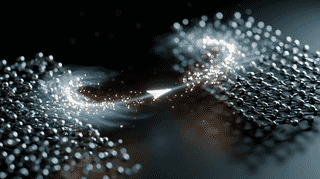
Here is the rough idea. Any measurement of light carries an irreducible quantum fuzziness, a built-in jitter you cannot delete. But you can rearrange it. Squeezing flattens the uncertainty in the property you care about, the wave's amplitude, while letting it bulge in the property you don't, its phase, the way pressing one side of a balloon makes the other side swell. The flatter you squeeze, the fewer errors creep into a computation built on that light.
The catch is that a fast, large machine needs squeezing that is both deep and broadband, and for decades you could only get one or the other. Optical cavities squeeze very deeply, with a record of 15 decibels, about 97% noise reduction, but only across a narrow slice of a few gigahertz, which caps how fast the machine can run. Waveguides can deliver terahertz-scale bandwidth, but fabrication difficulty and optical loss long kept their squeezing shallow, short of what error correction demands. Deep or broad. Not both.
Ten decibels
The broadband path was the only one that scaled, so NTT and the University of Tokyo kept grinding on one device: a periodically poled lithium niobate waveguide, a thin channel of crystal engineered to amplify light. In 2021 they reached 6 decibels of squeezing, about 75% noise reduction, across more than 6 terahertz, and by 2023 they had pushed that to 8.3 decibels. Good enough for a range of quantum experiments. Not good enough for error correction.
Two fixes closed the gap. First, the team reshaped the beam leaving the waveguide so its cross-section is almost a perfect circle, which lets it interfere cleanly with the reference light used to measure it. Second, they rebuilt the phase locking, the system that keeps the squeezed light and the reference beam in step. The old approach skimmed off part of the squeezed light to generate the locking signal, degrading the very thing it was trying to protect. The new scheme produces that signal separately, before the light is squeezed, so nothing precious is spent.
The payoff appeared online in Optics Express on February 25, 2026 (US time) and was announced by the four partners on March 5: 10.1 plus or minus 0.2 decibels. In plainer terms, more than 90% of the light's quantum noise crushed, the first time a broadband-capable waveguide device has cleared that bar. It runs at telecom wavelengths, the same band already humming through the world's fiber networks, which matters for connecting quantum hardware to infrastructure that exists. And around 10 decibels is roughly where error correction using so-called GKP qubits shifts from theoretical to realistic.
The map this puts Japan on
A light source is one piece. This one feeds the project Furusawa now runs as program manager, Moonshot Goal 6, Japan's national push for a fault-tolerant, general-purpose quantum computer by 2050, with a nearer target of demonstrating a 10,000-qubit optical machine in 2027. The machine itself already exists in early form, the cloud-connected optical quantum computer RIKEN switched on in 2024, with a University of Tokyo spinout, OptQC, now working to commercialize one. That machine, and Japan's bid to build its own rather than buy from abroad, is the subject of the earlier piece. What the squeezed-light record adds is the ingredient the next step needs: error correction good enough to trust.
Place this on the world map without overselling it. Quantum computing has rival camps. The loudest, IBM and Google, build superconducting chips that must be chilled to near absolute zero. Photonic machines, which compute with light, can largely run at room temperature and speak the native language of fiber optics. Inside the photonic camp there is a further split: some groups encode information in single photons, like the US company PsiQuantum and France's Quandela, while others use the squeezed continuous light field, like Canada's Xanadu, which demonstrated a Gaussian-boson-sampling advantage and listed on Nasdaq and the Toronto Stock Exchange on March 27, 2026, the first pure-play photonic quantum company to go public. China's Jiuzhang machines, built at the University of Science and Technology of China, are photonic too.
Japan sits in the continuous-variable corner, the very approach Furusawa's 1998 experiment helped found and that is now a global standard for this style of machine. Its distinctive edge is hardware: deep, broadband, telecom-band squeezed light made on a chip. The honest caveat belongs here too. Optical quantum computers are early. They are not yet universal, fault tolerance remains a future milestone, and a squeezing record is a component result, not a finished computer. What has changed is that a line of research that spent two decades fielding the question "what is it for" now has a clear job to do.
In 2004 the teleportation chapter sat in a book asking what frontier researchers see that the rest of us miss. The 2026 answer is a number on a workbench in a lab outside Tokyo, 10.1, and the machine it is meant to build.
Somewhere in your country there is probably a piece of research that keeps getting asked when it will ever be useful. Which one would you bet pays off twenty years from now?








Global Discussion
0 comments