
🎮 A Japanese mobile-game studio behind hits like BLEACH: Brave Souls just signed a deal to bring a counter-drone defense system to the United Arab Emirates. No, that's not a typo. And no, KLab isn't building weapons. Here's how a loss-making game company ended up as a middleman for battlefield-grade air defense.
The deal, and what it isn't
On July 6, KLab (TSE Prime: 3656) said it had signed a memorandum of understanding with an unnamed overseas defense firm that holds advanced radio-frequency (RF) technology. The aim: to push adoption of a counter-drone defense system in the UAE.
Two things are worth pinning down. First, the partner and the product are secret. KLab says it can't name either, citing contractual confidentiality and security considerations. Second, an MOU is not a contract, a sale, or a deployment. Nobody is shipping hardware or fielding anything yet. KLab has agreed to work toward getting someone else's system adopted, and it casts its own role as a trusted, neutral intermediary rather than a manufacturer.
According to the company's release, the system uses jamming and related RF techniques to detect, identify, and neutralize rogue drones. It describes layered defenses spanning detection, tracking, and takedown, AI-based threat classification, the ability to handle many drones at once, and even to seize control of a target. KLab calls it "combat-proven," with a track record at defense agencies, law-enforcement and government bodies, and sites such as power plants, airports, ports, and large event venues. Those are the company's own characterizations, lifted from its announcement, not independent verification.
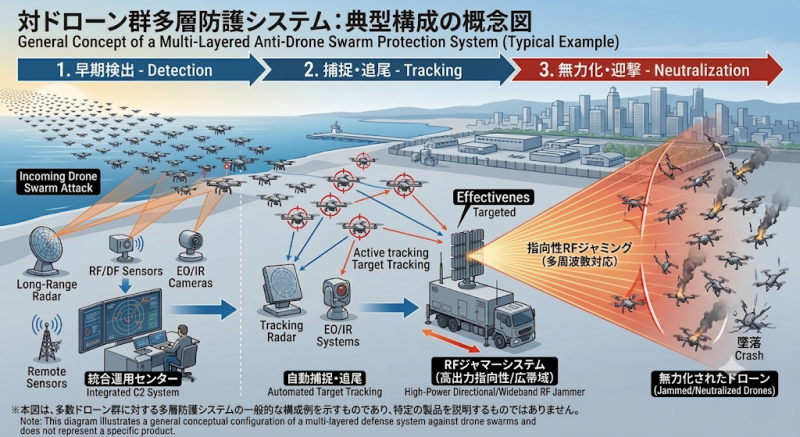
Source: KLab Inc. press release
How a game company got here
To see why KLab is doing this, rewind about a year.
KLab is an old-guard mobile developer; its catalog includes BLEACH: Brave Souls and Captain Tsubasa: Dream Team. But revenue had been sliding for years, from about ¥23.9 billion in 2021 to ¥8.3 billion in 2024 and ¥6.9 billion in 2025, with five straight years of operating losses. At the March 2025 shareholders' meeting, investors voted down the sitting president's reappointment to the board, an unusual rebuke at a listed Japanese game company, and founder Tetsuya Sanada moved back into the job from the chairman's seat. He later described the company as nearly out of cash. That May, KLab offered voluntary early retirement to about 100 employees, roughly a quarter of its full-time staff, and posted a quarterly net loss of about ¥480 million (around $3 million). For the full year, a roughly ¥4.4 billion writedown on the software assets of EA SPORTS FC TACTICAL pushed the net loss to about ¥4.2 billion.
Then came the money. In December 2025, KLab raised about ¥5.1 billion (roughly $31 million) through a share-and-warrant issue, most of it from ULTIMATE CLASSIC INVESTMENT LLC (UCI), a Dubai-based investment firm backed by UAE royals. UCI became KLab's largest shareholder at 23.15%; a large-holding report filed in January 2026 put its stake, counting warrants, at 27.64%. Sanada, who had cut staff, halved office space, and sold assets to keep the lights on, wrote on Facebook that the deal lifted a crushing weight, the kind of relief he said only a venture founder gets to feel.
From there the Gulf ties deepened quickly. In February 2026, KLab nominated Sheikh Salem Khalid Humaid Mohamed Al Qasimi, a member of the Ras Al Khaimah royal family, as an outside director; he took the seat at the March shareholders' meeting. In June, it set up a local subsidiary, KLab UAE. The counter-drone MOU, a month later, is the first concrete business to run through that new structure.
The defense move isn't the only reinvention, either. About ¥3.6 billion of the ¥5.1 billion December raise, roughly 70%, went into a "Dual Gold Treasury" plan of holding Bitcoin and gold on the balance sheet, with ¥1 billion earmarked for a new large-scale game and ¥500 million for new business development. The move into GPU and AI cloud services came earlier, announced in September 2025. A game studio, in other words, is trying to become several other kinds of company at once, all anchored to its new backers in the Gulf.
Why counter-drones, why the Gulf
The timing isn't random. Cheap attack drones and loitering munitions have rewritten modern conflict, and the Gulf sits near the center of that shift. The region's critical infrastructure, its oil and gas facilities, ports, and airports, has been struck or threatened repeatedly, a pattern running from the 2019 attack on Saudi Aramco's Abqaiq plant through more recent strikes. That has helped make the Middle East one of the fastest-growing counter-drone markets anywhere, with the UAE and Saudi Arabia among the biggest buyers.
KLab's release points to a projected ¥6 trillion (about $37 billion) global drone-defense market, citing Future Market Insights. Other research houses put the near-term number lower and the growth curve steeper; the figures swing widely depending on who's counting. What isn't really in dispute is the direction. Demand is climbing, and Gulf states are spending heavily while also trying to build capability of their own.
KLab's pitch leans on a specific gap. Advanced defense tech is often bottled up by export controls and diplomatic sensitivities, so even willing buyers can't always get what they want. A Japanese company, the argument goes, carries a kind of neutral credibility that can help move a partner's technology into a market hungry for it. One wrinkle: RF-jamming systems like the one described work best against radio-controlled drones. As fiber-optic and fully autonomous drones spread, jamming alone counts for less, which is part of why buyers increasingly want the layered, AI-driven setups KLab's unnamed partner claims to offer.
What it means, and what stays murky
Strip away the surprise of the source, and this is a telling case of a larger trend: Japanese firms with no defense heritage positioning themselves as brokers in a rearming world. Japan has loosened its defense-export rules in recent years, and a nimble, cash-hungry company freshly wired into Gulf capital is exactly the kind of player that can slip into gaps the traditional arms giants leave open.
The catch is that almost none of it is verifiable yet. Backed by royal money and a new UAE address, KLab has announced an intention. The company is guiding for a sharp rebound in 2026, ¥17 billion in revenue and ¥1 billion in operating profit, but most of that rests on new games landing.
In Japan, a game studio brokering battlefield air defense still reads as genuinely odd. Would it in your country, or is the line between a "tech company" and a "defense company" already thin enough that this barely raises an eyebrow?
References
- KLab Inc. press release, July 6, 2026: https://www.klab.com/jp/press/release/2026/0706/d.html
- ITmedia NEWS: https://www.itmedia.co.jp/news/articles/2607/06/news128.html
- AUTOMATON (Dec 2025 financing): https://automaton-media.com/articles/newsjp/dragon-quest-smash-grow-klab-20251208-370115/
- gamebiz: https://gamebiz.jp/news/418114
- Drone Intelligence / MarketsandMarkets / Fortune Business Insights (C-UAS market context)









Global Discussion
3 comments