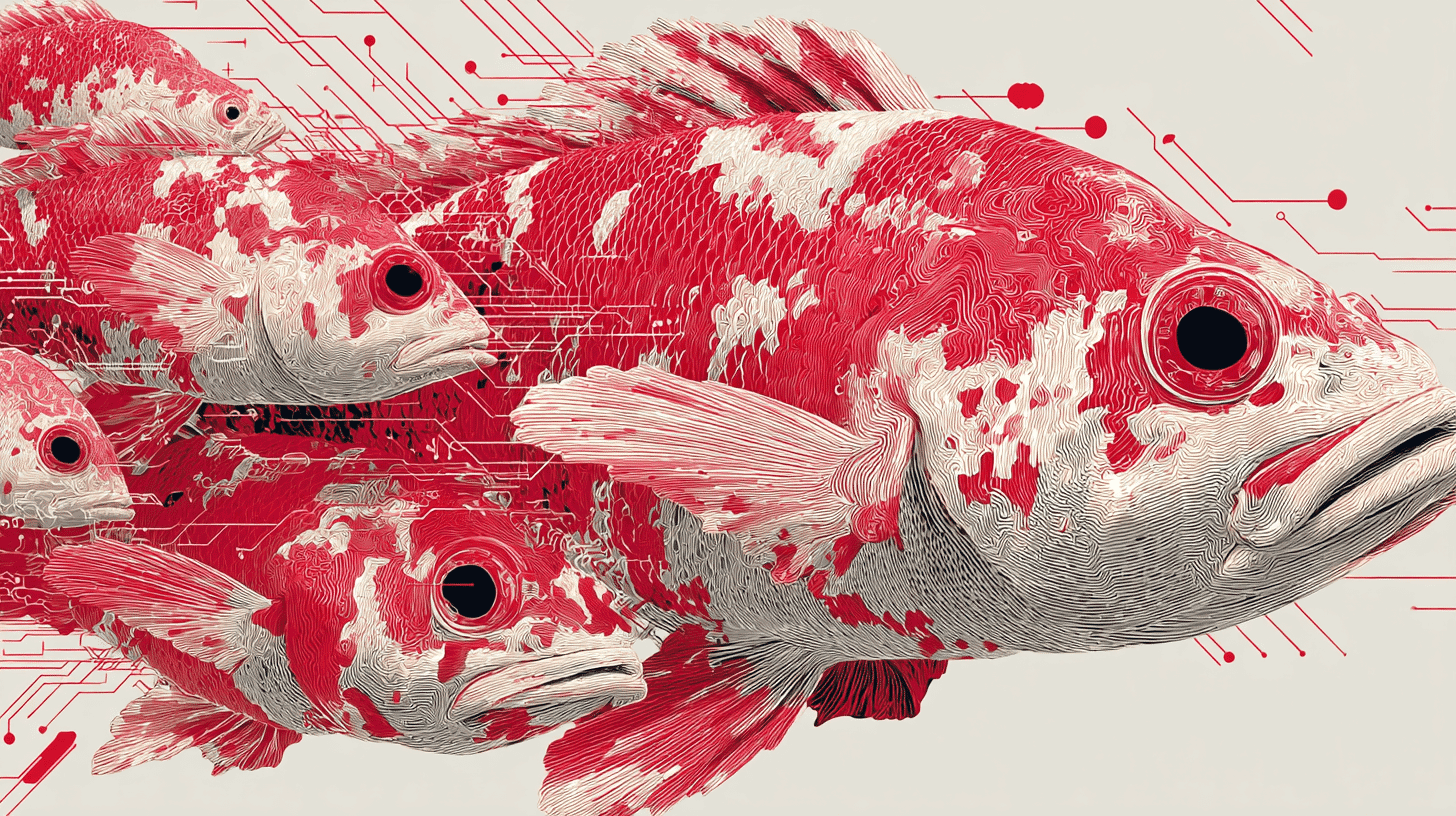
🐟 What if the future of AI didn't have to be decided in Silicon Valley or Beijing? A small startup in Tokyo, named after the Japanese word for "fish", just became Japan's most valuable private tech company, backed by the CIA's investment arm, Citibank, Google, and the world's biggest chipmaker. Here's the story of Sakana AI, and what it means for the global AI race.
Who Is Sakana AI? The Philosophy Behind the Name
Sakana AI was founded in 2023 in Tokyo's Minato district by a trio with rare credentials. CEO David Ha spent years as a research scientist at Google Brain, and before that, ran Japan's Fixed Income Trading desk at Goldman Sachs. Co-founder Llion Jones is one of the co-authors of the landmark 2017 paper "Attention Is All You Need," the foundational research that gave rise to every modern large language model (LLM), from ChatGPT to Gemini. The third co-founder, Ren Ito, brought strategic and operational expertise from Japan's Ministry of Foreign Affairs and the unicorn startup Mercari.
The name "Sakana", Japanese for fish, isn't arbitrary. It reflects the company's core philosophy: just as a school of fish creates remarkably intelligent, coordinated patterns by following simple rules together, AI can evolve through collective intelligence rather than sheer computational force. The company logo captures this perfectly: a single red fish swimming within a larger, invisible school.
A Different Kind of AI Race: Smarter, Not Just Bigger
The dominant model in today's AI industry is often described as a compute arms race, whoever pours the most money into the most powerful chips and the most data wins. OpenAI's GPT-4, Google's Gemini, and Anthropic's Claude were all built on this approach, requiring billions of dollars and enormous data centers to train.
Sakana AI deliberately took a different road. Their flagship technique, Evolutionary Model Merge, takes existing open-source AI models and combines them using evolutionary algorithms, essentially "breeding" the best qualities of multiple models into a new, superior one. No need to start from scratch. No need for massive compute. Just smart, nature-inspired optimization.
Their second headline project is the AI Scientist, an end-to-end automated research pipeline. Given a direction to explore, the AI Scientist can independently generate hypotheses, design experiments, analyze results, and even write academic papers. It's a glimpse at what AI-accelerated scientific discovery could look like.
David Ha summarized the approach simply: "Do more with fewer GPUs and smaller datasets." In an era of unsustainable resource consumption in AI development, that's a radical proposition.
$2.65 Billion and Counting: Japan's New Unicorn King
In November 2025, Sakana AI closed its Series B funding round, raising approximately $135 million (¥20 billion). The round pushed the company's post-money valuation to $2.65 billion (¥400 billion), the highest valuation ever recorded for an unlisted startup in Japan. Total cumulative funding now exceeds ¥52 billion (about $350 million).
The investor list reads like a who's-who of global finance, tech, and strategy:
Key Investors (cumulative):
- Mitsubishi UFJ Financial Group, SMBC, Mizuho (Japan's three megabanks)
- NVIDIA (world's leading AI chipmaker)
- NTT, KDDI (Japanese telecoms)
- Sony Group, NEC, Fujitsu (Japanese tech conglomerates)
- Khosla Ventures, Lux Capital, NEA (Silicon Valley VCs)
- In-Q-Tel (venture arm of the U.S. Central Intelligence Agency)
- Santander Bank, Spain's largest bank (November 2025)
- Google, capital and business partnership (January 2026)
- Salesforce Ventures (February 2026)
- Citigroup, its first-ever strategic investment in a Japanese company (February 2026)
Why Citibank Made History with Sakana AI
Of all the recent developments, Citigroup's investment stands out as a milestone. This was the global banking giant's first-ever strategic investment in a Japanese company, not just a passive financial bet, but a structured partnership.
Citigroup's statement noted that both companies are in active discussions about "specific plans and timelines for how Sakana's technology can be utilized within Citi internally." Sakana AI had already built a track record in financial AI, co-developing banking-specific models with Mitsubishi UFJ and Daiwa Securities Group. That domestic credibility opened the door for international giants.
In November 2025, Spain's Santander had made a similar move. The pattern is clear: major global financial institutions are looking to Japan's AI frontier, and Sakana AI is becoming their entry point.
Understanding "Sovereign AI": Why Nations Want Their Own Models
The term "Sovereign AI" describes an AI system that is specifically designed to reflect the language, culture, regulatory environment, and national values of a particular country, rather than a generic, globally-deployed model optimized primarily for English-speaking users.
This idea matters more than it might seem. Today's most powerful AI systems, ChatGPT, Claude, Gemini, were primarily built around English-language data. When they handle Japanese text, financial regulations, or culturally specific content, their performance often degrades. More fundamentally, relying entirely on foreign-built AI infrastructure creates strategic dependencies that some policymakers compare to critical infrastructure risk.
David Ha has articulated this concern directly, saying he doesn't want the future of a critical technology like AI to be dominated by a handful of companies in the Bay Area or by the government in Beijing, and arguing that Japan, sitting between the U.S. and China, should play a key role.
Sakana's models are trained with Japanese language nuances, cultural context, and domestic regulatory frameworks baked in. This makes them far more reliable for sectors like banking and healthcare, where a misunderstanding of a Japanese regulatory term can have serious consequences.
The CIA Connection: Defense Ambitions Come Into Focus
The involvement of In-Q-Tel, the venture capital arm established by the CIA to invest in national security-relevant technologies, adds a geopolitical dimension to Sakana's story.
In March 2025, Sakana AI stood out at a prestigious competition jointly organized by Japan's ATLA (Acquisition, Technology and Logistics Agency), the defense procurement arm of Japan's Ministry of Defense, and the DIU (Defense Innovation Unit) of the U.S. Department of Defense. Out of 60 companies worldwide, Sakana AI was the only one selected as a finalist in both themes, biodefense and counter-disinformation, and it received one of the three awards, the Innovative Spirit Award, as the only Japan-based winner.
The company has indicated plans to expand into defense, intelligence, and government services. These ambitions, combined with In-Q-Tel's backing, suggest Sakana may become an important player in the AI dimension of U.S.–Japan defense cooperation.
Silicon Valley vs. Tokyo: An AI Ecosystem Comparison
| Factor | Silicon Valley | Tokyo (Sakana Model) |
|---|---|---|
| Funding scale | Mega-rounds ($1B+) | Strategic mid-scale rounds |
| Core approach | Raw compute and data scaling | Efficient, nature-inspired design |
| Primary markets | Global, English-first | Japan-first, then global |
| Government role | Limited | Active (NEDO grants, GPU access) |
| Defense link | DARPA, Defense contracts | ATLA/DIU partnership + In-Q-Tel |
| Key differentiator | Model size and capability | Cultural and linguistic alignment |
Japan's startup ecosystem has historically lagged Silicon Valley in funding scale and global recognition. Sakana AI is changing that narrative by blending Japan's industrial strengths, banking, manufacturing, telecom, with global AI talent and Silicon Valley VC networks. This "Team Japan" model of capital formation is being watched closely as a potential blueprint for other non-U.S. AI ecosystems.
Conclusion: What the School of Fish Is Teaching the World
Sakana AI's rise is more than a startup funding story. It's a signal that the global AI map is being redrawn.
Not by building the biggest possible model at any cost, but by evolving smartly, the way nature does. That philosophy has attracted the CIA's investment fund, one of the world's largest banks making its Japan debut, and the tech company that invented the underlying architecture of modern AI.
Japan, long seen as a technological laggard in the software age, is charting its own course. And "Sakana", a school of fish moving with collective intelligence, may be its most visible symbol yet.
Does your country have its own AI strategy? Should nations build their own AI, or is global collaboration better than going it alone? We'd love to hear your perspective.
References
- https://sakana.ai
- https://techstartups.com/2025/11/17/sakana-ai-raises-135m-at-a-2-65b-valuation-to-become-japans-most-valuable-private-startup/
- https://www.nea.com/blog/our-investment-in-sakana-ai-pioneering-japans-ai-future
- https://theaiinsider.tech/2025/11/17/sakana-ai-secures-135m-series-b-at-a-2-65b-valuation-to-advance-japan-optimized-ai-models/
- https://www.thecorporate.world/post/sakana-ai-raises-135m-as-japan-pushes-sovereign-ai








Global Discussion
13 comments